
SellerCenter Review 2026: Honest Verdict for Shopify Dropshippers
SellerCenter positions itself as an all-in-one dropshipping intelligence platform for Shopify sellers. It promises to help you find trending products, track competitor sales, spy on winning ads, and source from AliExpress without burning your ad budget on blind guesses. With over 1.4 million users and more than 500,000 tracked stores, the platform has clearly found an audience. But does the actual product live up to the marketing? This review digs into features, real use cases, pricing signals, setup friction, and the limitations you won't see on the sales page.
What Is SellerCenter?
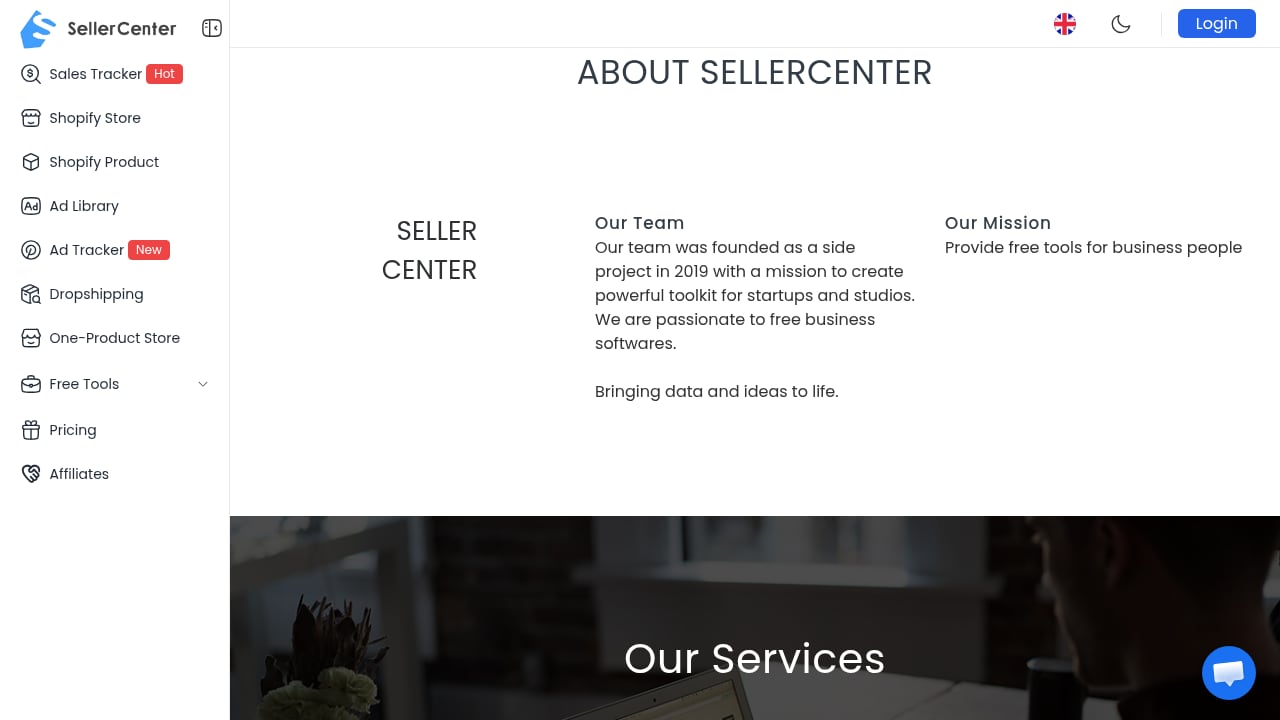
First viewport screenshot of SellerCenter - About Us.
SellerCenter is a dropshipping research suite built specifically for Shopify entrepreneurs. Rather than forcing you to juggle five separate tools, it bundles product discovery, competitor tracking, ad intelligence, and sourcing utilities into one dashboard.
The core promise is simple: reduce blind ad spending by making data-driven decisions before you launch a product. You can see what other Shopify stores are selling, which ads are driving traffic, and which AliExpress products have viable margins.
Key modules include:
- Shopify sales tracker — monitor store revenue and order volume estimates
- ShopifyHunt extension — detect which apps and themes any Shopify store uses
- AliNiche — AliExpress product research with profit potential filters
- Multi-platform ad tracker — monitor ads across Facebook, TikTok, YouTube, and Instagram
- Ads library — search over 610 million ad creatives
- Free utilities — profit calculator, trademark/patent search, theme and app detectors
Who Is SellerCenter For?
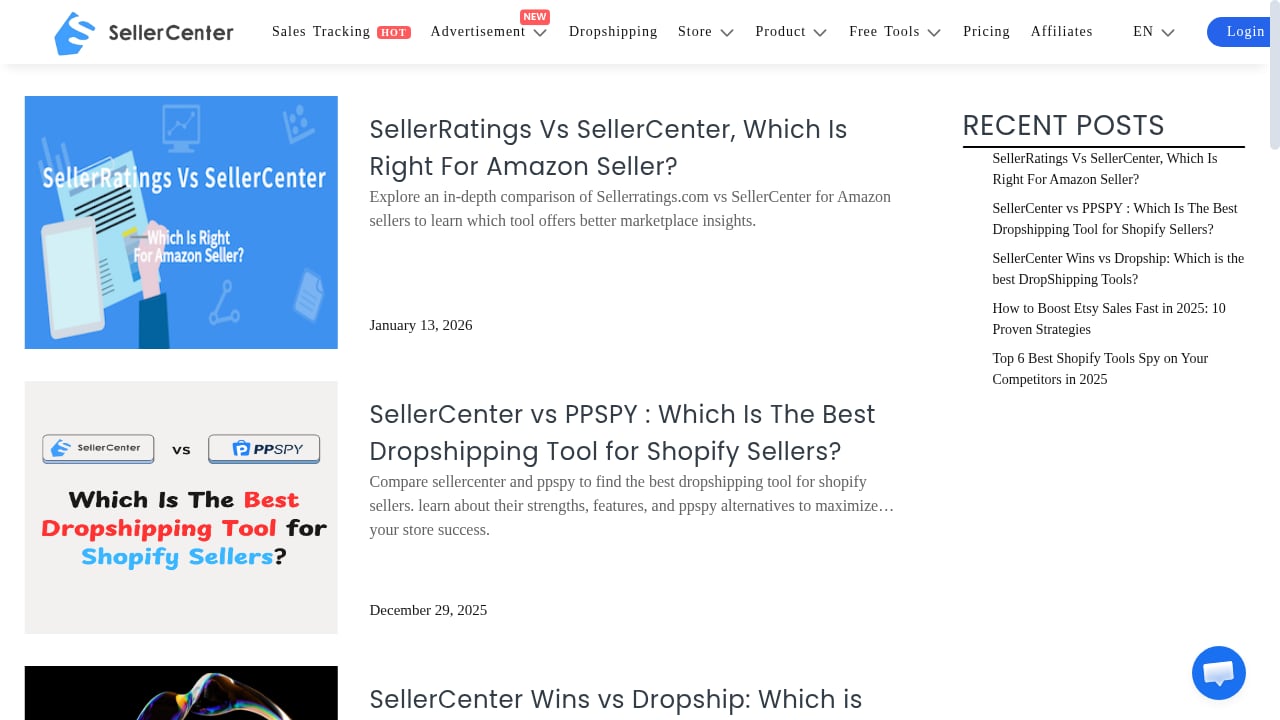
First viewport screenshot of Guide to Grow Your Business - SellerCenter Blog.
SellerCenter is not a general-purpose e-commerce tool. It's built for a specific profile:
Ideal users
- New dropshippers who need a guided way to find their first winning product without subscribing to five tools
- Shopify store owners who want to monitor direct competitors and spot shifts in their product mix
- Media buyers and ad managers who need fast access to competitor creatives across multiple platforms
- AliExpress sellers looking to validate products before committing to inventory or ad spend
Who should skip it
- Amazon FBA sellers — SellerCenter is Shopify-centric; it won't help with Amazon keyword rankings or PPC
- Brand owners with proprietary products — competitor tracking matters less when you own your niche
- Enterprise teams needing API access, SSO, or compliance features — SellerCenter is built for solo operators and small teams
If you're still deciding between ad intelligence tools, our PrimeSpy vs SellerCenter comparison breaks down the differences in data depth, workflow, and pricing.
Core Features: What You Actually Get
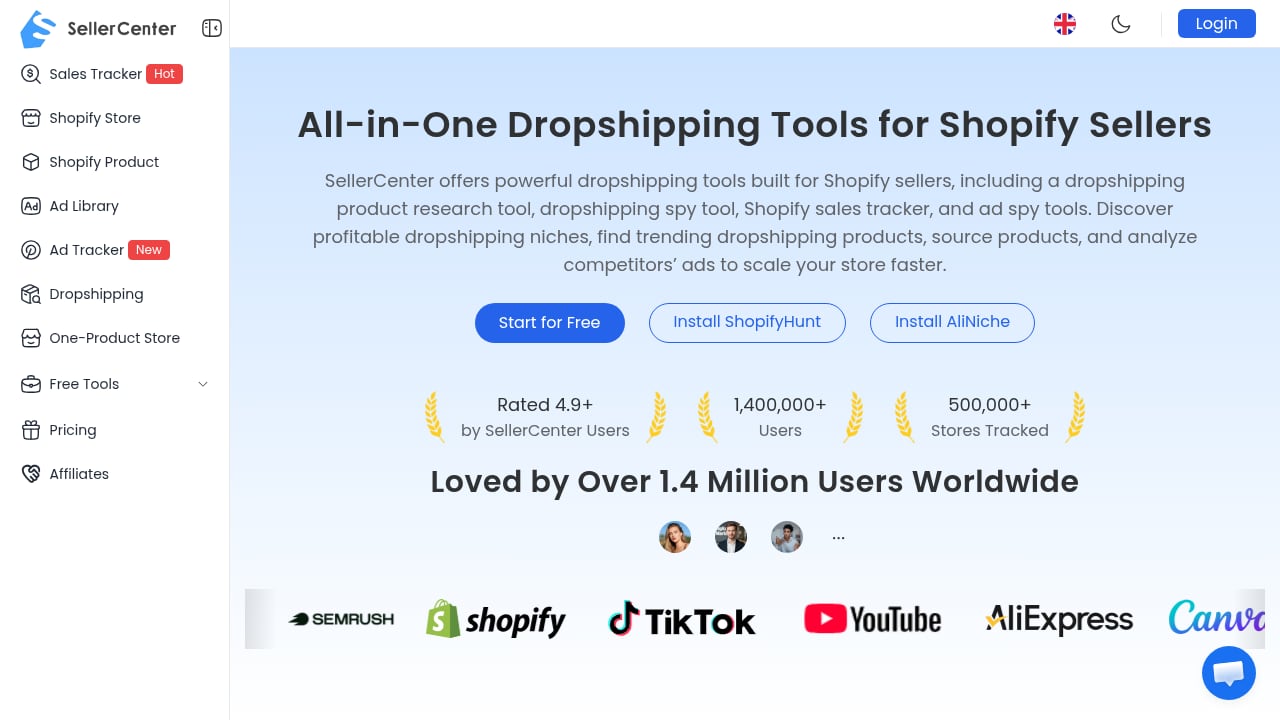
First viewport screenshot of All-in-One Dropshipping Tools & Shopify Sales Tracker - SellerCenter.
Shopify Sales Tracker
The sales tracker is SellerCenter's flagship feature. It estimates revenue and order volume for any Shopify store, giving you a window into competitor performance. The data is modeled, not exact — no third-party tool can access Shopify's private analytics — but the estimates are directionally useful for spotting trends and validating whether a niche has real buyer demand.
Practical example: You notice a store in the pet accessories niche showing consistent order growth over eight weeks. That's a stronger signal than a single viral spike, and it justifies deeper product research.
ShopifyHunt Extension
ShopifyHunt is a Chrome extension that reveals the tech stack behind any Shopify store — themes, apps, and integrations. This is genuinely useful for two reasons:
- You can see which upsell, review, or email capture apps successful stores use
- You can identify stores running the same theme as you, which helps with competitive benchmarking
AliNiche Product Research
AliNiche connects to AliExpress and filters products by growth rate, order volume, and margin potential. Instead of scrolling endless AliExpress categories, you can sort by products that are already selling well and have room for markup.
The profit calculator utility pairs well here — you can estimate landed cost, shipping, and ad spend before committing.
Multi-Platform Ad Tracker
SellerCenter tracks ads across Facebook, TikTok, YouTube, and Instagram. The ads library contains over 610 million creatives, which is a substantial dataset. You can filter by platform, niche, engagement metrics, and ad duration.
Long-running ads are the most valuable signal. If a competitor has been running the same creative for 60+ days, it's likely profitable. Our ad creative database guide explains how to use these signals systematically.
Free Utilities
SellerCenter offers several genuinely useful free tools:
- Dropshipping profit calculator — estimate margins before you source
- Trademark and patent search — avoid legal issues before scaling
- Shopify theme/app detectors — identify tech stacks without installing anything
These utilities function as lead magnets, but they're legitimately useful even if you never upgrade.
Pricing Signals: What the Tiers Tell You
SellerCenter uses a tiered subscription model starting with a free tier. While exact pricing changes over time, the structure reveals the platform's strategy:
| Tier | Typical Access | Best For |
|---|---|---|
| Free | Limited searches, basic store lookup | Testing the interface |
| Entry paid | Core product research, limited ad tracking | New dropshippers validating first products |
| Mid paid | Full ad library access, more tracked stores | Active sellers scaling ad spend |
| Top paid | Maximum data limits, priority support | Agencies and multi-store operators |
The free tier is genuinely usable for basic store lookups, which is more than many competitors offer. However, the most valuable features — deep ad analytics and unlimited competitor tracking — sit behind paid plans.
Pricing signal to watch: If you're spending more than $500/month on ads, the mid-tier usually pays for itself if it prevents one bad product launch.
Setup and Onboarding Experience
Getting started with SellerCenter is straightforward:
- Create an account with email or Google sign-in
- Install the ShopifyHunt Chrome extension
- Run your first store lookup or product search
- Set up competitor tracking lists
The interface is clean and product-focused, with less clutter than some legacy spy tools. New users can typically find a product idea within 10-15 minutes of signing up, which is a reasonable onboarding bar.
Friction point: The Chrome extension requires permissions that some privacy-conscious users may hesitate to grant. It needs to read store data on Shopify domains, which is necessary for the app/theme detection to work, but worth knowing before you install.
Strengths and Limitations
What SellerCenter does well
- All-in-one workflow — product research, ad spying, and competitor tracking in one place reduces tool fatigue
- Large ad creative database — 610 million+ creatives is a serious dataset for pattern analysis
- Genuinely free utilities — the profit calculator and trademark search are useful standalone tools
- Shopify-specific focus — features are built for Shopify sellers, not bolted on as an afterthought
- Active user base — 1.4 million users suggests the data stays relatively fresh
Where SellerCenter falls short
- Estimated data — sales figures are modeled, not exact; treat them as directional signals, not gospel
- Shopify-only scope — no meaningful support for Amazon, Etsy, or WooCommerce sellers
- No API access — data can't be piped into custom dashboards or internal tools
- Learning curve for ad analytics — the ad tracker has depth, but filtering effectively takes practice
- Affiliate-heavy marketing — many glowing reviews come from affiliates earning 30% recurring commissions, so independent verification matters
SellerCenter vs. Alternatives
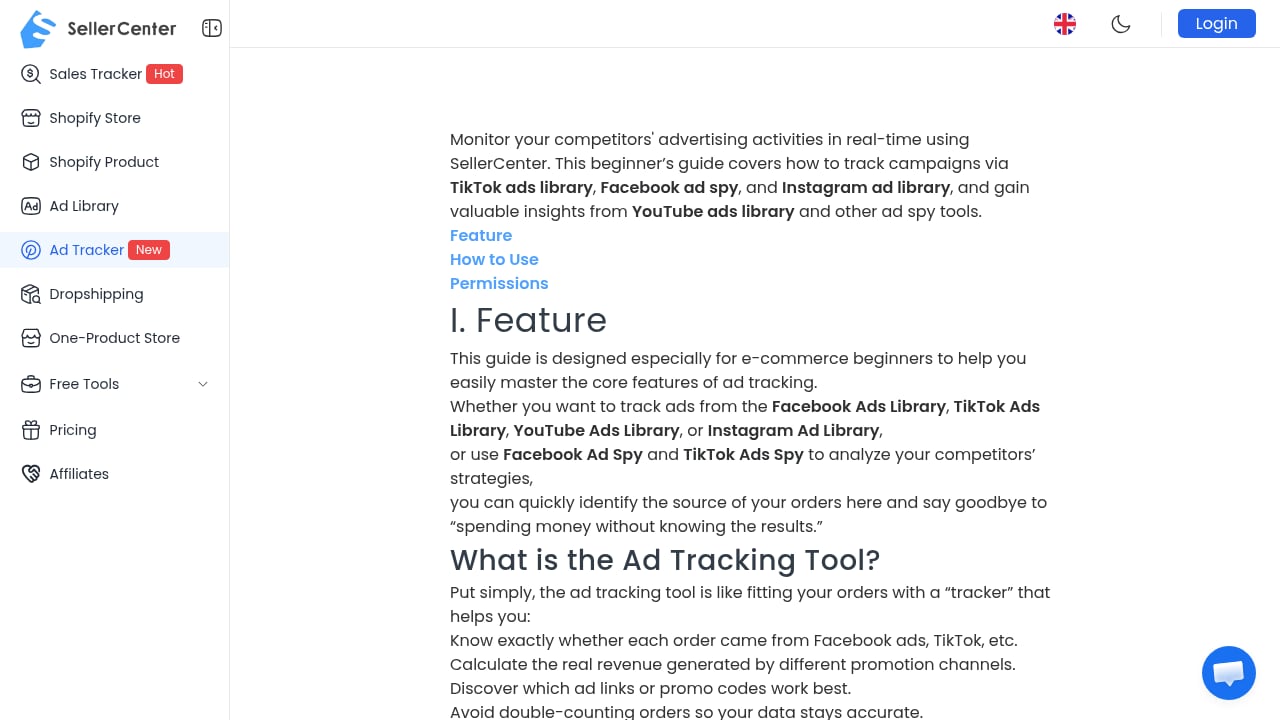
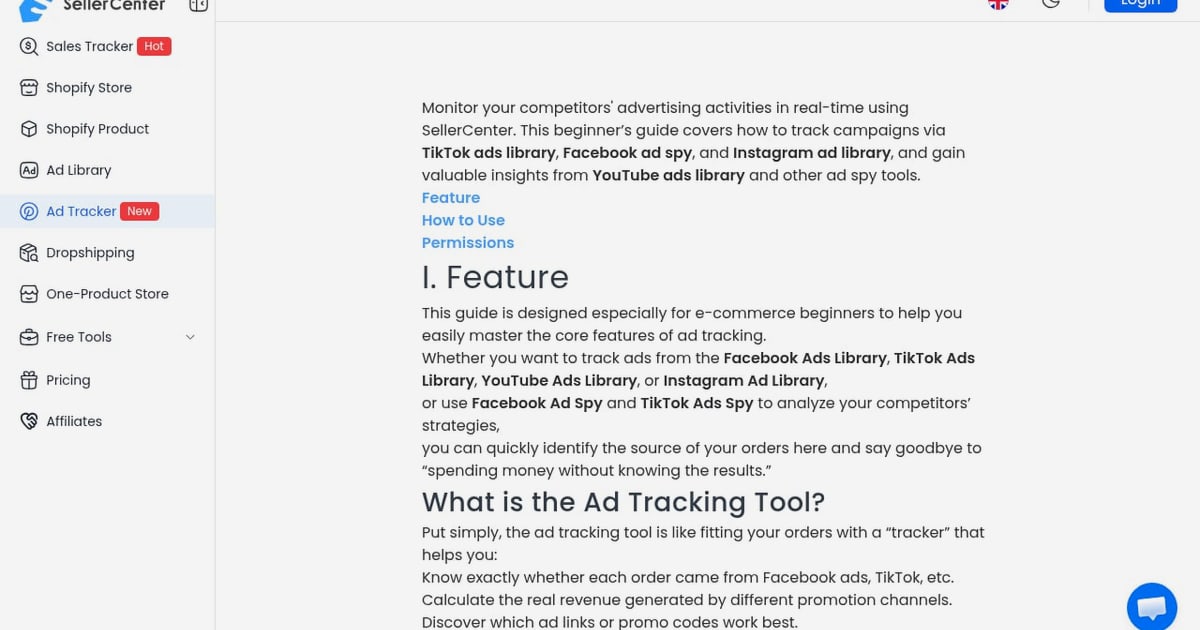
First viewport screenshot of Real-Time Ad Monitoring with TikTok Ads Library & Facebook Ad Spy – SellerCenter Beginner’s Guide.
If you're evaluating SellerCenter against other tools, here's how the landscape breaks down:
- SellerCenter vs. PPSPY — PPSPY focuses heavily on Shopify sales tracking accuracy, while SellerCenter offers broader ad intelligence. Our PPSPY review covers the differences in detail.
- SellerCenter vs. Dropispy — Dropispy is primarily an ad spy tool with a Chrome extension focus. SellerCenter bundles more product research features. See our Dropispy review for a hands-on comparison.
- SellerCenter vs. AdsLibrary — AdsLibrary specializes in capturing and organizing competitor ads across platforms. If ad creative analysis is your only need, a focused tool might serve you better. Our AdsLibrary review explores this.
For most new dropshippers, SellerCenter's all-in-one approach wins on convenience. For power users who need maximum data depth in one specific area, specialized tools may still have an edge.
Decision Criteria: Should You Buy SellerCenter?
Use this checklist to decide:
Choose SellerCenter if:
- You run or plan to run a Shopify store
- You want product research, ad spying, and competitor tracking in one subscription
- You're spending under $5,000/month on ads and need to validate products efficiently
- You value free utilities like profit calculators and trademark search
Look elsewhere if:
- You sell on Amazon, Etsy, or marketplaces other than Shopify
- You need exact sales data rather than estimates
- You require API access or enterprise features
- You only need ad spy functionality and already have product research covered
Related reading
- Foreplay Tutorial: 20+ Techniques, Tips & Step-by-Step Ideas - Learn foreplay step by step with 20+ techniques, expert tips, and practical ideas. Build arousal, improve intimacy, and make sex more satisfying.
- Foreplay: What It Is, Why It Matters, and 20+ Ideas to Try - Learn what foreplay really means, why it matters for arousal and intimacy, and get practical foreplay ideas, tips, and techniques for better sex.
Sources and further reading
- Read Customer Service Reviews of sellercentral.amazon.com - I set up a seller central account so i could begin to sell my products on amazon. For some reason the otp code from my authenticator app isn't allowing me ...
- Amazon Sign-In
- SellerCenter.io | Software Reviews & Alternatives - Crozdesk - What is SellerCenter.io? SellerCenter is a dropshipping product tool for Shopify! Track Shopify store, uncover best-selling products and top ads, and connect ...
FAQ
Is SellerCenter free to use?
SellerCenter offers a free tier with limited searches and basic store lookups. The most valuable features — deep ad analytics, unlimited competitor tracking, and advanced AliExpress filters — require a paid subscription.
How accurate is SellerCenter's sales tracking?
Sales data is estimated using modeling algorithms, not exact figures from Shopify's private analytics. The estimates are useful for spotting trends and comparing relative performance between stores, but you should not treat them as precise revenue numbers.
Does SellerCenter work for Amazon sellers?
No. SellerCenter is built specifically for Shopify dropshippers. Amazon sellers should look for tools focused on Amazon keyword research, PPC optimization, and Buy Box tracking.
Can I cancel my SellerCenter subscription anytime?
SellerCenter subscriptions are typically month-to-month with no long-term contract. Check the current terms on their pricing page, as policies can change.
Is the ShopifyHunt extension safe to use?
The extension requires permissions to read data on Shopify domains, which is necessary for its app and theme detection features. It's a legitimate tool used by over a million users, but you should review the permissions before installing and uninstall if you're uncomfortable.
How does SellerCenter compare to free alternatives?
Free alternatives exist for individual features — Facebook Ad Library for ad research, AliExpress search for product browsing — but they lack the integrated filtering, competitor tracking, and cross-platform data that SellerCenter provides. The value proposition is consolidation, not any single feature.
Final Verdict
SellerCenter delivers on its core promise: it's a practical, all-in-one research toolkit for Shopify dropshippers who want to validate products and competitors before spending money. The combination of sales tracking, ad intelligence, and AliExpress research in one dashboard is genuinely convenient, and the free utilities add real value.
The main caveats are inherent to the category: sales data is estimated, the platform is Shopify-only, and the affiliate-driven marketing means you should verify claims independently. But for its target user — a solo dropshipper or small team launching and scaling Shopify stores — SellerCenter is a solid, reasonably priced option that can pay for itself by preventing a single bad product launch.
If you're still comparing options, start with our PrimeSpy vs SellerCenter breakdown or the PPSPY review to see how the alternatives stack up before committing.