
Dropispy Review 2026: Honest Verdict for Dropshippers
Dropispy has built a reputation as one of the most recognizable ad intelligence tools in the dropshipping space. Its pitch is straightforward: spy on millions of Facebook ads, uncover the stores behind them, and validate products before you spend a dollar on testing. But in 2026, the competitive intelligence landscape has changed, and the real question is whether Dropispy still earns its subscription price for the way modern ecommerce operators actually research products.
This review is based on hands-on testing, community feedback, and a close look at what the platform covers — and what it misses. You will learn exactly what Dropispy does well, where it breaks down, who should buy it, and who should look elsewhere.
What Dropispy Actually Does
Dropispy is an ad spy tool built specifically for the dropshipping workflow. It performs three distinct jobs that work together as a research loop:
- Indexes Meta ads. Dropispy crawls Facebook and Instagram ads independently of the official Meta Ad Library. Its database includes creative thumbnails, ad copy, estimated engagement signals, run-length estimates, and targeting metadata where available.
- Scrapes Shopify storefronts. Product pages, pricing, app stacks, and store age are captured. This store-level context is what separates Dropispy from pure ad-spy tools.
- Overlays data through a Chrome extension. The extension surfaces Dropispy data while you browse Facebook feeds and Shopify product pages, removing the need to switch between apps.
The combination creates a practical workflow: you see an ad in your feed, the extension tells you how long it has been running and links to the Shopify store behind it, you click through and see the store's full app stack and top products. That loop — ad to store to product and back to ad research — is well executed and remains Dropispy's strongest selling point.
Who Dropispy Is For
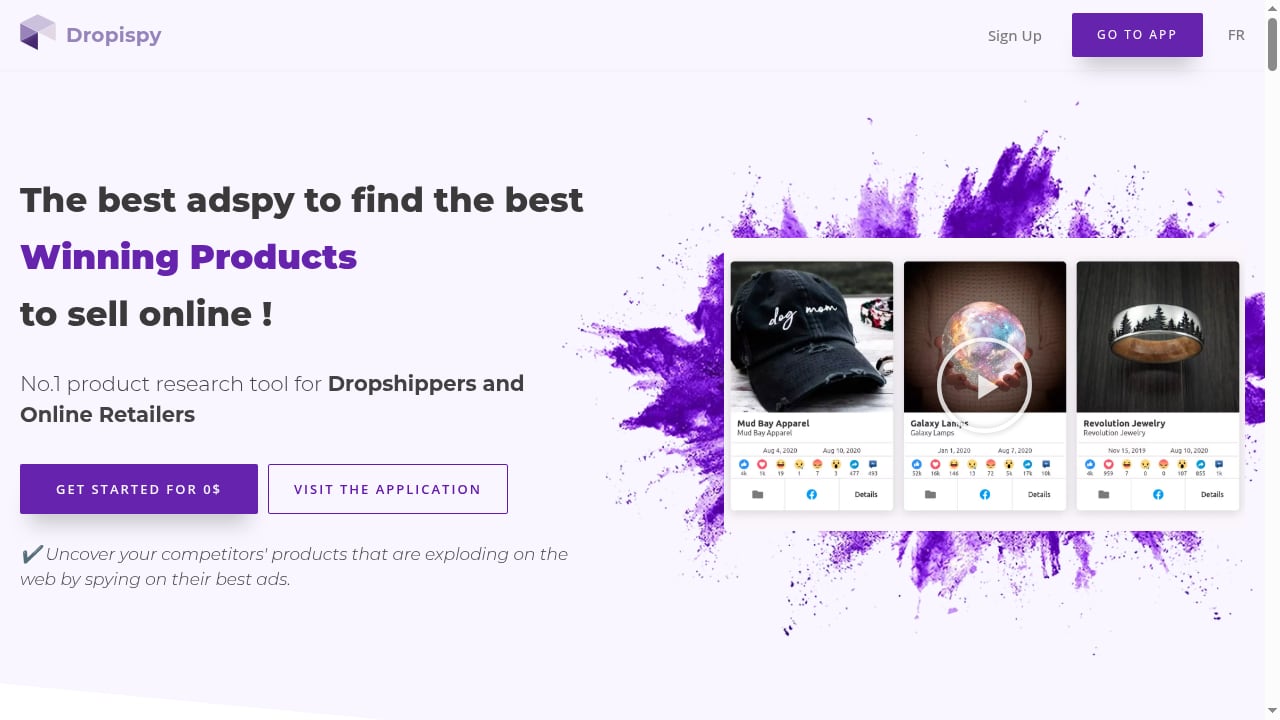
First viewport screenshot of Dropispy - No.1 Adspy specially designed for Dropshippers.
Dropispy fits a specific operator profile. If you match this description, the tool will likely feel like a natural extension of your research process:
- Solo dropshippers spending under roughly $1,000 per month on ads
- Shopify-first merchants whose entire product discovery happens through Meta advertising
- Beginners who need a structured way to see what competitors are running before committing to a product
- Researchers who prefer browsing Facebook feeds with an intelligence overlay rather than running separate searches
If you are scaling past that budget, running multi-platform campaigns, or managing client accounts, you will likely hit Dropispy's ceiling quickly.
Key Features Breakdown
First viewport screenshot of AdSpy vs Dropispy: the ultimate comparison guide - Dropispy.
Ad Creative Database
The flagship feature is a searchable database of over 50 million Facebook ad creatives, with roughly 20,000 new ads added daily. You can search by keyword, niche, engagement metrics, ad format, country targeting, and estimated spend range. For operators whose primary research method is finding what competitors are actively spending money on and reverse-engineering the products behind those campaigns, this is a genuinely useful resource.
Shop Analysis
Clicking through from any ad to the store profile behind it reveals active ad count, product range, and advertising history. This reduces the manual work required to connect a creative to the business strategy driving it. Knowing a store has been running for three years and uses a specific upsell app stack tells you something meaningful about the maturity and profitability of the business behind a product.
Engagement and Spend Metrics
Dropispy surfaces estimated likes, comments, shares, and spend activity for individual ads. These are estimates derived from scraping rather than platform API data, so treat them as directional signals rather than precise numbers. The logic is sound: brands do not typically scale spend on creatives that are not converting.
Geographic Targeting Data
You can see which countries specific ads are being served in. This helps identify products performing well in particular markets and assess whether those opportunities are replicable in your own target geography.
Daily New Ad Alerts
Saved search criteria can trigger notifications when new matching ads appear. This is useful for monitoring competitive activity in specific niches without manually running searches every day.
Chrome Extension
The Chrome extension is the feature that most consistently earns positive mentions in community discussions. On Facebook and Instagram, a small overlay badge shows ad metadata — estimated run duration and a link to the full record — without interrupting your browsing. On Shopify product pages, it surfaces store age, detected apps like Klaviyo or Loox, and a link to the store's full profile.
Two caveats matter here. First, extension reliability has been uneven across browser updates. A meaningful portion of negative Dropispy reviews trace back to the extension breaking after a Chrome update and taking weeks to patch. This is a recurring pattern, not a one-off. Second, the extension only works for Meta. There is no TikTok overlay, no YouTube ad detection, and no cross-platform behavior.
Data Depth: Strong Surface, Thin Underneath
Dropispy's index reliably surfaces ads that have been running for a week or more in major markets like the US, UK, Australia, and the EU. Viral dropshipping creatives are well represented. The limitations emerge when you dig deeper:
- Historical depth rarely goes past 60 to 90 days. If you want to study how long a winning creative ran before fatigue or how quickly a competitor refreshed, that window is limiting.
- Engagement accuracy is estimated, not exact. The numbers are directionally useful but should not be treated as precise data.
- Search recall misses smaller advertisers and ads with very short run durations. This is true of all third-party scrapers, but it is worth knowing before you rely on Dropispy for exhaustive competitor coverage.
For most dropshipper workflows — finding proven products, studying creative formats, identifying store strategies — the depth is sufficient. For DTC ad intelligence at scale, it starts to show seams.
What Dropispy Does Not Cover
This is the most important section for making an honest buying decision. Dropispy's scope is clean and specific, but the dropshipping world has diversified:
Covered:
- Facebook feed ads, including image, video, and carousel formats
- Instagram feed and story ads with varying coverage
- Shopify storefronts, including products, pricing, app detection, and store age
- Ad copy and headline text, searchable by keyword
- Estimated engagement counts and approximate run duration
- Detected geographic targeting markets
Not covered:
- TikTok ads
- YouTube video ads
- Google display or search ads
- LinkedIn, Snapchat, or Pinterest ads
- WooCommerce, BigCommerce, or non-Shopify stores in any useful depth
- Advertiser spend estimates at the precision level of more expensive tools
- Full landing page crawls beyond the product page
The Meta plus Shopify focus was the right bet in 2022 and 2023. In 2026, a growing share of ecommerce activity runs through TikTok Shop and YouTube. Dropispy covers roughly half the competitive landscape a serious operator needs to watch, which means most scaling merchants will need a second tool. For a broader view of how ad intelligence platforms compare, see this competitive ad analysis guide.
Pricing Signals
First viewport screenshot of Adspy pricing & Adspy cost + Adspy discount - Dropispy.
Dropispy's pricing runs from a free tier with heavy search limits through paid plans in the roughly $29 to $79 per month range. Annual billing applies a discount of about 20 to 30 percent.
At the entry tier, you get enough search volume for occasional research — identifying a new product category or checking a competitor's active creatives before a launch. At the mid-tier, you get expanded search access and more frequent data refreshes. The value proposition is fair at entry and limiting at scale: once you need multi-platform coverage, API access, or deeper historical data, you will be paying for Dropispy plus at least one other tool.
Dropispy vs Alternatives: Decision Criteria
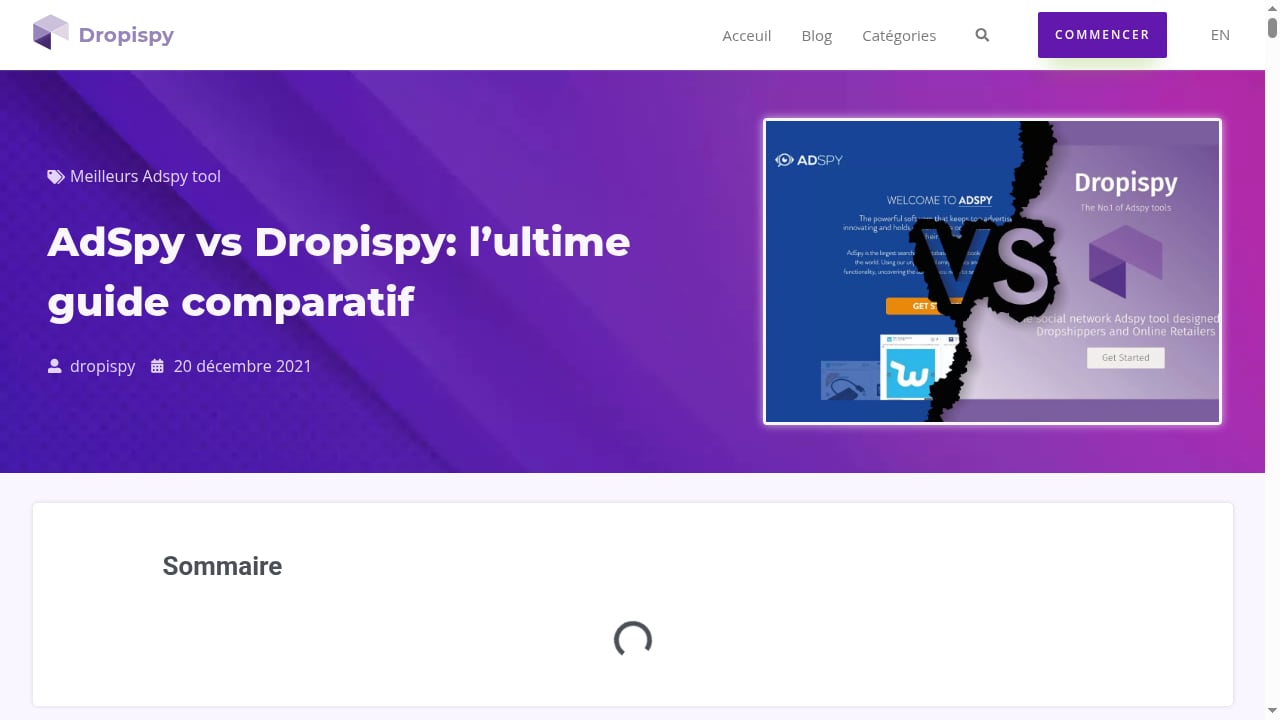
First viewport screenshot of AdSpy vs Dropispy: l’ultime guide comparatif - Dropispy.
The right tool depends on your workflow, not on a generic score. Here is a practical decision framework:
Choose Dropispy if:
- Your product research is entirely Facebook and Instagram focused
- You run a Shopify-first store and value store-level scraping
- You want a Chrome extension that overlays intelligence while you browse
- You are spending under $1,000 per month on ads and need a focused, affordable tool
Skip Dropispy if:
- TikTok, YouTube, or Google ads are part of your competitive research
- You need historical data beyond 90 days for creative fatigue analysis
- You manage multiple client accounts or need API access
- You want a single platform that covers organic trends, store traffic, and ad intelligence together
For operators who need to compare ad tools side by side before committing, a structured comparison like PrimeSpy vs SellerCenter can clarify which feature set matches your workflow. If your research extends beyond Meta into TikTok and other platforms, learning how to search an ad creative database effectively becomes essential.
Setup and Learning Curve
Getting started with Dropispy is straightforward. Sign up, install the Chrome extension, and run a few test searches on product keywords you already know. The dashboard is cleaner than most tools in its price bracket, and the filter panel is logically organized. Search results load quickly enough that the tool does not feel like an obstacle.
The learning curve is shallow for basic research but steeper for structured workflows. Bulk actions are limited — you can save individual ads, but there is no way to tag, label, or export a filtered set in batch. If you are building a creative research library rather than casually browsing, that gap becomes meaningful.
Limitations You Should Know Before Buying
- Platform concentration. Dropispy is fundamentally a Facebook ad spy tool. Products gaining momentum through organic search, TikTok virality, influencer content, or emerging social platforms are essentially invisible within its framework.
- Data freshness lag. The processing cycle between when an ad runs and when it surfaces prominently in Dropispy's database introduces enough delay that trending products are frequently already entering saturation by the time most users act on them. In dropshipping, where first-mover advantage can be measured in days, this lag is a direct cost.
- Extension reliability. Browser updates have repeatedly broken the Chrome extension, with fixes sometimes taking weeks. If your workflow depends on the extension running consistently, this is a real operational risk.
- No API. For agencies or operators who want to build custom reporting or integrate ad data into internal tools, the absence of an API is a hard limitation.
- No organic intelligence. Store traffic data, niche-level market analysis, and organic trend monitoring are not part of the platform. You will need supplementary tools to fill those gaps.
Related reading
- Pipiads Tutorial: Find Winning Ads Step by Step - Learn how to use Pipiads in this practical tutorial: search winning ads, filter by performance, track competitors, and spot product opportunities.
- AdCreative.ai Review 2026: Tested Features, Pricing & Limits - Evidence-based AdCreative.ai review: real output quality, credit costs, pricing traps, setup, limitations, and who should use this AI ad generator in 2026.
Sources and further reading
- Read Customer Service Reviews of dropispy.com - Trustpilot - dropispy.com Reviews. 38. Internet Marketing Service · Write a reviewVisit website · Write a review. We use technology to protect platform ...
- Dropispy Review 2026: Honest Verdict for Dropshippers, DTC Researchers, and Agencies - Hands-on Dropispy review 2026: UI, data depth, chrome extension reliability, pricing, and who should actually buy it — vs who should skip to something better.
- Dropispy review 2026: Is it a good tool? - Read our honest Dropispy review for 2026. Discover its key features, limitations and how it compares to TrendTrack for dropshipping product research.
Frequently Asked Questions
Is Dropispy worth it in 2026?
For solo dropshippers running a Shopify-first business with a Meta-only ad strategy, Dropispy is worth a trial. The Chrome extension and store scraping features are genuinely useful at its price point. For multi-platform operators or agencies, it is not enough on its own.
Does Dropispy have a free trial?
Dropispy offers a free tier with heavy search limits. It is enough to test the interface and run a few product searches, but not enough for ongoing research. Paid plans unlock expanded search access and more frequent data refreshes.
Does Dropispy cover TikTok ads?
No. Dropispy covers Facebook and Instagram ads only. TikTok, YouTube, Google, and other platforms are outside its scope. If TikTok research is part of your workflow, you will need a separate tool.
How accurate are Dropispy's engagement metrics?
Engagement counts are estimates derived from scraping, not pulled from platform APIs. They are directionally useful for identifying high-performing ads but should not be treated as precise data.
Can Dropispy replace the Meta Ad Library?
Dropispy offers search and filtering capabilities that go beyond the free Meta Ad Library, including store-level scraping and engagement estimates. However, the official Ad Library has its own completeness advantages. Many operators use both.
Is Dropispy good for beginners?
Yes. The interface is approachable, the Chrome extension makes research feel natural, and the ad-to-store workflow teaches beginners how to validate products by studying what competitors are already running.
Final Verdict
Dropispy earns a qualified recommendation. It is the best Chrome-extension-first scraper for the Shopify plus Meta dropshipper workflow under $50 per month. The UI is clean, the Shopify store scraping is genuinely useful, and the Meta ad index covers enough creative volume to generate real product hypotheses.
Where it breaks down: no API, no TikTok or YouTube data, and historical depth that rarely goes past 90 days. If you are spending under $1,000 per month on ads and working a Shopify-first business, it is worth a trial. Above that budget, or the moment you add a second platform to your mix, you will hit its ceiling fast and need to supplement it with additional tools.
The honest assessment is that Dropispy is a strong Facebook ad intelligence tool serving a specific research use case well. For operators who need deep Meta creative analysis as part of a broader research stack, it delivers genuine value. For operators looking for a single comprehensive ecommerce intelligence platform, it will feel incomplete. Match the tool to your workflow, not the other way around.