
Do You Want to Scale Your Brand? Review for D2C Ad Teams
Most D2C brands do not stall because they lack ambition. They stall because the ad engine that got them to their first few hundred thousand in revenue cannot produce enough creative, test it fast enough, or read the results accurately enough to keep compounding. "Do you want to scale your brand?" is positioned as a fix for exactly that bottleneck: an AI ad intelligence and creative generation platform that bundles video ads, Meta ads, and AI search visibility into one managed service, described as delivering the output of a 10-person marketing team at the cost of one hire.
That is a strong claim, and strong claims deserve scrutiny. This review breaks down who the platform actually fits, what it does well, where it falls short, how pricing signals should be read, and what to check before you commit.
What the platform actually is
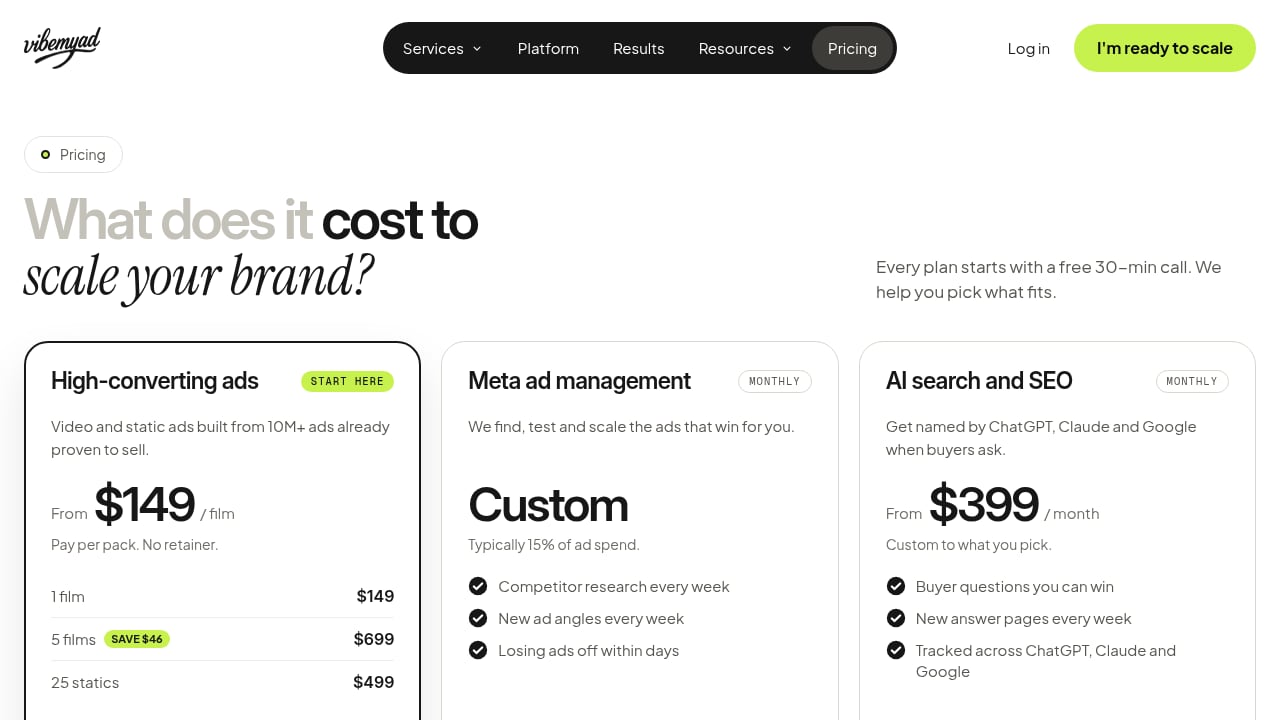
First viewport screenshot of www.vibemyad.com.
Stripped of marketing language, the product is a hybrid of three things:
- Ad intelligence — monitoring ad activity, likely across Meta and other channels, to identify what is working in a category.
- Creative generation — producing video ads and Meta ad variants with AI agents, then refining them with human marketers.
- AI search visibility — helping a brand show up when buyers ask AI assistants and search engines for product recommendations.
The operating model is the differentiator. Rather than handing you a dashboard and wishing you luck, the platform runs campaigns through a combination of AI agents and human marketers. You are buying an outcome-oriented service layer, not just software seats.
That matters because most ad tools fail D2C teams at the execution stage. A tool can surface a winning competitor creative in seconds; turning that insight into ten on-brand variations, launching them, and killing the losers is where small teams run out of hours.
Who this is built for
First viewport screenshot of Are Meta Ads Worth It for Small Brands in 2026?.
Strong fit: lean D2C teams spending real money on ads
If you are a founder-led or small marketing team spending meaningfully on Meta and short-form video, the value proposition is straightforward. You get creative volume and testing cadence that would otherwise require a designer, a video editor, a media buyer, and an analyst. For brands in fashion, beauty, supplements, home goods, and other visual categories, the creative generation angle is especially relevant.
Strong fit: brands hitting a creative ceiling
A common pattern: your best-performing ad has been running for months, frequency is climbing, and every new concept feels like a variation of the last one. An intelligence-plus-generation loop is designed for this exact plateau, because it feeds outside signals into new creative rather than asking your team to brainstorm from memory.
Weaker fit: brands with no product-market fit yet
If you are still figuring out whether anyone wants your product, automation will simply help you lose money faster. Scaling spend before retention and repeat purchase are proven is one of the most reliable ways to burn a budget.
Weaker fit: heavily regulated or highly technical categories
AI-generated creative still needs compliance review in health, finance, and similar verticals. Human marketer oversight helps, but you should confirm the review workflow before assuming it meets your legal bar.
Strengths worth paying for
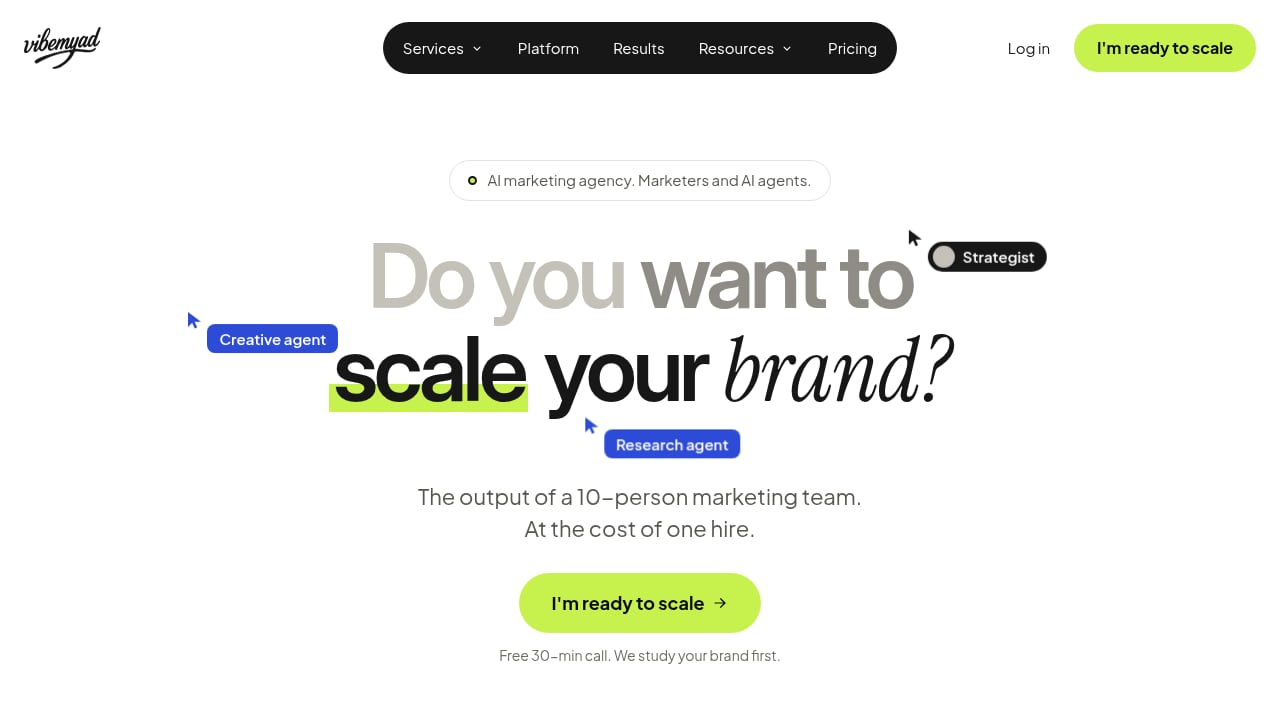
First viewport screenshot of www.vibemyad.com.
1. Creative throughput. The single biggest constraint for most D2C advertisers is not targeting anymore; it is creative supply. A system that generates and iterates video and static concepts at volume directly attacks that constraint.
2. Intelligence feeding creation. Competitor ad research is only useful if it changes what you ship. Bundling intelligence and generation closes the loop that most teams leave open. If you want to understand the underlying discipline, our guide to creative intelligence for ads explains how creative elements become measurable performance data.
3. A blended human-AI model. Pure AI tools tend to produce generic output; pure agencies tend to be slow and expensive. A hybrid model is a reasonable middle path, provided the human layer is genuinely strategic rather than a thin account-management veneer.
4. Cost structure relative to headcount. The "10-person team at the cost of one hire" framing is a positioning statement, not a guarantee, but the underlying math is real. A senior performance marketer, a video editor, and a designer can easily exceed six figures in combined cost. Any service that credibly replaces part of that stack has room to be worth it.
5. Coverage beyond Meta. Including AI search visibility acknowledges where discovery is shifting. Buyers increasingly ask assistants for recommendations, and brands that ignore that surface are ceding ground.
Limitations and honest risks
Brand voice drift. AI-generated creative can drift toward category clichés. Ask specifically how brand guidelines, tone, and visual identity are enforced across generated assets.
Attribution ambiguity. When a single provider runs intelligence, creative, and media, it becomes harder to isolate what drove results. Insist on channel-level and creative-level reporting you can audit independently.
Platform dependency. Meta is a core channel, and Meta's own automation is increasingly capable. The platform needs to demonstrate value above and beyond Advantage+ style campaign automation.
Opaque pricing. Managed AI services often price on retainer plus spend percentage. Until you see a written quote, treat any cost comparison as directional.
Human layer variability. Results will depend heavily on the specific marketers assigned to your account. Ask who they are and how much time they spend on your brand.
Pricing signals and how to evaluate the cost claim
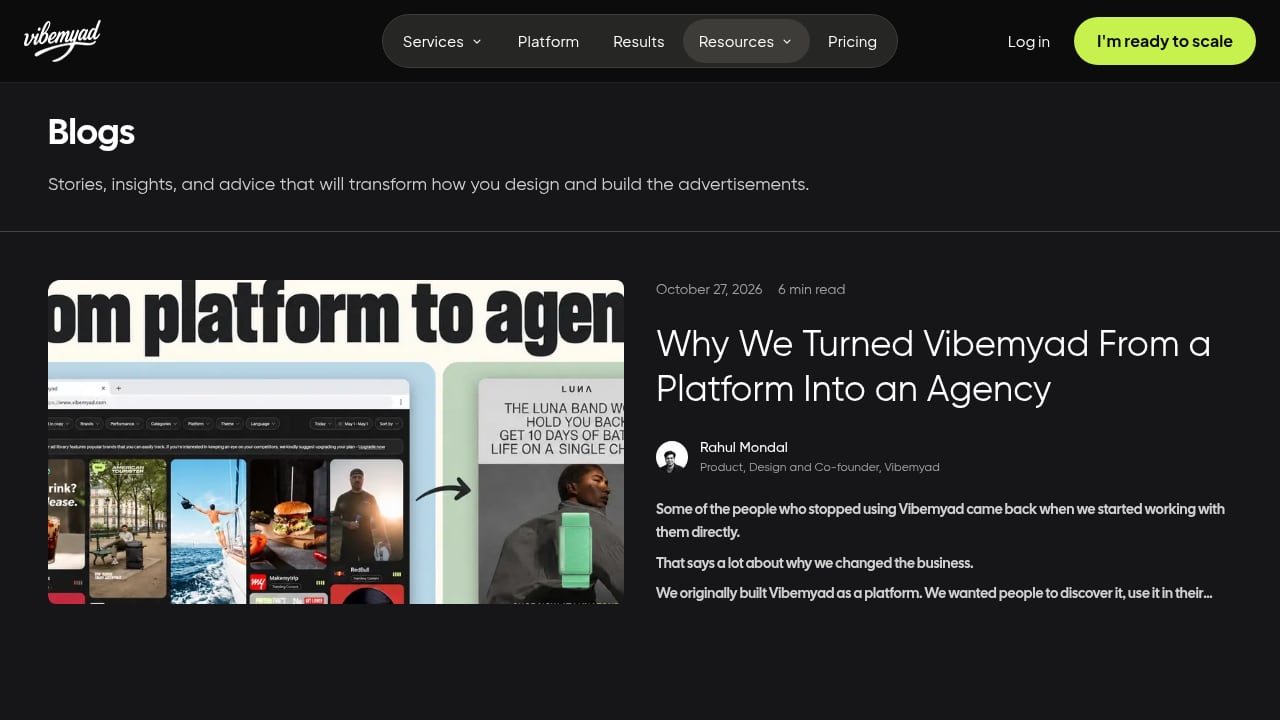
First viewport screenshot of www.vibemyad.com.
The headline comparison — a full marketing team's output for the price of one hire — is best read as a budgeting heuristic. To evaluate it properly, build a simple comparison:
| Cost category | In-house build | Managed AI platform |
|---|---|---|
| Creative production | Designer + editor salaries | Included in service |
| Media buying | Performance marketer salary | Included or shared |
| Ad intelligence | Separate subscription tool | Bundled |
| Ramp-up time | Weeks to months | Days to weeks |
| Flexibility | High | Contract-dependent |
Two pricing questions decide most deals: Is the fee flat, or does it scale with ad spend? And what happens to creative assets and ad account access if you leave? Get both in writing. If you are comparing this against buying point tools separately, our ranking of the top ad intelligence platforms gives a useful cost baseline.
Setup: what onboarding should look like
A credible onboarding should cover five steps:
- Access and audit — connecting Meta ad accounts, pixel, catalog, and analytics, then reviewing historical creative performance.
- Brand calibration — documenting voice, visual rules, prohibited claims, and offer structure so generated creative stays on-brand.
- Intelligence baseline — mapping competitors and category creative patterns to identify gaps worth testing.
- First creative sprint — shipping an initial batch of video and static variants with a clear testing framework.
- Reporting cadence — agreeing on which metrics define success and how often results are reviewed.
If onboarding skips step two, expect generic creative. If it skips step five, expect disputes about performance later.
Decision criteria: a practical checklist
Before signing, get clear answers to these:
- Can you see creative-level performance data in your own ad account, independent of their dashboard?
- How many net-new creative concepts per month are guaranteed, and what is the revision process?
- Who are the human marketers on your account, and what is their experience in your category?
- How is AI search visibility measured, and what does success look like in 90 days?
- What is the exit clause, and do you retain all generated assets?
- Can you pause or reallocate spend without penalty?
If the answers are vague on creative volume, data ownership, or exit terms, that is your signal to negotiate harder or look elsewhere.
How it compares to alternatives
There are three realistic alternatives: build in-house, hire a traditional performance agency, or assemble point tools. In-house gives control but is slow and expensive to staff. Traditional agencies bring seniority but often move at a monthly creative cadence that is too slow for modern ad platforms. Point tools are cheap but assume you have the team to act on what they surface.
This platform's bet is that the middle ground — automated execution with human oversight — is where most D2C brands actually need help. That bet holds when your bottleneck is execution capacity. It holds less well when your bottleneck is strategy, positioning, or product.
Related reading
- Top 10 Dropshipping Analytics & Competitor Research Tools 2026 - We ranked the 10 best dropshipping analytics and competitor research tools for 2026 by data coverage, tracking depth, workflow fit, and pricing—with evidence.
- How to Use PrimeSpy with IPFoxy: Enterprise Proxy Ad Spy Setup - Combine PrimeSpy ad intelligence with IPFoxy residential proxies to research ads across regions, verify creatives, and avoid IP blocks. Step-by-step setup and workflows.
- PrimeSpy vs AdsLibrary vs AdSpy: 2026 Ad Spy Comparison - Compare PrimeSpy, AdsLibrary, and AdSpy on ad database, tracking, filters, and pricing. Find the right ad intelligence tool for your 2026 workflow.
Sources and further reading
- From Mom-and-Pop to National Powerhouse: 6 Steps to Effectively Scale Your Brand - Discover the 6 key steps brands should be taking to effectively scale their brands and build more retail opportunities.
- How to Scale a Business: 8 Strategies & Tips (2026) - Discover how to scale a business from scratch. Learn key strategies, mistakes to avoid, and the best tips for scaling your business.
- The heart of the internet - I’m 19 years old, in college full time, and I also work at Home Depot. A few months ago I started my own cleaning company. I got my LLC, still working on getting insured, and I’m planning to open a business bank account soon.
FAQ
Is this a replacement for a marketing team?
No. It is best understood as a force multiplier for a small team or a substitute for several specialized roles. Strategy, brand positioning, and major creative direction still need human ownership.
What size brand is the right fit?
Brands spending enough on ads to justify a managed service, typically those with proven product-market fit and a consistent creative testing need. Very early-stage brands are usually better served by learning the fundamentals first.
Does it only work with Meta ads?
Meta is a core channel alongside video ads and AI search visibility. Confirm current channel coverage during your evaluation, since platform support changes.
How should I measure success in the first 90 days?
Track creative velocity, cost per acquisition trend, creative win rate, and incrementality where possible. Judge the service on whether your testing engine got faster and more effective, not on a single campaign's result.
Can I keep my existing ad intelligence tools?
Usually yes, and it is worth doing during a trial period so you can cross-check the platform's recommendations against an independent source. Tools like a dedicated ad library and creative saver can serve as a sanity check.
Conclusion
"Do you want to scale your brand?" is a credible answer to a real problem: D2C brands need more creative, faster testing, and sharper intelligence than small teams can produce manually. The hybrid AI-and-human model is a sensible structure, and the cost framing is directionally honest even if it should not be read literally.
The decision comes down to your bottleneck. If you have proven demand and cannot produce or iterate creative fast enough, this is worth a serious evaluation. If you are still searching for product-market fit, or if your growth problem is positioning rather than production, fix that first. Either way, demand written answers on creative volume, data ownership, and exit terms before you sign — those three details separate a genuine scaling partner from an expensive subscription.