
Top 10 AI Ad Creative Generation Platforms 2026
AI ad creative generation has moved from experimental to essential. In 2026, the bottleneck is no longer producing creative — it is knowing which creative will perform. The best platforms now combine generation, scoring, testing, and performance feedback in a single workflow, letting teams ship dozens of on-brand variations without doubling headcount.
This ranking focuses specifically on AI ad creative generation platforms: tools whose core job is to create, score, and iterate ad creatives — static images, video, UGC-style clips, and copy — at scale. We evaluated each product against five transparent criteria: creative output quality, generation speed and volume, performance prediction or scoring, integration depth with ad platforms, and pricing transparency. Every ranked product is supported by current public evidence, user reviews, and vendor documentation.
How We Evaluated These Platforms
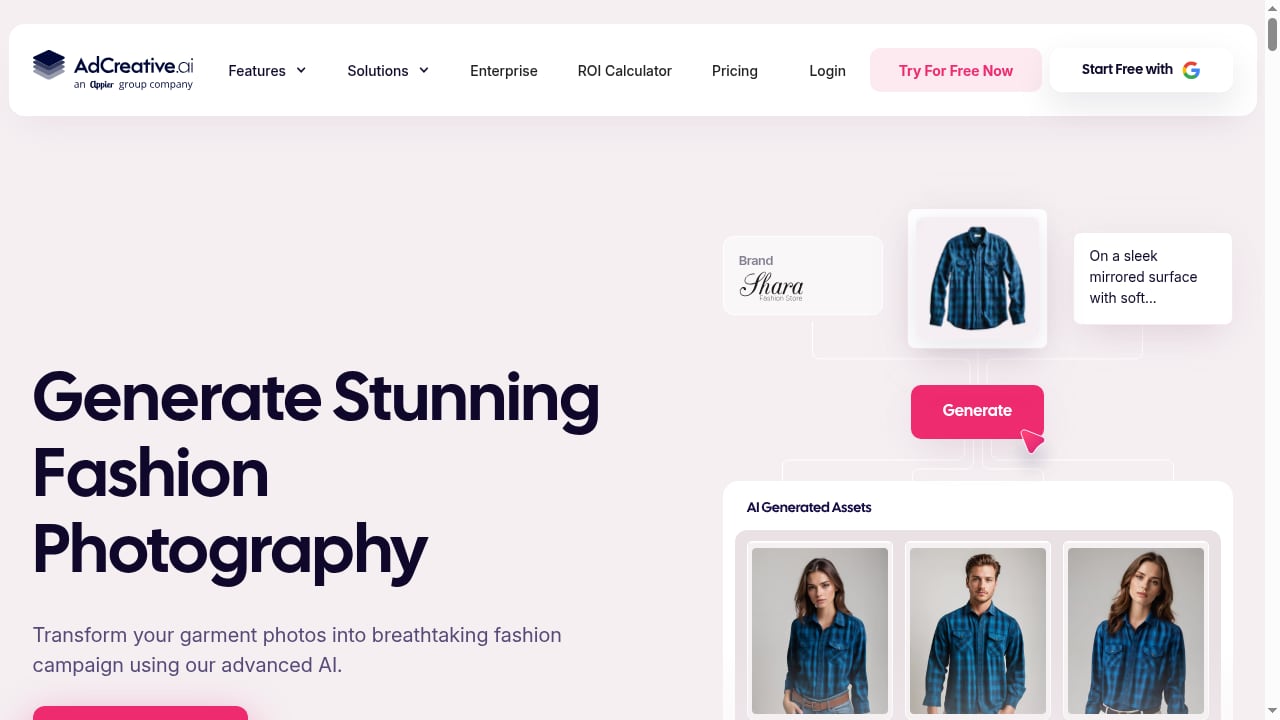
First viewport screenshot of Fashion & Apparel.
We applied a consistent framework across all candidates:
- Creative output quality — Does the AI produce ads that look professional and on-brand, or do outputs require heavy manual cleanup?
- Generation speed and volume — How many usable variations can a team produce per hour or per campaign?
- Performance prediction — Does the platform score creatives before spend, and how accurate is that scoring?
- Integration depth — Does it connect natively to Meta, Google, TikTok, or programmatic channels?
- Pricing transparency — Are costs published and predictable, or hidden behind enterprise sales calls?
We also excluded tools that are primarily ad intelligence or spy platforms, general-purpose design tools, or pure analytics dashboards. The list below ranks products that genuinely belong in the AI ad creative generation category.
1. AdCreative.ai
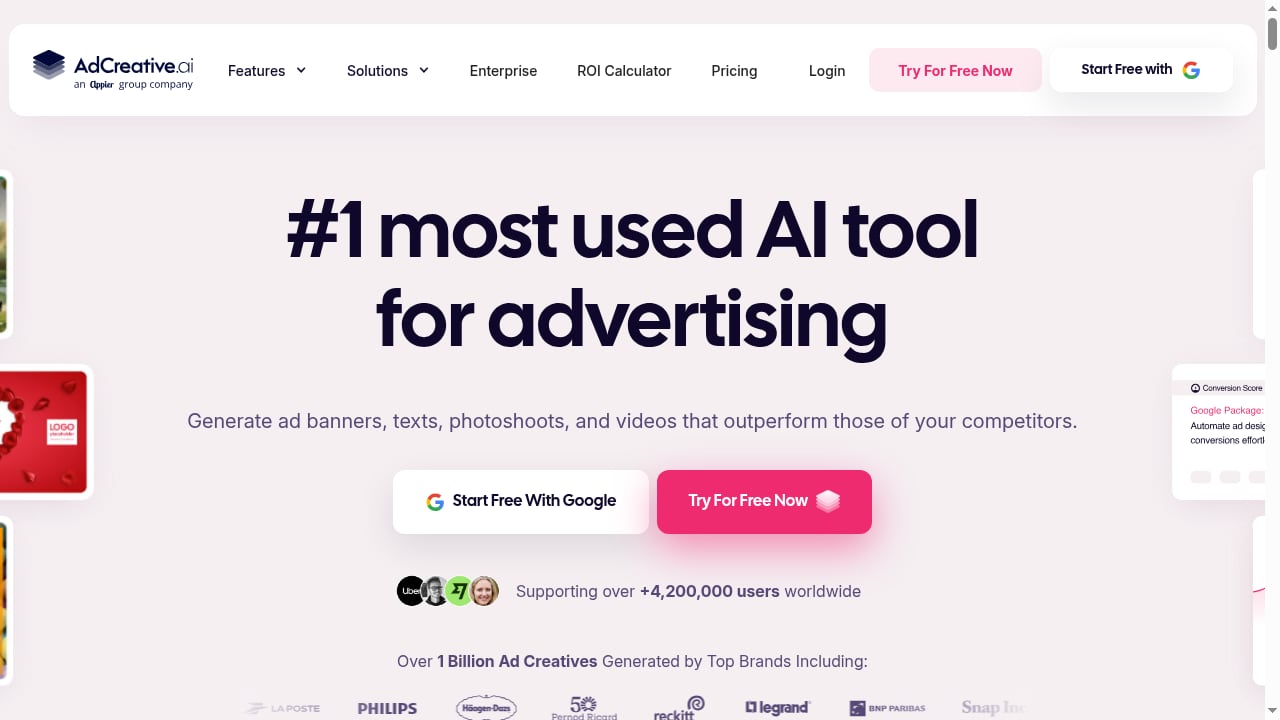
First viewport screenshot of AI Ad Creative Generator for High-Converting Ads | AdCreative.ai.
Best for: SMBs, e-commerce brands, and agencies that need high-volume static and video ad variations with built-in performance scoring.
AdCreative.ai earns the top spot because it is the most complete AI ad creative generation platform for the broadest set of users. It generates branded static ads, video ads, and ad copy from product URLs or simple prompts, then scores each variation based on historical performance data before you spend a dollar.
The platform has expanded significantly for 2026. Beyond static image generation, it now supports AI product photoshoot simulation, UGC-style video creation, buyer persona targeting, and bulk creative production for entire e-commerce catalogs. A fashion brand can generate professional model photoshoots without booking a studio; an agency can auto-generate product banners for hundreds of SKUs in one batch.
What separates AdCreative.ai from basic image generators is the conversion-focused scoring layer. The platform claims up to 14x higher conversion rates for scored creatives, and third-party reviews consistently note that the scoring helps teams prioritize which variations to test first. Pricing is transparent and accessible: Starter at $39/month, Professional at $249/month, and Ultimate at $599/month, with an Enterprise tier for larger teams.
Key strengths: All-in-one generation for images, video, and copy; performance scoring; bulk catalog production; transparent SMB-friendly pricing.
Watch for: Output quality still benefits from human review for premium brands; advanced video editing requires a complementary tool.
2. Pencil
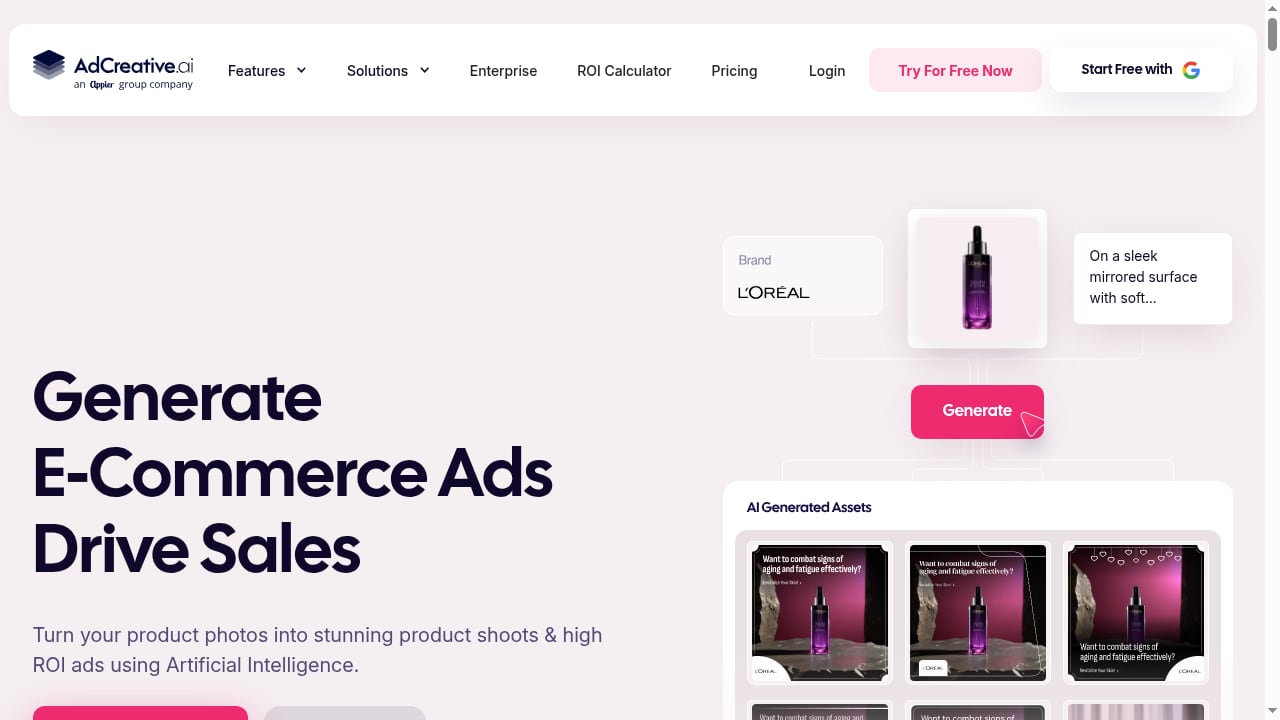
First viewport screenshot of AI-Powered Ad Creatives for E-commerce Success.
Best for: Performance teams focused on fast short-form video and motion creative with predictive AI.
Pencil, now part of the Brandtech Group, has matured into one of the strongest AI video ad generation platforms for direct-response advertisers. It generates short-form video ads from product assets, brand guidelines, and copy inputs, then applies predictive AI to forecast which variations are most likely to drive conversions before launch.
The platform's standout feature is its performance prediction model, trained on millions of ad outcomes. Teams can generate 50 video variations in an afternoon and launch only the top-scored five, dramatically reducing wasted spend on underperforming creative. This prediction-first approach aligns with how modern performance marketers actually work: test fast, kill losers early, scale winners.
Pricing is published and competitive: Core at $14/month, Growth at $55/month, and Pro with custom pricing. The low entry point makes it accessible for solo media buyers, while the Pro tier supports agency-scale production.
Key strengths: Predictive scoring on video creative; fast generation from existing assets; low entry pricing.
Watch for: Less control over fine-grained design details compared to template-based tools; strongest for video rather than static display ads.
3. Celtra
Best for: Enterprise creative operations teams that need cross-channel creative governance and large-scale production.
Celtra is the enterprise answer to AI ad creative generation. It centralizes template-based production for static, HTML5, video, and rich media ads, then layers AI automation on top to adapt a single master creative into hundreds of channel-specific variations. Brands like Adidas, Nike, Spotify, and Unilever use Celtra to keep global campaigns on-brand while localizing creative for dozens of markets.
The platform's differentiator is governance. Creative teams build modular templates with locked brand elements, and AI handles the repetitive resizing, localization, and variant generation. Every output remains compliant with brand guidelines because the system enforces them structurally, not just through review workflows.
Celtra integrates deeply with design tools (Photoshop, Figma), ad servers, DSPs, and analytics stacks including Google Ad Manager, The Trade Desk, and Salesforce. Pricing is custom and enterprise-oriented, which makes it impractical for small teams but appropriate for organizations managing thousands of creative assets across markets.
Key strengths: Enterprise-grade governance; cross-channel production; deep integrations with existing creative and media stacks.
Watch for: Expensive for SMBs; implementation and onboarding take time; less focused on GenAI ideation than on adaptation and scale.
4. Marpipe
Best for: Advertisers who need exhaustive multivariate creative testing with component-level answers.
Marpipe occupies a unique position: it is both a creative generation platform and a rigorous testing engine. It generates large numbers of ad variants from existing assets, launches structured multivariate tests to real audiences on Meta and Google, and reports results broken down by individual elements — headline, background, CTA, image, and more.
This element-level intelligence is what makes Marpipe valuable. Instead of learning that "Creative A beat Creative B," teams learn that "a dark background with a yellow CTA outperforms a light background with a blue CTA." Over time, this builds a reusable creative playbook that compounds across campaigns.
Pricing is flat monthly SaaS rather than a percentage of ad spend, with tiers ranging from approximately $1,499/month to $3,499/month for large catalogs. That positions Marpipe for mid-market and growth-stage advertisers who are serious about structured testing, not casual experimenters.
Key strengths: True multivariate testing; element-level performance insights; flat pricing that scales with usage rather than spend.
Watch for: Requires commitment to structured testing methodology; higher entry price than pure generation tools.
5. Hunch
Best for: Advertisers requiring dynamic creative optimization (DCO) and highly personalized creative at scale.
Hunch brings dynamic creative optimization to the AI generation conversation. It builds feed-driven, personalized ad variations that adapt in real time based on audience signals, product catalogs, and contextual data. For retail, travel, and e-commerce advertisers running catalog-led campaigns, Hunch automates the creation and decisioning of thousands of personalized variations.
The platform's AI Workspace starts between $25 and $50 per user, with Enterprise plans beginning around $2,800/month. This makes the entry point accessible while scaling to serious production volumes.
Hunch is strongest when paired with large product feeds and clear conversion events. It is less suited for brand campaigns with ambiguous attribution or teams that need hands-on creative control over every output.
Key strengths: Real-time personalization; feed-driven creative automation; accessible entry pricing.
Watch for: Best for catalog-led advertisers; less relevant for bespoke brand creative.
6. Arcads
Best for: Scaling UGC-style video ads without expanding your creator network.
Arcads generates video ads featuring AI actors delivering scripted content. The quality has improved dramatically for 2026, and the platform is now a staple for brands that need UGC-style creative at volumes that exceed what real creators can produce on schedule.
The core use case is clear: write a script, select an AI actor, and generate a UGC-style ad in minutes. This is especially valuable for DTC brands testing dozens of hooks and angles per week. Arcads works best as a complement to real customer testimonials — using AI actors for volume testing and reserving authentic creator content for scaling winners.
Key strengths: Fast UGC-style video production; no creator scheduling or negotiation; high volume output.
Watch for: AI actors still lack the authenticity of real customers; best used alongside, not instead of, genuine testimonials.
7. Canva Pro
Best for: Small teams and non-designers who need fast, branded static and light motion creative.
Canva Pro is not a dedicated ad creative generation platform, but its AI features — Magic Design for layouts, Magic Write for copy, and integrated image generation — make it a legitimate production tool for social assets and ad variations. In 2026, the addition of AI-powered brand kit enforcement and video templates has strengthened its position for SMBs.
At $15 per user per month, Canva Pro is the most accessible entry point on this list. It is the right choice for founders and small teams that need on-brand creative quickly without hiring a designer. The tradeoff is depth: Canva does not offer performance scoring, multivariate testing, or ad platform integrations at the level of dedicated tools.
Key strengths: Extremely accessible; brand kit enforcement; massive template library.
Watch for: No performance prediction or testing layer; limited high-volume automation.
8. Runway
Best for: Creative teams producing hero assets, concept videos, and visual prototypes.
Runway's Gen-4 model produces cinematic-quality video from text or image prompts. For ad creative teams, its primary value is in concept prototyping and visual direction exploration — testing what a campaign might look like before committing to a full production shoot.
Runway will not replace your full production pipeline, but it dramatically reduces the cost of visual experimentation. A creative director can generate five distinct visual directions in an afternoon and present them to stakeholders before spending on photography or video production.
Key strengths: Cinematic output quality; strong for concept prototyping; reduces pre-production costs.
Watch for: Not designed for high-volume ad variation testing; outputs require professional editing for final use.
9. Kling AI
Best for: Teams that need full orchestration of AI video creation workflows.
Kling AI provides an orchestration layer for AI video creation, combining prompts, images, and editing into production-quality output. It is gaining traction with DTC brands producing high-volume video variations for social platforms, particularly where teams need to chain multiple AI steps — image generation, motion, voiceover, and editing — into a single workflow.
Key strengths: End-to-end video workflow; strong for high-volume social video variations.
Watch for: Newer ecosystem with fewer third-party integrations than established platforms.
10. Segwise
Best for: Mobile app studios and gaming companies that need creative analytics tied to MMP data.
Segwise uses multimodal AI to analyze every element of ad creatives and connects that analysis to performance data from 15+ ad networks and all four major mobile measurement partners — AppsFlyer, Adjust, Branch, and Singular. For mobile and gaming teams where creative element analysis drives CPI and ROAS optimization, Segwise fills a critical gap.
It is more of an analytics-and-insight layer than a pure generation tool, but its creative analysis capabilities inform which variations to generate next, making it a valuable part of a complete AI ad creative stack.
Key strengths: Deep mobile/gaming integration; element-level creative analysis across networks.
Watch for: Less focused on generation; best as a complement to production tools.
How to Choose the Right Platform
Your choice depends on three factors: team size, creative volume, and performance maturity.
Small teams and solo media buyers should start with AdCreative.ai or Pencil. Both offer transparent entry pricing, fast generation, and performance scoring without requiring a dedicated creative operations team.
Mid-market and growth-stage advertisers running structured testing programs should evaluate Marpipe for multivariate testing or Hunch for dynamic catalog creative. These platforms reward teams that commit to systematic experimentation.
Enterprise organizations with global brand governance needs should look at Celtra. The investment is significant, but the governance and scale benefits compound across markets and channels.
Mobile and gaming teams should pair a generation tool with Segwise for element-level creative analytics tied to MMP data.
Complementary Workflow: Ad Intelligence Before Generation
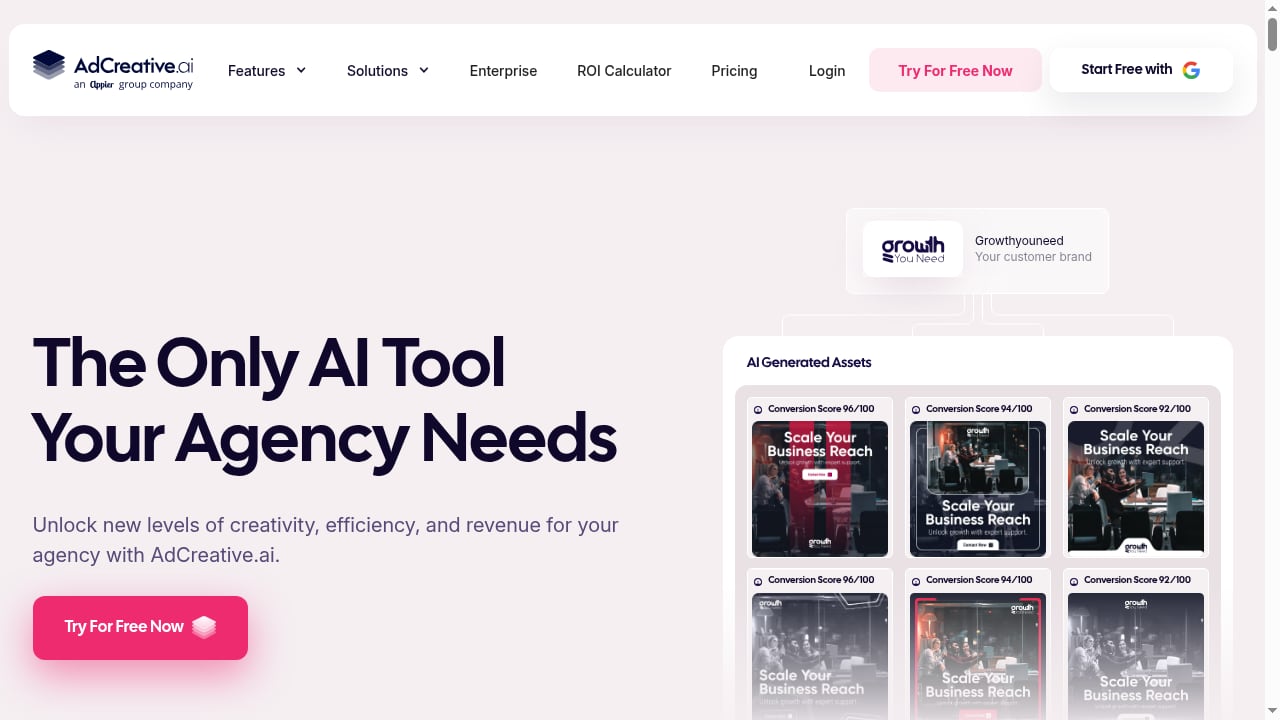
First viewport screenshot of AI-Driven Ad Solutions for Agencies: Scale & Impress.
AI ad creative generation is most effective when informed by data about what is already working in your market. Before generating variations, many teams research competitor creatives and winning ad patterns using ad intelligence tools. PrimeSpy, for example, is a multi-platform ad spy tool that helps marketers discover winning ads and analyze competitor creatives across Facebook, TikTok, and Meta Ad Library. It is not an AI ad creative generation platform — it belongs in the research phase, not the production phase — but it complements generation tools well. For a practical workflow that combines ad intelligence with AI creative generation, see How to Use PrimeSpy with AdCreative.ai.
For teams that prefer a swipe file approach to capturing winning ideas before generating variations, our Top 10 Swipe File Software Products 2026 comparison covers the best tools for organizing creative inspiration.
Sources and further reading
- Top 10 AI Advertising Companies to Watch in 2026 - Compare the top 10 AI advertising companies in 2026. Discover platforms that automate campaign optimization, budget allocation, and creative testing at scale.
- 12 Best AI Tools for Creatives in 2026 (Ranked) - The 12 best AI tools for creatives in 2026 — from creative intelligence and video generation to hook testing and brief automation, and what each is best for.
- The Best Platforms for AI-Generated Ad Creatives: Creation, Testing, and Placement - Discover the best platforms for creative ads, including creation, testing, and placement, to build your optimal performance ad stack for any objective or scale.
FAQ
What is an AI ad creative generation platform?
An AI ad creative generation platform is software that uses machine learning to create, score, and iterate advertising creatives — including static images, video, UGC-style clips, and ad copy — at scale. These platforms typically generate variations from product URLs, brand assets, or text prompts, and many include performance prediction to help teams prioritize which variations to test.
How is this different from a general AI image generator?
General AI image generators like Midjourney or DALL-E produce images from prompts but lack ad-specific features: brand kit enforcement, platform-specific format optimization, performance scoring, bulk catalog production, and ad platform integrations. Ad creative generation platforms are purpose-built for paid media workflows.
Do AI-generated ad creatives actually perform well?
Evidence from platform vendors and third-party reviews suggests that AI-generated creatives can perform as well as or better than manually produced ads when properly scored and tested. AdCreative.ai reports up to 14x higher conversion rates for scored creatives, and the IAB reports that 86% of advertisers already use or plan to use generative AI in video ad creation. The key is pairing generation with rigorous testing.
How much do AI ad creative generation platforms cost?
Pricing ranges widely. Entry-level tools start at $14–39 per month (Pencil Core, AdCreative.ai Starter, Canva Pro). Mid-tier platforms range from $249–$599 per month (AdCreative.ai Professional and Ultimate). Testing-focused platforms like Marpipe start around $1,499 per month. Enterprise platforms like Celtra use custom pricing.
Can AI ad creative platforms replace my design team?
For high-volume variation testing and catalog-scale production, yes — these platforms can replace the repetitive work that would otherwise consume designer hours. For premium brand campaigns, hero assets, and creative direction, human designers remain essential. The most effective teams use AI for volume and testing, and human creativity for strategy and brand-defining work.
What is the difference between ad creative generation and ad intelligence?
Ad creative generation creates new ads. Ad intelligence — tools like PrimeSpy, AdFox, or Adplexity — analyzes existing ads from competitors and the broader market. They are complementary: use ad intelligence to understand what is working, then use creative generation to produce your own variations informed by that data. For a deeper look at ad intelligence tools, see our AdFox Review and Adplexity Social Review.
Conclusion
The AI ad creative generation category has matured dramatically for 2026. The best platforms no longer just generate images — they score, test, and learn from performance data, closing the loop between creation and results. AdCreative.ai leads for its all-in-one breadth and accessible pricing. Pencil excels at predictive video. Celtra owns enterprise governance. Marpipe delivers rigorous multivariate testing. Hunch powers dynamic personalization.
The right choice depends on where your team sits on the maturity curve. Start with an accessible generation tool, add structured testing as your volume grows, and layer in enterprise governance when brand consistency becomes a competitive requirement. The production bottleneck is solved — the advantage now goes to teams that build a systematic creative stack and feed it with data.
For further reading on building a complete ad research and creative workflow, see How to Use PrimeSpy with Facebook for Winning Ad Research.