
SparkToro Review 2026: Audience Research Software Tested
SparkToro promises to answer a question that has historically cost marketers weeks of manual work and thousands of dollars in survey budgets: where does my target audience actually spend time online? Instead of guessing which podcasts, YouTube channels, websites, or social accounts matter, the platform claims to surface that data in seconds. This review examines whether SparkToro delivers on that promise, who benefits most, where it falls short, and what you should know before subscribing.
What Is SparkToro?
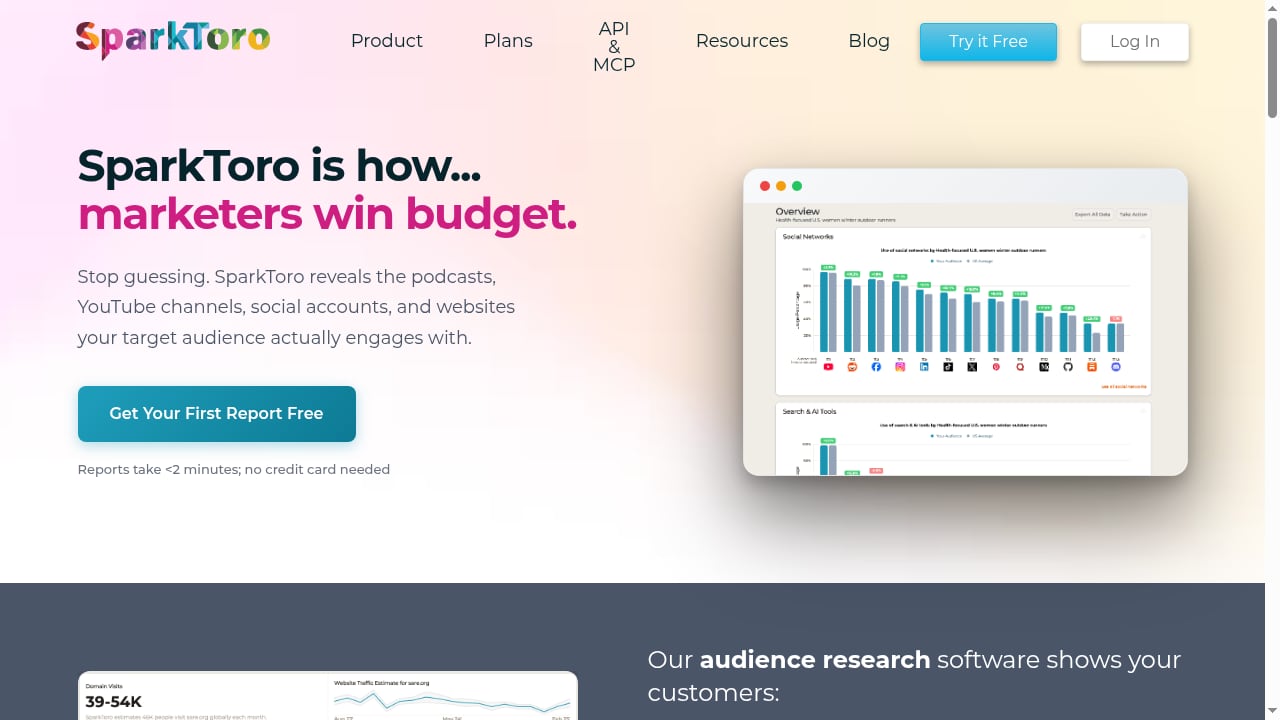
First viewport screenshot of SparkToro | Audience Research at Your Fingertips.
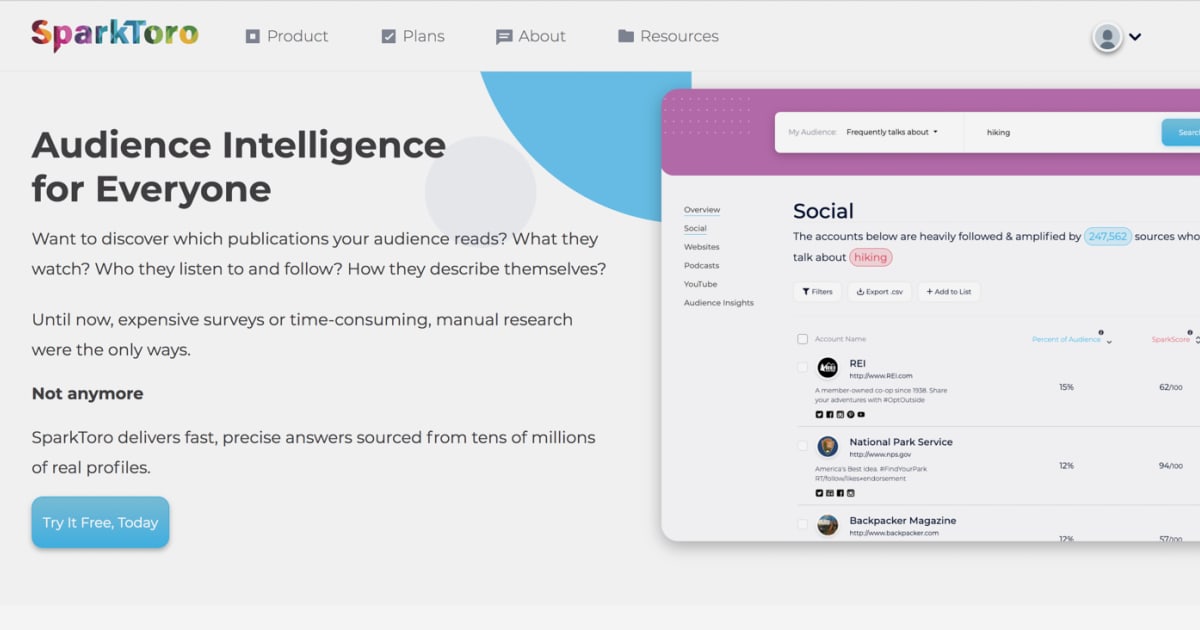
SparkToro is an audience research and intelligence platform built for marketers, agencies, PR professionals, and solo consultants. Its core function is simple: you enter a keyword, a website, a social account, or a topic that describes your audience, and SparkToro returns a ranked list of the sources that audience engages with most.
Those sources span multiple channels:
- Websites and blogs
- YouTube channels
- Podcasts
- Social media accounts across major platforms
- Reddit communities and subreddits
- Press and media outlets
Beyond source discovery, SparkToro layers in demographic signals, preferred social networks, search behavior, topics of interest, and even AI tool usage. The result is a practical map of where your audience congregates online, which you can then use for outreach, partnerships, content distribution, and campaign targeting.
Who Is SparkToro For?
First viewport screenshot of Adwordizing Case Study - Using SparkToro for competitor analysis is extremely useful | SparkToro Case Study.
SparkToro is not a one-size-fits-all tool. It solves a specific problem exceptionally well, and that problem matters most to certain roles.
Ideal Users
Solo consultants and freelancers who need to pitch the right podcasts, blogs, or newsletters without a research team benefit immediately. A single search can replace hours of manual Googling.
In-house marketers at small and mid-sized companies use SparkToro to identify partnership opportunities, refine content distribution, and understand where competitors' audiences overlap with their own.
PR and communications professionals can identify journalists, publications, and media outlets that genuinely reach a specific demographic, making outreach lists far more targeted than generic media databases.
Agencies running campaigns for multiple clients use SparkToro to build audience profiles quickly and justify media placement decisions with data rather than assumptions.
Who Should Look Elsewhere
SparkToro is not a product validation tool. If you are trying to determine whether people will buy a new product, you need customer interviews, landing page tests, or survey data, not audience source lists. Community feedback on platforms like Reddit echoes this distinction: SparkToro excels at PR outreach and influencer discovery, but it is not designed for validating product-market fit.
It is also not a replacement for traditional SEO tools. While SparkToro surfaces related keywords, its keyword data describes what an audience searches for in aggregate, not the keyword difficulty, SERP features, or ranking opportunities you would find in Ahrefs or Semrush.
Core Use Cases and Practical Examples
First viewport screenshot of SparkToro Case Studies | SparkToro.
1. Podcast and Guest Post Outreach
Suppose you sell analytics software and want to reach marketing operations professionals. Instead of manually compiling a list of relevant podcasts, you search for "marketing operations" or a related topic in SparkToro. The platform returns podcasts ranked by audience affinity, along with episode counts and recency data. You now have a prioritized outreach list in minutes.
The same logic applies to guest posting. The website results show which blogs and publications your audience reads, with affinity scores indicating how strongly that audience over-indexes on each source. You can pitch the highest-affinity sites first.
2. Influencer and Partnership Discovery
SparkToro's social account data includes a metric called SparkScore, which measures an account's reach relative to its following. This helps distinguish genuinely influential accounts from those with large but passive follower counts. For affiliate recruitment, partnership outreach, or co-marketing campaigns, this distinction matters.
For example, a search for "SEO consultant" surfaces social accounts that SEO consultants disproportionately follow and engage with. The affinity percentage tells you how much of that audience overlaps with each account, helping you prioritize outreach.
3. PR and Media Targeting
Traditional media databases list journalists by beat, but they rarely tell you which journalists actually reach your specific audience. SparkToro flips the approach: search for your audience, then see which publications and media sources they consume. This produces a more evidence-based media list than manual guesswork.
4. Competitor Audience Analysis
SparkToro allows you to search by website or social account, not just keywords. Enter a competitor's domain, and the platform shows which other websites, podcasts, and social accounts that competitor's audience also engages with. This reveals partnership opportunities, content gaps, and channels where you might intercept attention before your competitor does.
5. Reddit Community Discovery
A newer addition to SparkToro's toolkit is Reddit analysis. If your audience congregates in specific subreddits, SparkToro surfaces those communities. For brands investing in community-led growth or Reddit advertising, this data directly informs where to participate and where to place ads.
Key Features and Metrics Explained
Understanding SparkToro's metrics is essential to using the tool effectively. Here are the most important ones:
Affinity is SparkToro's core metric. It estimates what percentage of your defined audience also engages with a given source. A high affinity score means that source is disproportionately popular with your audience compared to the general population. This is more useful than raw popularity, because a massive site might have huge traffic but low relevance to your specific audience.
SparkScore measures a social account's influence relative to its follower count. An account with 10,000 highly engaged followers can outrank an account with 500,000 passive followers if the smaller account drives more meaningful interaction.
Domain Authority and Linking Websites appear in website results, providing SEO context for evaluating the authority of potential outreach targets.
Traffic estimates help you gauge the size of a website's audience, complementing affinity data. A high-affinity, high-traffic site is typically a stronger outreach target than a high-affinity, low-traffic site.
Keyword data shows what else your audience searches for, which is distinct from traditional SEO keyword tools. This data reveals adjacent topics and content opportunities rather than ranking difficulty.
Pricing Signals and Plan Structure
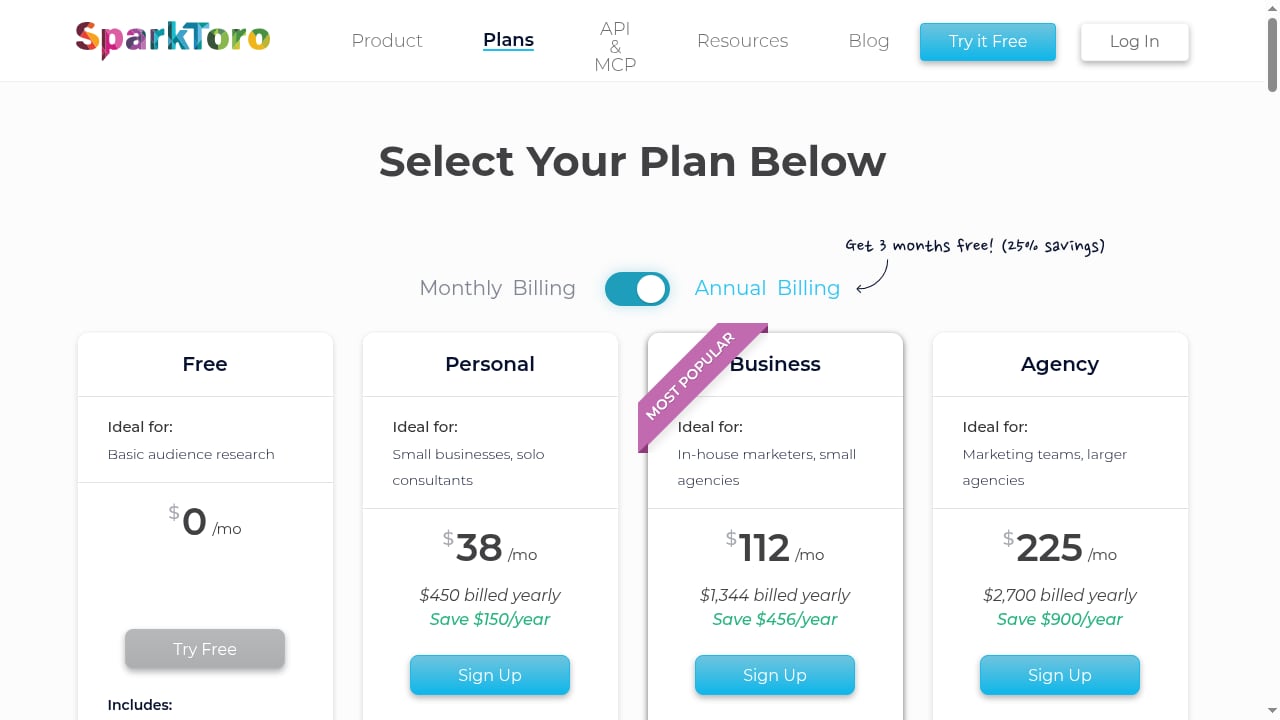
First viewport screenshot of SparkToro Pricing.
SparkToro operates on a freemium model. The free plan provides limited searches, which is enough to test the interface and understand the data structure before committing. Paid plans unlock additional searches, saved reports, and advanced features.
While specific pricing tiers change over time, the key signal is that SparkToro positions itself as an affordable alternative to traditional market research. Custom audience research projects typically cost $15,000 to $35,000 or more. SparkToro's subscription pricing, even at the higher tiers, represents a fraction of that cost for ongoing access to audience intelligence.
The value calculation depends on how frequently you need audience data. A solo consultant doing one-off research projects might find the free plan or a single month of paid access sufficient. An agency running continuous campaigns will likely need a higher tier with more searches and saved reports.
SparkToro also offers API and MCP access, which matters for teams that want to integrate audience data into internal tools or workflows. Integrations with tools like Hunter.io extend the platform's utility for outreach workflows.
Setup and Learning Curve
Getting started with SparkToro is straightforward. After creating an account, you land on a search interface with two components: what your audience does or talks about, and your topic of interest. You can then filter results by channel (websites, social accounts, podcasts, YouTube, Reddit, and more).
There is no installation, no data pipeline to configure, and no technical setup required. The main learning curve is interpretive: understanding what affinity means, how to combine multiple searches into a coherent audience profile, and how to translate the data into action.
Most users report that the interface is intuitive. The challenge is not using the tool but applying the insights strategically. A list of high-affinity podcasts is only valuable if you have a pitch strategy and follow-up process.
Strengths and Limitations
What SparkToro Does Well
Speed. What previously took days of manual research now takes minutes. The time savings alone justify the subscription for many users.
Affordability. Compared to custom market research or enterprise audience intelligence platforms, SparkToro is accessible to small businesses and solo practitioners.
Actionable output. The data is structured for outreach: ranked lists of sources with clear metrics. You can move from search to pitch list without additional processing.
Cross-channel coverage. Few tools aggregate websites, podcasts, YouTube, social accounts, and Reddit communities in a single interface.
Evidence-based approach. Instead of relying on self-reported survey data, SparkToro analyzes actual engagement patterns, which reduces the gap between what people say and what they do.
Where SparkToro Falls Short
Not a product validation tool. If you need to know whether people will buy something, SparkToro cannot answer that question. It tells you where an audience exists, not whether that audience has purchase intent.
Not a full SEO suite. The keyword data is useful for content ideation but does not replace dedicated SEO tools for rank tracking, backlink analysis, or technical audits.
Data coverage limitations. While SparkToro covers major platforms, some niche communities or regional platforms may be underrepresented. The podcast data, for example, has historically drawn primarily from Apple Podcasts rather than aggregating all podcast platforms equally.
Interpretation required. The tool provides data, not strategy. Users who expect SparkToro to tell them exactly what to do will be disappointed. The value comes from combining the data with domain expertise and outreach execution.
Search volume constraints. Depending on your plan, you may have a limited number of searches per month. Teams with heavy research needs should evaluate plan limits carefully before subscribing.
SparkToro vs. Alternatives
SparkToro occupies a distinct niche, but it is worth understanding how it compares to adjacent tools.
SparkToro vs. traditional SEO tools (Ahrefs, Semrush): SEO tools focus on keyword rankings, backlinks, and technical site health. SparkToro focuses on audience behavior across channels. They are complementary, not competitive. Many teams use both.
SparkToro vs. social listening tools (Brandwatch, Sprout Social): Social listening tools monitor conversations about specific topics or brands in real time. SparkToro maps audience affinities across channels. Social listening is reactive; SparkToro is more about discovery and targeting.
SparkToro vs. media databases (Muck Rack, Cision): Media databases list journalists and outlets by beat. SparkToro identifies which outlets actually reach your audience. For PR teams, SparkToro can refine and prioritize lists built from traditional databases.
SparkToro vs. ad intelligence tools: Tools like Anstrex or wetracked.io focus on ad creative, placement, and tracking data. SparkToro focuses on organic audience behavior. If your goal is understanding where to place ads based on audience affinity, SparkToro can inform your targeting strategy before you dive into ad spy research.
For teams building a broader research stack, SparkToro pairs well with performance marketing workflows, where audience insight directly informs channel selection and campaign targeting.
Real-World Results and Case Study Signals
SparkToro's published case studies highlight meaningful outcomes. One documented example shows a 50% reduction in customer acquisition cost after using audience intelligence to refine targeting. Another case describes a $1 million product launch supported by SparkToro-driven outreach and partnership selection.
These results are not universal. The tool works best when paired with a clear outreach strategy and execution capacity. A list of high-affinity podcasts does not generate revenue by itself; the follow-up, pitching, and relationship building do. Teams that treat SparkToro as a research accelerator rather than a complete solution see the strongest returns.
Community feedback on platforms like G2 consistently praises the intuitive interface and the value of audience insights for identifying relevant sources. The most common criticism is that the tool's value depends heavily on how you use the data, which is true of most research platforms.
Decision Criteria: Should You Subscribe?
Consider these questions before committing:
Do you regularly need to identify new outreach targets? If you pitch podcasts, blogs, or influencers monthly, SparkToro will pay for itself in time savings alone.
Is your audience research currently manual? If you are compiling lists through Google searches, social media browsing, and spreadsheet tracking, SparkToro automates that process.
Do you need cross-channel audience data? If you only care about one channel, specialized tools might suffice. SparkToro's value increases when you need websites, podcasts, social accounts, and Reddit communities in one place.
Is your budget constrained? Compared to custom research, SparkToro is inexpensive. But if you only need audience data once per quarter, a monthly subscription might be overkill. The free plan is a good way to test the waters.
Are you trying to validate a product idea? If yes, SparkToro is the wrong tool. Invest in customer interviews and landing page tests instead.
For a broader view of how audience research fits into your marketing stack, explore global ad trends for 2026, which contextualizes where audience attention is moving across channels.
Related reading
- AdSpy Free: 7 Legit Ways to Spy on Ads Without Paying - Looking for AdSpy free access? Compare free ad spy tools, trials, and alternatives for Facebook, TikTok, and Meta ads research in 2026.
- Top 10 AI Shopify Store Builders & Product Research Tools 2026 - We tested the 10 best AI-powered Shopify store builders and product research tools for 2026. Compare features, pricing, and real output quality.
Sources and further reading
- What is SparkToro? What you need to know before subscribing (2026) - Learn more about Sparktoro. This tool finds you the sources of influence for your audience. What do you need to know before signing up?
- spent $400 on sparktoro but didn't work for me : r/DigitalMarketing - Mar 16, 2026 ... sparktoro is great for pr outreach and influencer discovery. it's terrible for product validation :).
- SparkToro Reviews 2026: Details, Pricing, & Features - G2 - What do users say? ... Users consistently praise the intuitive interface and valuable audience insights provided by SparkToro, making it easy to identify and ...
Frequently Asked Questions
Is SparkToro worth it for a solo consultant?
Yes, in most cases. A solo consultant who regularly pitches podcasts, blogs, or partnership opportunities can replace hours of manual research with a few SparkToro searches. The free plan provides a risk-free way to test whether the data quality meets your needs.
How accurate is SparkToro's data?
SparkToro analyzes actual engagement patterns rather than self-reported survey data, which generally improves accuracy. However, no audience intelligence tool is perfect. Affinity scores are estimates, and coverage varies by channel and region. Use the data as a prioritized starting point, not an absolute truth.
Does SparkToro replace traditional market research?
No. SparkToro answers "where is my audience?" but not "why do they buy?" or "what do they think about my product?" For behavioral audience mapping, it is excellent. For deep customer insights, you still need interviews, surveys, and qualitative research.
Can SparkToro help with Facebook or Google Ads targeting?
Indirectly. SparkToro can identify websites, YouTube channels, and social accounts your audience engages with, which can inform placement decisions and custom audience strategies. However, it does not provide ad creative intelligence or competitor ad data. For that, tools like Anstrex are more appropriate.
What is the difference between SparkToro and an SEO tool?
SEO tools analyze search rankings, backlinks, and technical site health. SparkToro analyzes audience behavior across websites, social platforms, podcasts, and communities. They serve different purposes and are often used together.
Does SparkToro offer a free trial?
SparkToro offers a free plan with limited searches rather than a time-limited trial. This allows you to test the platform's core functionality at your own pace before upgrading.
Conclusion
SparkToro solves a specific, expensive problem: discovering where your target audience spends time online. It does this faster and more affordably than traditional research methods, and the output is structured for immediate action. For marketers, PR professionals, and consultants who regularly need to identify outreach targets, partnership opportunities, or media placements, SparkToro is a high-value tool.
The platform's limitations are equally clear. It is not a product validation tool, not a full SEO suite, and not a replacement for strategic thinking. The data requires interpretation and follow-through to generate results.
If your workflow involves audience discovery and outreach, SparkToro deserves a place in your research stack. Start with the free plan, run a few searches relevant to your actual work, and evaluate whether the affinity data surfaces sources you would not have found otherwise. If it does, the subscription will likely pay for itself quickly.