
wetracked.io Review 2026: Ad Tracking for Shopify & WooCommerce
If you run paid ads for a Shopify or WooCommerce store, you have likely seen the same painful pattern: Meta reports one ROAS, your store reports another, and neither number feels trustworthy. wetracked.io positions itself as the fix. It promises to recover the 40–60% of conversions that iOS restrictions, ad blockers, and weak pixel implementations routinely miss, then push that corrected data back into your ad managers.
This review examines what wetracked.io actually does, how it works, where it excels, where it falls short, and who should consider it. It is based on the vendor's published documentation, public reviews, and how the product compares with standard server-side tracking setups.
What Is wetracked.io?
First viewport screenshot of Meta Andromeda Update Explained: What It Means for Ecommerce Ads (2026) | wetracked.io.
wetracked.io is a server-side ad tracking tool built specifically for Shopify and WooCommerce stores. Instead of relying only on browser pixels or Meta's Conversion API (CAPI), it captures first-party data from your store's server, enriches it with additional visitor signals, and sends completed conversion events back to Meta, Google Ads, TikTok, Snapchat, Pinterest, and X.
The core claim is simple: native pixels and CAPI alone capture roughly 40% of real conversions, while wetracked.io reaches 95–100% accuracy. That difference matters because ad algorithms optimize on the data they receive. Incomplete data leads to poor bidding, wasted spend, and misleading ROAS reports.
Who Should Use wetracked.io?
wetracked.io is not for every advertiser. It solves a specific problem for a specific profile.
Ideal Users
- Shopify and WooCommerce merchants spending at least $1,000–$3,000 per month on paid ads. Below that threshold, the cost of the tool may outweigh the recovery benefit.
- Stores running Meta, TikTok, or Google Ads with significant iOS traffic. iOS 14.5+ and Safari's Intelligent Tracking Prevention disproportionately break browser-based tracking.
- Merchants who see a large gap between platform-reported conversions and actual store orders. This is the clearest signal that tracking loss is hurting optimization.
- Teams that want corrected data inside their existing ad managers rather than learning yet another analytics dashboard.
Who Should Look Elsewhere
- Very low-spend advertisers. If you spend under $500 per month, improving tracking accuracy from 40% to 95% may not recover enough revenue to justify the subscription.
- Stores on platforms outside Shopify and WooCommerce. wetracked.io supports several checkout plugins such as Funnelish, Checkify, CheckoutChamp, and Sticky.io Checkout, but native support for other carts is limited.
- Teams that need deep multi-touch attribution or offline conversion modeling. wetracked.io focuses on accurate event capture and pass-back, not full marketing mix modeling.
How wetracked.io Works
wetracked.io's approach has three layers: first-party capture, data enrichment, and ad platform pass-back.
1. First-Party Server-Side Capture
When a visitor lands on your store and later purchases, wetracked.io records the event directly from your server. This bypasses browser cookies and pixels that ad blockers and iOS privacy features can strip away. The result is a conversion record that exists even when the browser refuses to cooperate.
2. Data Enrichment and Session Stitching
The tool creates a digital fingerprint from multiple data points for each visitor. This stitching connects the pre-purchase session with the final order, even when the user switches devices, clears cookies, or uses a privacy-focused browser. wetracked.io states this fingerprint is GDPR-compliant.
3. Direct Ad Platform Integration
Rather than showing corrected data in a separate dashboard, wetracked.io pushes the enriched conversion events back to your connected ad accounts. Meta, Google, TikTok, and other platforms then optimize using the more complete dataset. This is the key difference from tools that only provide reporting: wetracked.io feeds the algorithm, not just the marketer.
Setup Process
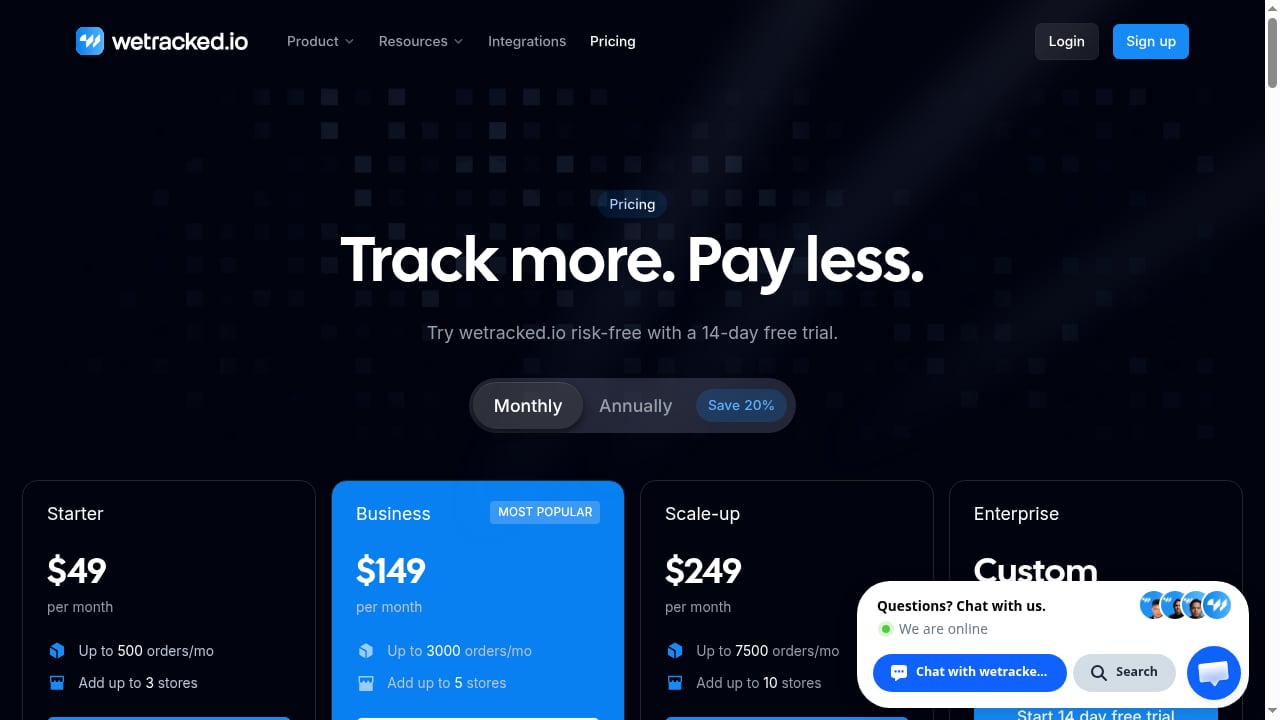
First viewport screenshot of Transparent & Affordable Pricing | wetracked.io.
wetracked.io claims a sub-five-minute setup with no coding. For Shopify, the process is typically:
- Install the wetracked.io app from the Shopify App Store.
- Connect your store with one click.
- Paste your pixel IDs from Meta, Google, TikTok, or other platforms.
- Let the tool begin capturing and passing back events.
For WooCommerce, the vendor published a similar flow: install the plugin, connect the store, add ad platform IDs, and monitoring begins automatically. Most merchants should see improved accuracy within 24–48 hours.
No UTM parameters or manual event configuration are required, which is a meaningful advantage over custom server-side setups that often demand developer time.
Key Strengths
High Reported Accuracy
The central value proposition is near-complete conversion capture. The vendor claims 95–100% accuracy versus the 40% baseline of native tracking. Public testimonials reinforce this, with one founder describing "close to 100% tracking" and no over- or under-reporting.
No Additional Dashboard Required
Many tracking tools improve reporting but leave ad platforms starved of data. wetracked.io sends corrected events directly to Meta, Google, and TikTok, so your existing ad manager reports become more reliable without adding another tool to check daily.
Broad Platform Support
Beyond Shopify and WooCommerce, wetracked.io integrates with several checkout platforms and supports Meta, TikTok, X, Pinterest, Snapchat, and Google Ads. This breadth is useful for merchants running multi-channel campaigns.
Adblock-Proof Design
Because tracking happens server-side, browser-based ad blockers cannot prevent conversion capture. This matters for audiences that skew toward privacy tools or technical users.
Risk Reversal
The vendor offers a 14-day free trial and a money-back guarantee tied to a specific outcome: if your ROAS does not increase by at least 20%, you can request a refund. This is a stronger guarantee than most tracking tools provide.
Limitations and Considerations
First viewport screenshot of 2026 Hyros Pricing Plans: How Much Does it Cost? | wetracked.io.
Pricing Is Not Transparent
wetracked.io does not publish fixed pricing on its main site. The vendor offers a calculator that estimates recovered ad spend, but actual subscription costs require contacting sales or starting a trial. This is common in the tracking category but worth noting if you prefer self-serve pricing.
Results Depend on Ad Platform Behavior
wetracked.io can send accurate events, but it cannot control how Meta or Google weight those events. Platforms may still apply their own modeling or attribution windows. The tool improves the input data; it does not replace platform logic.
Limited Platform Coverage for Non-Shopify/WooCommerce Stores
While several checkout plugins are supported, merchants on Magento, BigCommerce, or custom carts may not have a native integration. Check compatibility before committing.
No Standalone Attribution Dashboard as the Primary Interface
wetracked.io recently introduced a Pulse Dashboard for consolidated ad performance, but its core philosophy remains pass-back to ad managers. If you want sophisticated multi-touch attribution reports, you may still need a complementary analytics tool.
wetracked.io vs. Native Tracking and CAPI
The most useful comparison is not wetracked.io versus another paid tool, but wetracked.io versus what you already have.
| Factor | Native Pixel + CAPI | wetracked.io |
|---|---|---|
| Typical conversion capture | ~40% | 95–100% claimed |
| Adblock resistance | Low | High |
| Setup complexity | Low to moderate | Low |
| Data fed to ad algorithms | Incomplete | Enriched and complete |
| Additional dashboard required | No | No |
| Cost | Free | Paid subscription |
Native CAPI is a connection, not a data enrichment engine. It sends whatever your store captures, which is often incomplete. wetracked.io adds capture, enrichment, and stitching before pass-back. That is the functional difference.
Pricing Signals
Although exact pricing is not public, several signals help estimate value:
- The vendor's calculator suggests merchants spending $1,000 per month on ads recover about $187 per month through improved ROAS and reduced waste.
- The 20% ROAS improvement guarantee implies the tool must deliver at least that level of uplift to justify its cost.
- Typical server-side tracking tools in this category range from roughly $50 to $300+ per month depending on order volume and ad spend.
If your monthly ad spend is $5,000 and tracking loss is 50%, recovering even a fraction of that lost signal can pay for the subscription several times over. If you spend $300 per month, the math is much tighter.
Decision Criteria: Should You Try It?
Consider wetracked.io if you answer yes to most of these:
- You run Shopify or WooCommerce.
- You spend at least $1,000 per month on Meta, TikTok, or Google Ads.
- Your platform-reported conversions are consistently lower than actual store orders.
- A meaningful share of your traffic comes from iOS or privacy-focused browsers.
- You want corrected data inside your existing ad managers, not a separate dashboard.
- You are willing to run a 14-day trial and compare ROAS before and after.
If you are unsure, the trial period is the most practical test. Connect the tool, let it run for one to two weeks, and compare conversion volume and ROAS against your pre-install baseline.
How wetracked.io Fits a Broader Tracking Stack
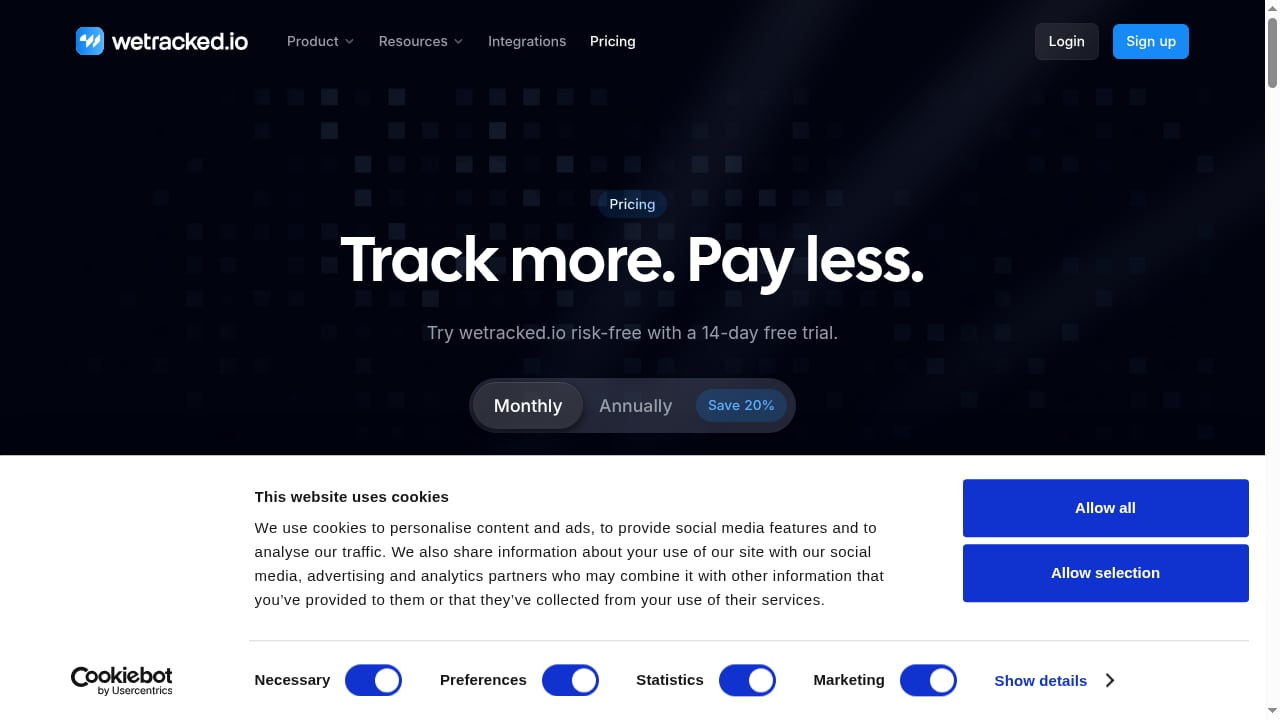
First viewport screenshot of Transparent & Affordable Pricing | wetracked.io.
wetracked.io solves the pass-back problem, but it is not a replacement for every analytics need. Many merchants pair accurate event tracking with performance marketing discipline to evaluate channel-level profitability. Others use ad intelligence tools to understand competitor creative before scaling spend. For example, creative insights can help you decide which ads deserve more budget once wetracked.io shows you which ones actually convert.
If you are still researching the Shopify tooling landscape, a broader comparison of AI Shopify store builders and product research tools can help you evaluate whether tracking is the right next investment or whether other parts of your stack need attention first.
Related reading
- AdSpy Free: 7 Legit Ways to Spy on Ads Without Paying - Looking for AdSpy free access? Compare free ad spy tools, trials, and alternatives for Facebook, TikTok, and Meta ads research in 2026.
- Top 10 AI Shopify Store Builders & Product Research Tools 2026 - We tested the 10 best AI-powered Shopify store builders and product research tools for 2026. Compare features, pricing, and real output quality.
- Anstrex Review 2026: Ad Spy Data, Pricing, and Verdict - Evidence-based Anstrex review covering native, TikTok, push, and pop ad intelligence, pricing signals, workflow limits, and who should use it.
Sources and further reading
- wetracked.io | The #1 Ad Tracking Software for Shopify & WooCommerce - Stop losing 60% of ad data the #1 ad tracking tool for Ecommerce. Boost your ROAS by 50% in 1 week on Facebook Ads, Google Ads, TikTok Ads and more!
- wetracked.io Reviews 2026: Details, Pricing, & Features - G2 - wetracked.io is a specialized ad tracking solution designed to help Shopify & WooCommerce store owners accurately capture and report their sales data back ...
- wetracked.io Now Available for WooCommerce: The Same Ad Tracking That's Revolutionizing Shopify Stores | wetracked.io - After helping over 7,000 Shopify merchants recover millions in lost ad revenue, we're thrilled to announce that wetracked.io is now available for WooCommerce stores. The same #1 highest-rated ad tracking software that's been transforming Shopify advertising is now ready to solve WooCommerce merchants' most pressing challenge: accurate conversion tracking in a post-iOS 14.5 world.
FAQ
Does wetracked.io work with iOS 14.5+ and ad blockers?
Yes. wetracked.io captures events server-side and stitches sessions using first-party data, so iOS privacy restrictions and browser ad blockers do not prevent conversion tracking.
Is wetracked.io different from Meta's Conversion API?
Yes. CAPI is a connection that sends whatever data your store captures, which is often incomplete. wetracked.io captures more data points, enriches them, stitches sessions, and then pushes a complete conversion record back to Meta and other platforms.
Does wetracked.io support WooCommerce?
Yes. The vendor announced full WooCommerce support after initially focusing on Shopify. Setup uses a plugin and requires no coding.
Which ad platforms does wetracked.io integrate with?
Meta, TikTok, X, Pinterest, Snapchat, and Google Ads are supported. The vendor states more integrations are in development.
Is wetracked.io GDPR compliant?
The vendor states that its digital fingerprint method is GDPR-compliant. As with any tracking tool, you should review its data processing terms against your specific compliance obligations.
Does wetracked.io offer a free trial?
Yes. A 14-day free trial is available, along with a money-back guarantee tied to a 20% ROAS improvement.
Will wetracked.io block my ad account?
The vendor states that it sends events in the exact format required by each ad platform's API and is invisible to ad platforms. You can also connect multiple pixels as a backup.
Conclusion
wetracked.io addresses a real and expensive problem: ecommerce ad platforms optimizing on incomplete data. Its server-side, first-party approach is technically sound, and the pass-back model means the benefit flows directly into the algorithms that control your bidding and audience building.
The tool is not a magic ROAS multiplier. It is an accuracy layer. If your tracking is already strong and your platform data closely matches store orders, the upside may be modest. But if you see a 40–60% gap between reported and actual conversions, wetracked.io's 14-day trial is a low-risk way to test whether better data meaningfully improves performance.
For Shopify and WooCommerce merchants spending enough on ads to feel the pain of tracking loss, this is one of the more focused solutions available. For very small advertisers or stores on unsupported platforms, the value proposition is weaker. The decision ultimately comes down to one question: how much is accurate conversion data worth to your ad algorithm?