
How to Use PrimeSpy with Cropink: Spy Ads to DPA Workflow
Most ecommerce teams treat ad research and ad production as two separate jobs. One person hunts for winning angles in the Meta Ad Library or TikTok Creative Center; another waits on a designer to turn those ideas into catalog ads. By the time the creative ships, the trend has cooled.
This guide shows how to close that gap by pairing PrimeSpy (ad intelligence and competitor tracking) with Cropink (dynamic product ad creative automation). You will learn the exact workflow, setup steps, and practical examples for turning spied ads into on-brand dynamic product ads (DPAs) at scale.
Why combine PrimeSpy and Cropink?
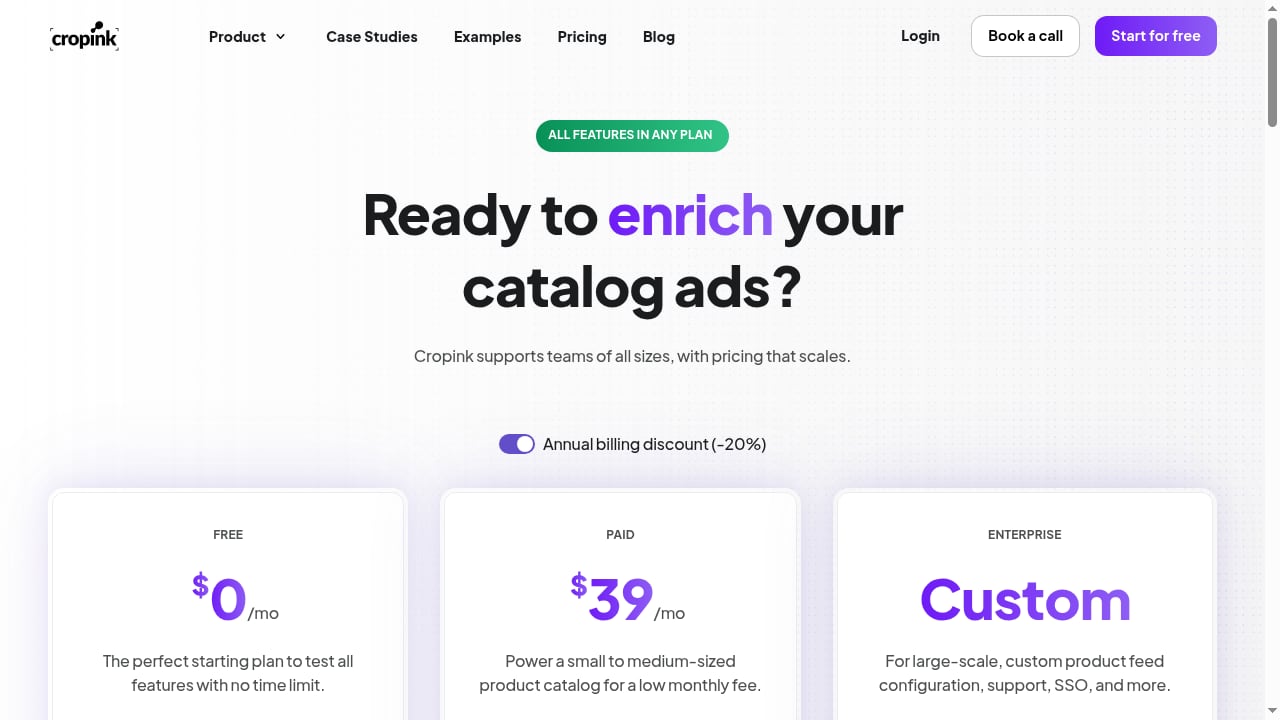
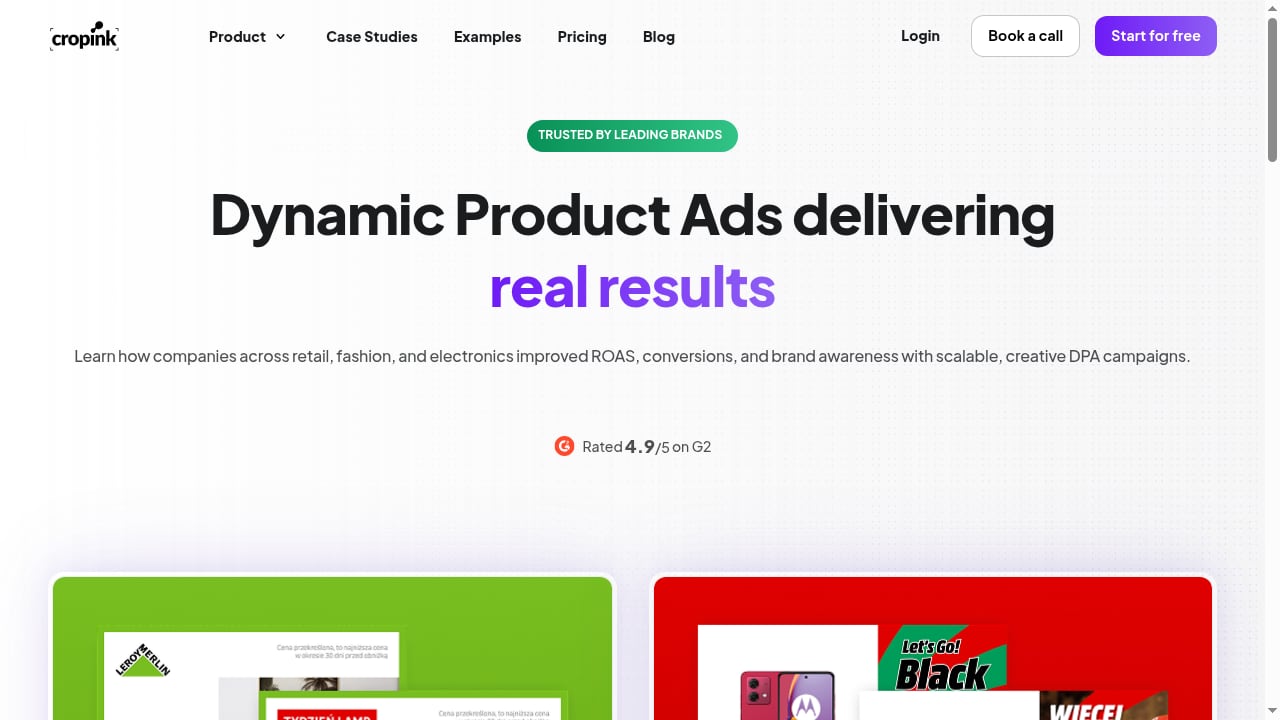
First viewport screenshot of Cropink.
The two tools solve opposite ends of the same problem.
- PrimeSpy answers what is working right now: which creatives competitors are scaling, which angles appear in duplicate ads, and which product pages keep changing.
- Cropink answers how do I produce that at scale: connecting a product feed and generating dynamic catalog ads with custom backgrounds, pricing overlays, and brand styling across Meta, TikTok, and Google.
Used alone, each leaves a gap. PrimeSpy gives you insight but no production line. Cropink gives you a production line but no signal about what to produce. Together they form a loop: research → design → launch → measure → refresh.
If you are still deciding which ad intelligence tool fits your stack, the comparison of top ad intelligence and competitive analysis platforms is a useful starting point before you commit to a workflow.
What each tool does (quick reference)
| Capability | PrimeSpy | Cropink |
|---|---|---|
| Primary role | Ad spy and competitor ad tracking | Dynamic product ad creative automation |
| Core data | 120M+ searchable ads, reach/spend signals, duplicate detection | Product feeds from XML, CSV, Meta, or Shopify |
| Platforms covered | Meta (Facebook, Instagram), TikTok, Meta Ad Library | Meta, TikTok, Google, Snapchat |
| Output | Winning ad examples, tracked competitors, alerts | On-brand catalog ad creatives, campaign automation |
| Best for | Finding angles, hooks, offers, and product ideas | Producing and testing DPA variants quickly |
| Entry pricing | Free trial (500 credits, 2 trackers); Pro at $9.99/mo | Free plan up to 25 products; paid from $39/mo |
The combined workflow: from spied ad to live DPA
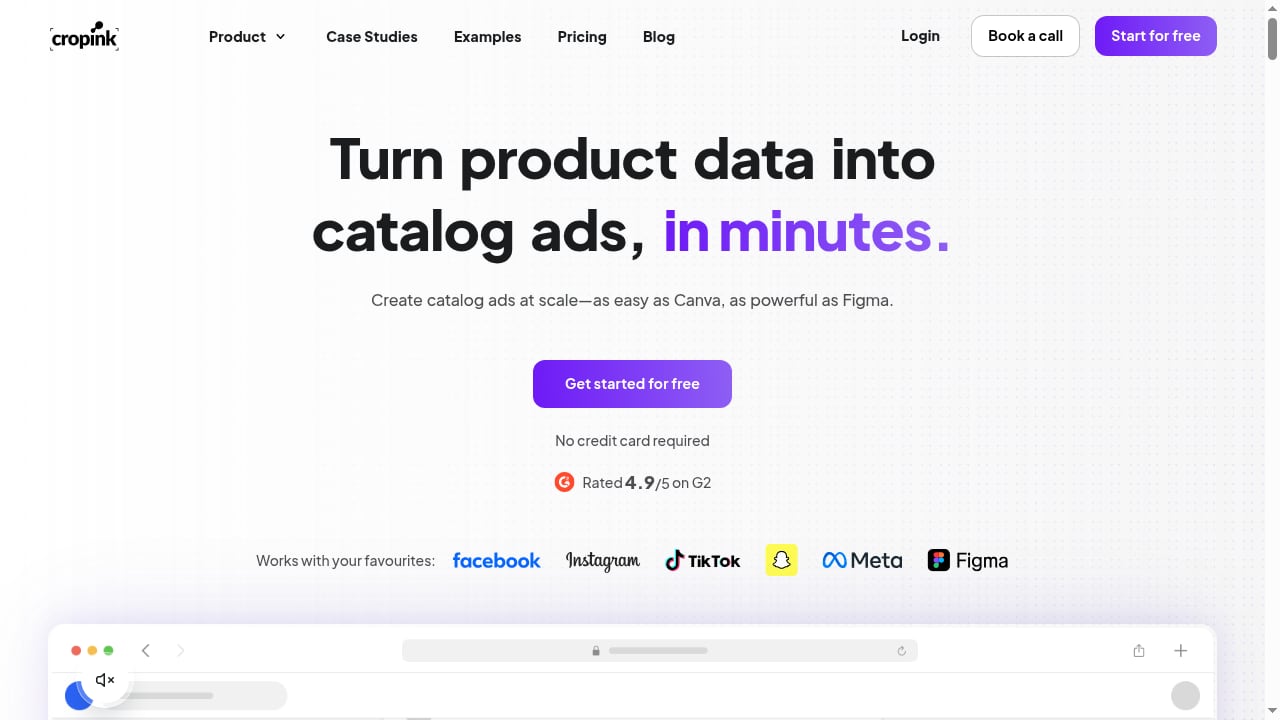
First viewport screenshot of Create Better Catalog Ads with Cropink.
Step 1 — Find winning ads in PrimeSpy
Start with a focused search rather than browsing. In PrimeSpy you can search by keyword, advertiser, or landing page URL, then filter by platform, engagement signals, and region (including EU-specific filters).
Practical example: you sell ergonomic desk accessories. Search "standing desk mat" and filter to ads running for more than 30 days. Long-running ads are a strong proxy for profitability, because most advertisers kill losers quickly. Save the best examples to a list and export it.
Step 2 — Decode the creative pattern, not the creative
Do not copy the ad. Extract the structure:
- Hook type: problem-first, before/after, price shock, or social proof
- Visual format: lifestyle photo, flat lay, UGC video, or catalog grid
- Offer mechanic: percentage discount, bundle, free shipping threshold
- On-image text: the exact claim doing the heavy lifting
Write these down as a short brief. This brief is what you will translate into Cropink designs.
Step 3 — Track competitors for ongoing signals
Set up ad trackers in PrimeSpy for three to five direct competitors. The platform monitors 24/7 and can email you when new creatives appear, landing pages change, or products are updated. This turns a one-time research session into a standing intelligence feed.
If your team also maintains a swipe file of reference ads, the PrimeSpy and SwipeWell workflow shows how to organize those references so they stay searchable instead of buried in a folder.
Step 4 — Connect your product feed to Cropink
In Cropink, create a project and connect your catalog. You can sync via XML, CSV, Meta, or Shopify — no developer work required. According to Cropink's own documentation, the platform processes around 100 million images daily and is used by more than 700 companies.
Once the feed is connected, product data such as title, price, image, and availability becomes available as dynamic fields.
Step 5 — Build the DPA design around your brief
This is where the research pays off. Use Cropink's design editor to build a template that mirrors the winning pattern you identified:
- Add a custom background if the winning ads used lifestyle context
- Insert clear pricing if the competitor's hook was price-led
- Apply on-image text for the discount or claim you saw repeated
- Layer in real customer reviews if social proof was the differentiator
For teams with an existing design system, the Figma plugin lets you design in Figma and export directly into Cropink, keeping typography and color tokens consistent. The Cropink help center walks through creating your first project and connecting Meta.
Step 6 — Map dynamic fields and apply conditional logic
Cropink's Design Manager supports dynamic data mapping with conditional logic. That means one template can behave differently depending on the product: show a "Sale" badge only when a discount field is populated, or switch background color by category.
This is the step that makes catalog ads feel hand-crafted even though they are generated automatically.
Step 7 — Launch and automate
Push the design to Meta campaigns through Cropink's campaign management, which includes a scheduler, hourly feed updates, and Facebook-specific tools. You can also run the same enriched creatives on TikTok and Google.
Step 8 — Measure, then refresh from PrimeSpy
After launch, return to PrimeSpy. Check whether competitors have refreshed their creatives, whether new advertisers entered the auction, and whether your tracked brands changed their offers. Feed those signals back into Step 2 and update your Cropink template.
Practical example: a 7-day sprint
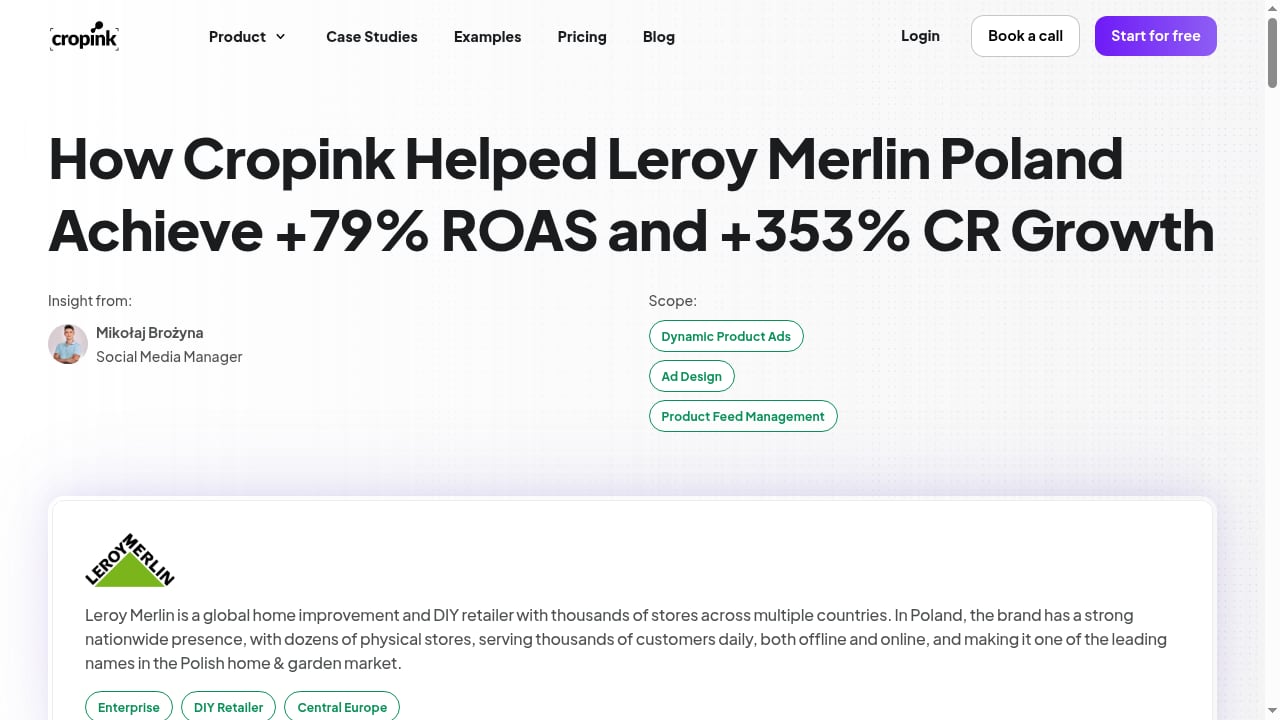
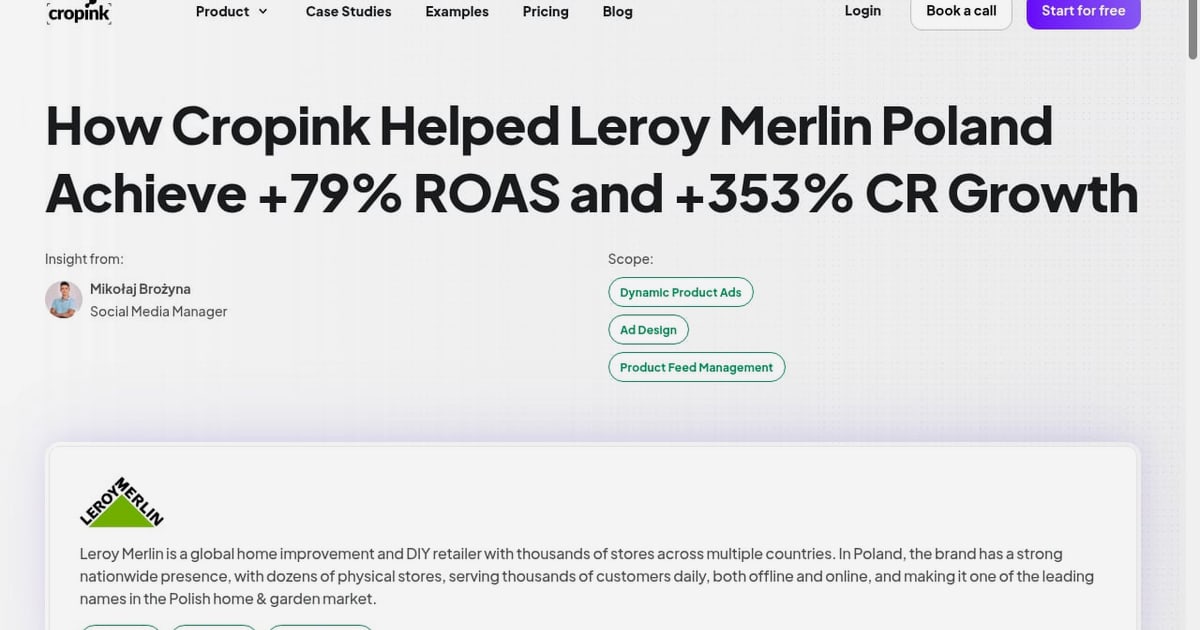
First viewport screenshot of How Cropink Helped Leroy Merlin Poland Achieve +79% ROAS and +353% CR Growth.
Here is how a small ecommerce team could run this in one week:
- Day 1 — PrimeSpy search for three product keywords; save 20 long-running ads; write one creative brief.
- Day 2 — Connect Shopify feed to Cropink; build a single DPA template with two background variants.
- Day 3 — Add conditional logic for sale badges and review overlays.
- Day 4 — Launch two creative variants on Meta; keep the product set identical.
- Day 5–6 — Let the campaign gather data; monitor PrimeSpy trackers for competitor changes.
- Day 7 — Compare CTR and conversion rate between variants; promote the winner and rebuild the loser using a new angle from PrimeSpy.
This cadence keeps creative testing continuous instead of episodic.
Common problems this combination solves
- Slow creative turnaround: design bottlenecks disappear when templates generate ads from feed data.
- Guesswork in creative direction: PrimeSpy replaces opinion with observed competitor behavior.
- Generic catalog ads: Cropink's branding controls prevent the plain, unbranded look that most DPAs share.
- Stale campaigns: automated feed updates plus competitor alerts keep ads current.
- Learning phase resets: testing creative variants within one campaign structure avoids restarting optimization.
When this pairing is not the right fit
First viewport screenshot of Cropink Case Studies – Success Stories from Our Clients.
If you run a single-product store with no catalog, dynamic product ads are not your format — a static creative workflow will serve you better. Likewise, if you already have an in-house design team producing dozens of variants weekly and no interest in feed-driven automation, Cropink's value is lower.
The combination shines for stores with 20+ SKUs, recurring promotions, and a need to test creative angles faster than a manual design queue allows. Dropshipping sellers validating product ideas can also benefit, since the dropshipping model depends heavily on rapid creative iteration.
Related reading
- PrimeSpy vs Atria vs Vibemyad: Winning Ad Campaign Tools - Compare PrimeSpy, Atria, and Vibemyad for tracking and analyzing winning ad campaigns. See coverage, analytics depth, pricing, and which tool fits your workflow.
- PrimeSpy vs Competitive Intelligence for Online Marketers - Compare PrimeSpy and Competitive Intelligence for Online Marketers on ad coverage, tracking, pricing, and workflow to pick the right ad spy tool.
- SpreshApp Review: Spy Competitor Ads & Find Winning Ads - Hands-on SpreshApp review: download ads from Meta, TikTok, and Google libraries, filter winners, and see pricing signals, limits, and who it fits.
Sources and further reading
- cropink - Cropink is an online tool developed so you can create ads with your product data. Automatically.
FAQ
Do I need both tools to run dynamic product ads?
No. Cropink alone can generate catalog ads from your feed. PrimeSpy adds the research layer that tells you which angles, offers, and formats are currently working for competitors, which reduces wasted test spend.
Can PrimeSpy track TikTok ads as well as Meta ads?
Yes. PrimeSpy covers Meta (Facebook, Instagram), TikTok, and the Meta Ad Library, with analytics for both Meta and TikTok on its Pro plan.
What product feeds does Cropink accept?
Cropink connects to XML, CSV, Meta, and Shopify feeds. The free plan supports up to 25 products, and paid plans start at $39 per month for up to 100 products.
How long before I see results from this workflow?
Expect the first meaningful creative comparison within one to two weeks. Catalog ad performance improves as you accumulate tested templates and feed your PrimeSpy research back into the design process.
Can agencies use this workflow for multiple clients?
Yes. PrimeSpy supports multiple ad trackers for monitoring different brands, and Cropink offers agency team billing plus shared assets across projects, which suits multi-client workflows.
Conclusion
PrimeSpy and Cropink are not competitors — they are two halves of a single loop. PrimeSpy tells you what the market is responding to; Cropink turns that insight into branded, feed-driven catalog ads at a speed manual design cannot match.
Start with the free tiers of both tools: run one PrimeSpy search on your top product keyword, write a one-page creative brief, and build a single Cropink template from it. If that template outperforms your current catalog ads, you have a repeatable system worth scaling.