
Atria Review 2026: AI Ad Creative Platform Tested
Atria is an AI advertising creative intelligence and workflow platform built for performance marketing teams running paid social on Meta and TikTok. It bundles ad research, competitor intelligence, AI brief generation, creative production, one-click Meta batch launch, and post-launch analytics into a single product. Pricing starts at $129 per month on the Core plan, with roughly 20% off on annual billing.
The pitch is consolidation: replace the ad spy tool, the swipe file, the brief doc, and the reporting spreadsheet with one workspace. That pitch holds up in some areas and breaks down in others. This review separates the two, using the product's own feature claims, third-party review signals, and documented user complaints.
What Atria actually does
First viewport screenshot of How Alpha Inbound decodes winning creative strategies | Atria.
Atria covers five jobs in the creative cycle:
- Ad inspiration discovery across a large stored ad library, with semantic search rather than keyword-only filtering.
- Competitor ad intelligence, so you can see what rivals are running and how long ads have survived.
- Creative performance analytics with letter-grade scoring per creative across metrics like ROAS, CTR, hook rate, and hold rate.
- AI ideation and brief generation, including an AI agent (Raya) trained on aggregate ad spend data.
- Reporting and launch workflow, including batch upload to Meta and REST API access plus an MCP integration for bringing ad data into AI agents like Claude and ChatGPT.
The MCP and API angle matters more than it sounds. Most creative tools trap your data in their dashboard. Atria lets you pipe ad performance into the AI assistant your team already uses, which is a real workflow unlock for teams that live in Claude or ChatGPT.
Who Atria is built for
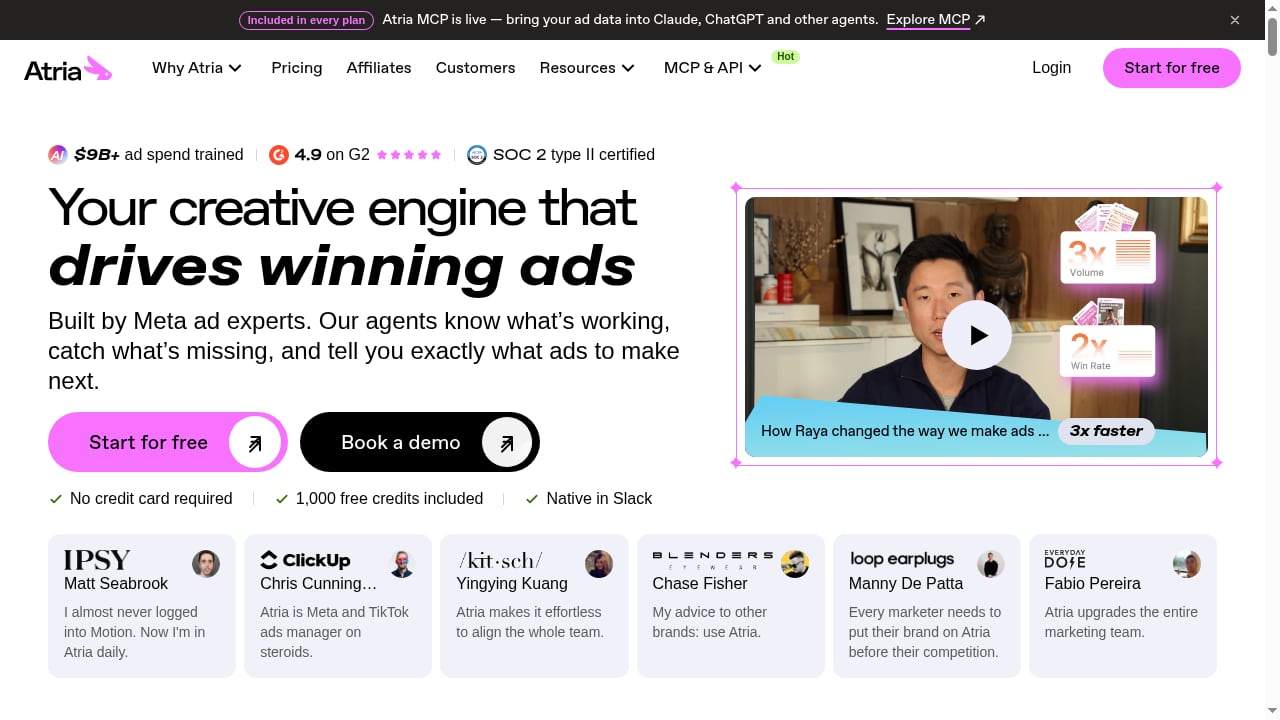
First viewport screenshot of Atria AI: Ship winning Meta ads.
Atria is not a beginner tool. It assumes you already understand ROAS, CTR, hook rate, hold rate, and testing frameworks. The letter-grade creative scoring is useful if you know what an A-grade hook rate looks like in your category, and confusing if you don't.
Good fit:
- Performance teams spending roughly $5K+/month on paid social who need volume and speed.
- Agencies managing multiple brand accounts that want one research and briefing workspace.
- Teams already producing 100+ creatives per month and hitting a bottleneck between insight and brief.
- Brands that want competitor ad intelligence and their own performance data in the same view.
Weak fit:
- Small advertisers under $5K/month in spend, where the price is hard to justify.
- Teams wanting a done-for-you AI video generator. Atria's strength is intelligence and workflow, not video production.
- Anyone who needs a frictionless self-serve trial before committing. The trial is short and limited.
Strengths
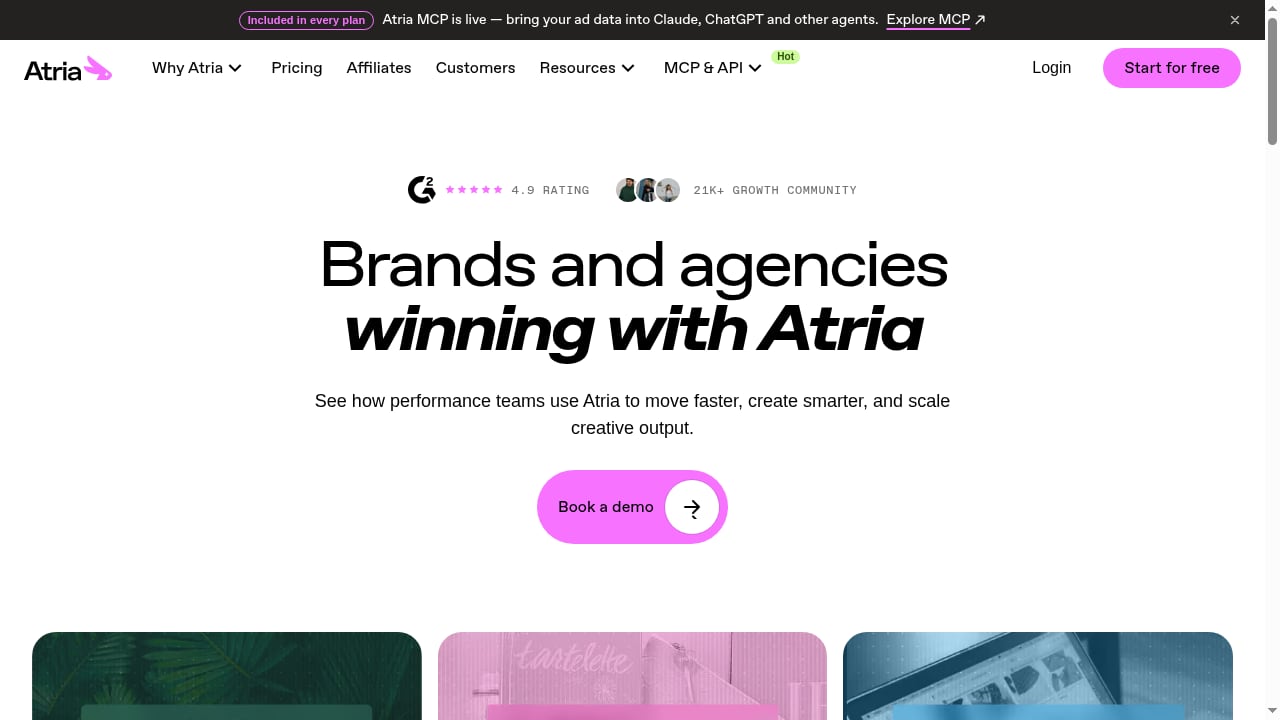
First viewport screenshot of Customers | Atria.
The ad library and semantic search
This is the most consistently praised part of the product. Searching competitor creatives by concept rather than exact keyword is genuinely faster than scrolling Meta Ad Library manually. For teams that build briefs from observed patterns, this alone can replace a dedicated ad spy subscription.
Insight-to-brief compression
The gap between "we found a winning angle" and "here is the brief" is where most creative teams lose days. Atria collapses that into a single flow. Reported outcomes from customers point the same direction: Ipsy reported 2x creative volume and a 25% ROAS increase, Orbitkey reported 2x faster iterations and 21% higher ROAS, and SelfMade reported 33% higher ROAS with 80% faster iterations. Treat vendor-published case studies as directional, not audited, but the pattern is consistent.
Consolidation value
Customers like VaynerCommerce and AGS have publicly described consolidating multiple creative tools into Atria. If you are currently paying for an ad spy tool, a swipe file tool, and a reporting layer separately, the math can work in Atria's favor even at $129/month.
Data portability
REST API access and MCP integration are rare in this category. If your team wants ad performance data inside Claude or ChatGPT workflows, Atria is ahead of most competitors.
Limitations and risks
This is where an honest review has to slow down.
Community review signal is mixed and small
Atria's own marketing cites a 4.9 rating and a 21k+ community. Independent review volume is thin. On G2, users praise ease of use and faster ideation. On Trustpilot, the sample is small but the tone is very different: multiple reviewers report billing without clear consent, a cancellation flow that failed for them, and unresponsive support. One independent review aggregating seven Trustpilot reviews found a 1.9/5 average with five 1-star complaints.
A seven-review sample is not statistically meaningful, and happy enterprise customers rarely post on Trustpilot. But the specific pattern, billing and cancellation friction rather than product quality, is the kind of complaint that recurs across SaaS categories and deserves weight in your decision.
AI clone output quality
Multiple users report that AI-generated ads and clone tools altered product appearance despite explicit instructions not to. If your brand depends on exact product representation, test this before scaling.
Credit-based cost creep
The $129/month Core plan is a floor, not a ceiling. Heavy AI credit usage can require top-up purchases, and credits reportedly do not roll over. Budget for the real monthly number, not the sticker price.
Learning curve
The interface is data-dense. Teams without an analytically oriented creative lead will need ramp time.
Pricing signals
| Plan tier | Entry price | Notes |
|---|---|---|
| Core | $129/mo | Annual billing saves ~20% |
| Higher tiers | Up to ~$479/mo | For larger teams and higher usage |
| Trial | 7 days | No free plan |
Two practical checks before you buy:
- Estimate your monthly AI credit consumption based on creative volume, not seat count.
- Confirm the cancellation process in writing during trial, and screenshot the billing terms.
Setup and time to value
Atria is cloud-based and self-serve. There is no developer setup. Most teams can connect a Meta account and start exploring the ad library within an hour. A Chrome extension lets you save ads from Meta and TikTok Ad Libraries in one click.
Realistic time to value:
- Day 1: Ad library exploration, competitor research, first saved swipe file.
- Week 1: First AI-generated briefs, connect analytics, start scoring live creatives.
- Month 1: Batch launch workflow running, reporting cadence established, credit usage pattern visible.
If you are not seeing brief-to-launch time drop by week three, the tool is not the bottleneck.
How Atria compares to alternatives
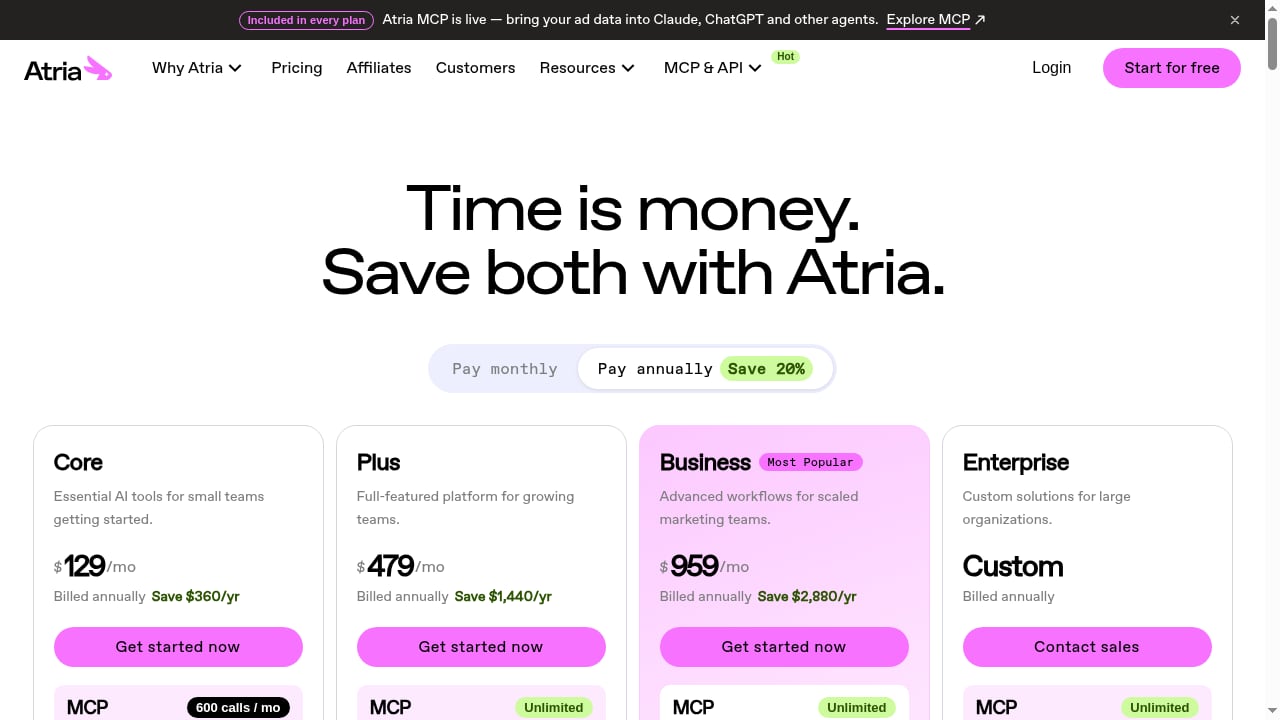
First viewport screenshot of Pricing | Atria.
The natural comparison set is Motion, Foreplay, and GetHookd for creative research and briefing, plus dedicated ad intelligence platforms for competitor data.
- Atria vs. Foreplay: Foreplay is stronger as a swipe file and inspiration tool for solo creators and small teams. Atria goes further into analytics, scoring, and Meta launch.
- Atria vs. Motion: Motion leans into creative analytics and reporting. Atria's differentiator is the combined research plus AI brief plus launch loop.
- Atria vs. dedicated ad spy tools: If you only need competitor ad data, a focused ad intelligence tool may be cheaper. If you need research, briefing, and performance scoring in one place, Atria's consolidation argument is stronger.
For a broader view of how these tools fit together, see our performance marketing tools stack guide and the top ad intelligence and competitive analysis platforms.
Decision criteria: should you buy Atria?
Score yourself honestly:
- Spend $5K+/month on Meta or TikTok? Yes leans toward buy.
- Producing 100+ creatives per month? Yes leans toward buy.
- Need competitor ad intelligence and your own analytics in one view? Yes leans toward buy.
- Want AI video generation? No, look elsewhere.
- Under $5K/month spend and price-sensitive? Probably not yet.
- Need a frictionless trial with no billing risk? Verify cancellation terms first.
If you are building a creative process from scratch, our creative workflow guide for ad teams covers the phases and bottlenecks Atria is designed to compress.
Related reading
- How to Use PrimeSpy with DuoPlus Cloud Phone - Pair PrimeSpy ad intelligence with DuPlus Cloud Phone to research winning ads, then test them safely across isolated Android devices. Full workflow inside.
- PrimeSpy vs AdSpyder vs SellerCenter: Which Ad Spy Tool Wins? - Compare PrimeSpy, AdSpyder, and SellerCenter on ad coverage, tracking, and pricing to find the best ad spy and Shopify research tool for your workflow.
Sources and further reading
- Atria AI Reviews | Read Customer Service Reviews of tryatria.com - Jun 4, 2025 ... 8 people have already reviewed Atria AI. Read about their experiences and share your own!
- Atria AI Reviews 2026: Details, Pricing, & Features - G2 - What do users say? ... Users consistently praise Atria AI for its ease of use and ability to streamline ad creation, allowing for faster ideation and improved ...
- Atria Review 2026: Honest Verdict + 7 Real Trustpilot Reviews | Hack'celeration - We tested Atria across 5 criteria. Real pricing ($129-$479/mo), 7 Trustpilot reviews (avg 1.9/5), honest pros/cons and who it's actually for in 2026.
FAQ
Is Atria worth the price?
For teams spending $5K+/month on paid social and producing high creative volume, the consolidation and speed gains can justify $129/month. For smaller advertisers, the floor price plus credit top-ups is hard to defend.
Does Atria have a free plan?
No. There is a 7-day trial. Budget for a paid plan from day one after the trial.
What is Raya in Atria?
Raya is Atria's AI agent, trained on aggregate ad spend data, used for ideation and brief generation across paid plans.
Can I use Atria data in Claude or ChatGPT?
Yes. Atria offers an MCP integration and REST API access, so ad data can flow into AI agents like Claude and ChatGPT.
What do negative Atria reviews say?
The recurring complaints are billing without clear consent, a cancellation flow that failed for some users, unresponsive support, and AI clone tools altering product appearance. The sample is small, but the pattern is specific enough to verify during trial.
Does Atria replace my ad spy tool?
For many teams, yes. The semantic ad library search covers the core ad spy use case. If you need deep cross-platform coverage beyond Meta and TikTok, you may still want a dedicated tool. See our TikTok and Facebook ad spy tool comparison.
Conclusion
Atria is a real product with a real workflow advantage: it compresses research, briefing, launch, and scoring into one loop, and its API and MCP access put it ahead of most creative tools on data portability. The customer case studies point to meaningful ROAS and iteration gains for teams already operating at volume.
The caveats are equally real. Pricing starts at $129/month with credit-based cost creep, the trial is short, and independent review volume is small with a documented pattern of billing and support complaints. None of that makes Atria a bad buy. It makes it a buy you should test deliberately: run the trial with your actual creative volume, confirm cancellation terms in writing, and measure brief-to-launch time before you commit annually.
If you fit the profile, high spend, high creative volume, Meta and TikTok focus, Atria is one of the more complete options in its category. If you do not, start with a cheaper research tool and revisit when your volume justifies the stack.