
Creative Workflow: A Practical Guide for Ad Teams
A creative workflow is the repeatable path your team follows from first idea to finished asset. When it works, nobody talks about it. When it breaks, you get missed deadlines, endless revision loops, and campaigns that launch late with creative nobody agreed on.
This guide breaks the creative workflow into its real phases, shows where it usually breaks, and explains how to add research and competitor tracking so your team produces ads that actually perform, not just ads that ship on time.
What a creative workflow actually is
Creative Workflow: A Practical Guide for Ad Teams - What a creative workflow actually is.
A creative workflow is the step-by-step process that moves a project from request to delivery. It defines how work is briefed, who produces it, how it gets reviewed, and where the final files live.
It is not the same as general project management. Creative work has specific traits that generic processes handle badly:
- Subjective feedback. "Make it pop" is not actionable. Workflows need a way to turn opinions into decisions.
- Multiple rounds of iteration. Ads, videos, and designs rarely pass in one review.
- Ripple effects. A change in messaging touches every asset in a campaign.
- Volume. Performance teams produce dozens of ad variations per month, not one hero asset per quarter.
The goal is not to make creative work rigid. It is to remove the admin noise so people can spend their time creating.
The five phases of a creative workflow
Creative Workflow: A Practical Guide for Ad Teams - The five phases of a creative workflow.
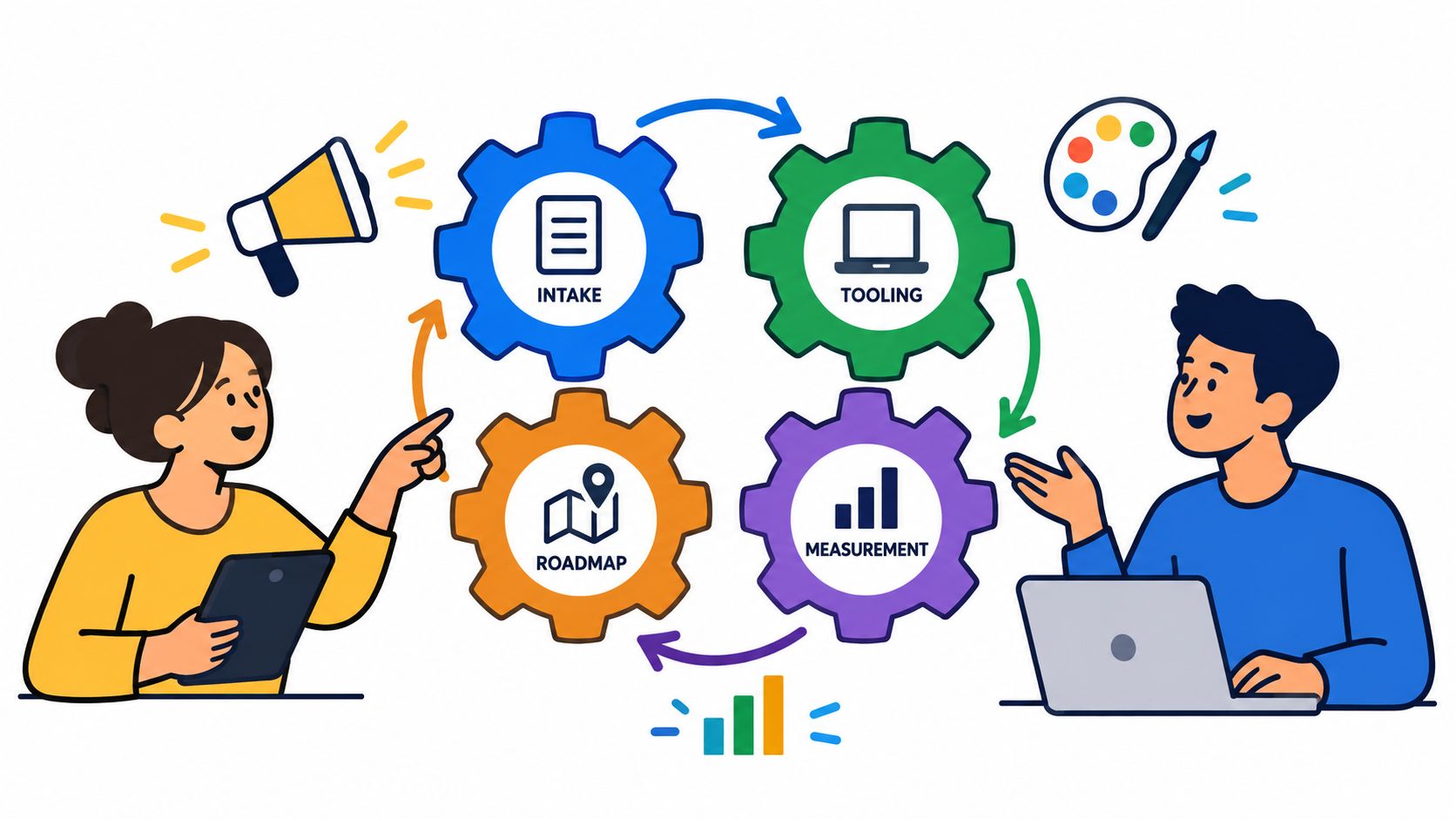
Most creative workflows follow the same arc, whether you are producing a brand video or twenty static ad variations.
1. Intake and the creative brief
This is where the project is defined. A good brief answers:
- What problem are we solving?
- Who is the audience?
- What is the core message or angle?
- Which channels will this run on?
- What does success look like, and by when?
For ad creative, the brief should also include the research behind the angle. Which competitor ads inspired it? What hook is being tested? What is the hypothesis? Without this, designers and editors are guessing, and you get revision rounds that could have been avoided.
2. Triage and scheduling
Not every request deserves the same resources. Triage means deciding what gets made, in what order, and by whom.
At this stage you set milestones, assign owners, and map dependencies. If the copy is late, the design slips. If the design slips, the review window shrinks. Seeing those dependencies on a timeline prevents the classic end-of-month panic.
3. Production
This is the hands-on phase: writing, designing, shooting, editing, building. It works best when:
- Everyone works from the same current version.
- Feedback is attached to the asset, not buried in a chat thread.
- Tasks have clear owners and deadlines.
For ad teams, production usually means producing variations, not a single asset. That makes templates and naming conventions essential. A folder full of files called final_v3_actualfinal is a workflow problem, not a personality problem.
4. Review and approval
This is where most creative workflows break down. Common failure modes:
- Feedback arrives through five different channels.
- Stakeholders see the work for the first time late in the process and request major changes.
- Nobody is sure who has final sign-off.
- Approval chains include people who do not need to be there.
Fix this by defining early who reviews, at what stage, and who has the final say. Consolidate feedback into one place. Set realistic revision limits so the process has an endpoint.
5. Delivery and archival
When the asset ships, the workflow is not over. Tag and store finished work so it can be found and reused. For ad teams, this matters more than for most: winning creative gets refreshed, adapted, and localized constantly. If your archive is a mess, you rebuild from scratch every time.
Where creative workflows break, and how to fix them
Creative Workflow: A Practical Guide for Ad Teams - Where creative workflows break, and how to fix them.
| Bottleneck | What it looks like | Fix |
|---|---|---|
| Chaotic intake | Requests arrive via chat, email, and hallway conversations | Standard intake form with required fields |
| Unclear ownership | Two people think the other is handling it | Named owner per task, visible to all |
| Feedback sprawl | Comments in email, chat, and annotated files | One review surface per asset |
| Approval bloat | Ten reviewers, no decision-maker | Defined approver and escalation path |
| Version confusion | Multiple "final" files | Single source of truth and naming rules |
| Weak research | Creative is based on opinion, not evidence | Structured ad research before briefing |
Notice that only one row is about tools. Most workflow problems are decision problems wearing a software costume.
Adding ad research to your creative workflow
Creative Workflow: A Practical Guide for Ad Teams - Adding ad research to your creative workflow.
For performance marketing teams, the creative workflow has an extra phase that general guides ignore: research. Before you brief a new ad, you need to know what is already working in your market.
This is where competitor ad tracking fits. Instead of brainstorming hooks in a vacuum, you study live ads to see which angles, formats, and offers are running at scale.
A tool like PrimeSpy supports this step by letting you search a large ad database across Meta and TikTok, filter by advertiser, keyword, or URL, and track competitors' new creatives as they launch. Signals like ad longevity, duplication across accounts, and creative refreshes help you separate tested winners from one-off experiments. You can also set up ad trackers with email notifications so new competitor creative lands in your workflow instead of being discovered three weeks late.
That research feeds directly into the brief. Instead of "make three ad variations," the brief becomes "test two proven hooks against one new angle, with the winning format from this competitor's longest-running ad." That is a workflow improvement that shows up in results, not just in process diagrams.
If you are comparing research tools before committing, this breakdown of ad intelligence and competitive analysis platforms covers coverage, tracking, and pricing differences.
A practical example: monthly ad creative cycle
Here is how the phases fit together for a team shipping ad creative every month.
Week 1 — Research and brief. Review competitor activity, note new angles and formats, and write briefs with a clear hypothesis per concept.
Week 2 — Production. Produce variations against the brief. Use templates so the team focuses on the message, not the file setup.
Week 3 — Review and approval. Consolidated feedback, one revision round, defined approver.
Week 4 — Launch and archive. Ship, tag assets, and log what was tested. The log becomes the input for next month's research.
The loop matters. Each cycle should make the next brief sharper. Teams that treat research as a one-time setup task lose that compounding effect.
Choosing tools without overbuilding
A creative workflow needs four capabilities, and they do not all have to live in one platform:
- Task and timeline tracking so work is visible.
- Asset collaboration so everyone works from the current version.
- Review and approval so feedback becomes decisions.
- Ad research so creative is grounded in evidence.
Start with what you have. If your team already lives in a project tool, fix the process inside it before buying anything new. Add specialized tools only where the gap is real. For many performance teams, the real gap is research, not project management.
If you want to see how research and production tools connect end to end, this walkthrough of combining ad intelligence with a swipe file workflow shows how to find, save, and organize winning ads in one repeatable loop.
Best practices that hold up
- Make status visible. If people have to ask where something stands, your workflow is leaking time.
- Automate the boring parts. Notifications, deadline flags, and status updates should not be manual.
- Template recurring work. Standard briefs and asset structures cut revision rounds.
- Keep approval chains short. Include only people who genuinely need to review.
- Build in research time. It is the cheapest way to improve creative quality.
- Review the workflow itself. Once a quarter, ask where work stalled and why.
For broader context on how structured workflows affect delivery, see this guide to creative workflow management and this overview of workflow phases and tools.
Related reading
- Top 10 TikTok & Facebook Ad Spy Tools 2026 - Compare the 10 best TikTok and Facebook ad spy and analytics platforms of 2026 on coverage, data freshness, analytics depth, and pricing.
- How to Use PrimeSpy with Cropink: Spy Ads to DPA Workflow - Learn how to use PrimeSpy with Cropink: find winning ad angles, then turn product feeds into high-converting dynamic catalog ads in one workflow.
- PrimeSpy vs Atria vs Vibemyad: Winning Ad Campaign Tools - Compare PrimeSpy, Atria, and Vibemyad for tracking and analyzing winning ad campaigns. See coverage, analytics depth, pricing, and which tool fits your workflow.
Sources and further reading
- How to build a creative workflow that really flows - Discover how to build a seamless creative workflow using practical strategies and tools. Get tips for collaboration and creative project management.
FAQ
What is the difference between a creative workflow and project management?
Project management covers scheduling, resources, and delivery across many types of work. A creative workflow is narrower: it handles the specific realities of creative production, including iteration, subjective feedback, and version control.
How many phases should a creative workflow have?
Most teams work well with five: brief, scheduling, production, review and approval, and delivery. You can split production into pre-production, production, and post-production if you handle video, but keep the overall structure simple.
Where do most creative workflows fail?
Review and approval. Fragmented feedback, unclear approvers, and late stakeholder input cause most delays. Fixing this one phase usually produces the biggest time savings.
Do small teams need a formal creative workflow?
Yes, but lighter. Even a two-person team benefits from a standard brief, one review surface, and a naming convention. The point is repeatability, not bureaucracy.
How does competitor ad research fit into a creative workflow?
It sits before the brief. Studying live competitor ads tells you which angles and formats are already validated, so your team tests informed concepts instead of starting from zero.
How often should a creative workflow be reviewed?
Quarterly is a reasonable default. Look at where projects stalled, which phases caused the most delays, and whether the process still matches how the team actually works.
Conclusion
A creative workflow is not a constraint on creativity. It is the structure that protects creative time from admin chaos. Define your phases, shorten your approval chains, and treat research as a first-class step rather than an afterthought.
Start with the phase that hurts most. For most ad teams, that is either review and approval or the research that happens before the brief. Fix one, measure the difference, then fix the next.