
Performance Marketing Tools: The 2026 Stack Guide
Performance marketing tools are software that plan, run, measure, or optimize campaigns against outcomes you can track: clicks, leads, sales, pipeline, ROAS. The pressure to prove cross-channel impact keeps rising, and third-party signals keep fading, so the stack you choose matters more than the number of tools you own. This guide breaks the category down by job to be done, shows where ad intelligence fits, and explains how to build a stack that actually proves performance.
What counts as a performance marketing tool
Performance Marketing Tools: The 2026 Stack Guide - What counts as a performance marketing tool.
A performance marketing tool is any software that helps you tie spend to a measurable result. That definition is deliberately broad because the category spans five distinct jobs:
- Media buying and delivery: ad platforms such as Google Ads, Meta Ads Manager, TikTok Ads, and programmatic DSPs.
- Measurement and attribution: analytics, incrementality testing, and multi-touch attribution platforms.
- Creative and campaign operations: tools that produce, test, and iterate ad variants at scale.
- Ad intelligence and competitor research: platforms that reveal what competitors are running, how long ads have been live, and which creatives are scaling.
- Reporting and decisioning: dashboards, BI layers, and marketing intelligence platforms that unify data across channels.
Most teams do not need one tool that does everything. They need coverage across all five jobs without creating another data silo.
Why the stack is shifting in 2026
Performance Marketing Tools: The 2026 Stack Guide - Why the stack is shifting in 2026.
Two forces are reshaping tool choices.
First, signal loss. Cookie deprecation, privacy regulation, and platform over-reporting have made last-click attribution unreliable. According to the IAB's State of Data 2024 report, 76% of brands and agencies are investing or planning to invest in new forms of multi-touch attribution. That pushes budget toward platforms that blend first-party data with independent measurement.
Second, creative velocity. Paid social remains the fastest-growing major channel in many markets, and platforms reward fresh creative. Teams that can spot which angles are working across Meta, Instagram, and TikTok, and refresh them faster than competitors, tend to win auctions at lower cost.
Both forces point to the same conclusion: measurement and ad intelligence are no longer optional add-ons. They are core infrastructure.
The five jobs, and the tools that do them
Performance Marketing Tools: The 2026 Stack Guide - The five jobs, and the tools that do them.
1. Attribution and analytics
This is the heartbeat of performance. The goal is to connect ad spend to revenue across channels, not just within one platform.
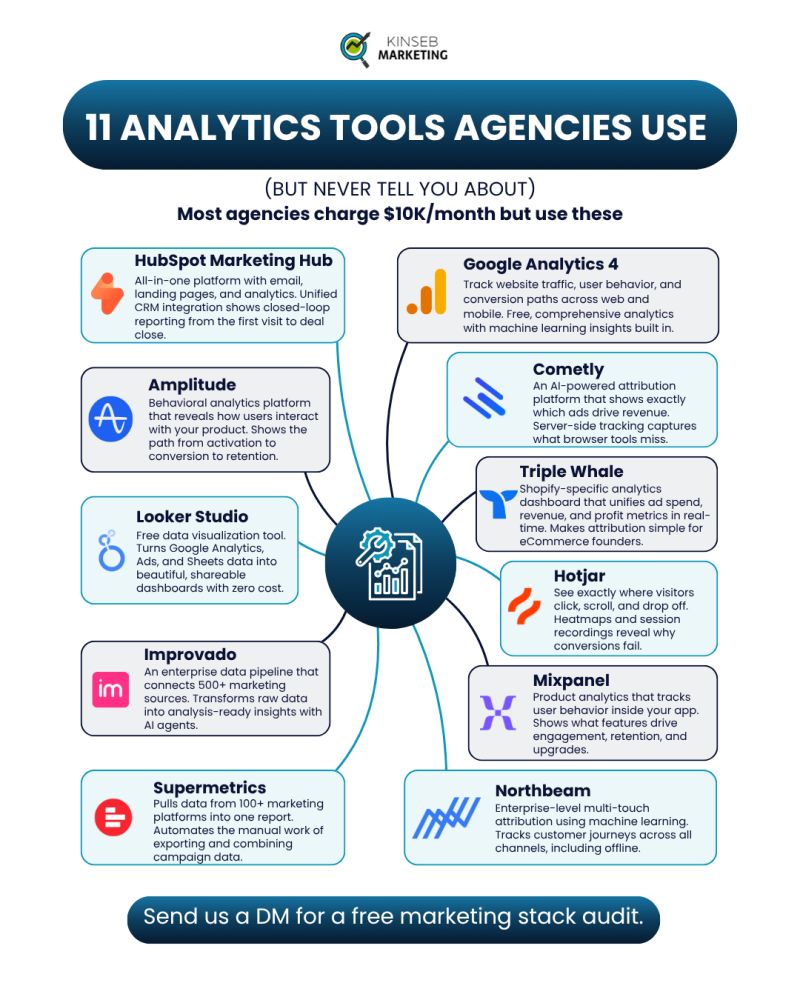
- Ecommerce attribution: Triple Whale connects Meta, TikTok, and Google Ads spend to Shopify orders, with blended ROAS and MER dashboards. It is built for lean Shopify teams that need daily budget decisions.
- Complex funnels: Hyros specializes in longer consideration cycles where calls, emails, and multi-step checkouts matter. It ties touchpoints back to specific ads.
- B2B visitor identification: Tools like Lead Forensics match anonymous traffic to companies, turning "LinkedIn drove 1,200 sessions" into "LinkedIn brought 40 target-sector companies to the pricing page."
Attribution tools are powerful, but they can become another silo if they do not feed a shared reporting layer. That is why many teams pair them with a marketing intelligence platform that normalizes data across sources.
2. Campaign management and creative testing
These tools build, target, and iterate creative at scale so bids, budgets, and variants update with fewer manual steps.
- VWO is best for accessible website and landing page testing. Its visual editor lets non-technical marketers run A/B tests, layer heatmaps, and ship winning variations without developer time.
- Smartly.io turns product feeds into hundreds of on-brand ad variations across Facebook, Instagram, TikTok, and Pinterest, updating automatically as price, stock, or images change.
Creative testing tools tell you what works once it is live. They do not tell you what competitors are already scaling. That is where ad intelligence comes in.
3. Ad intelligence and competitor tracking
Ad intelligence platforms reveal the ads competitors are running, how long they have been live, and which creatives are being duplicated or refreshed. For performance marketers, this is upstream research: it shapes the brief before a single dollar is spent.
PrimeSpy is an ad spy and ad intelligence platform built for this job. It offers a searchable database of over 120 million ads across Meta (Facebook, Instagram), TikTok, and the Meta Ad Library, with smart search by keyword, URL, or advertiser. Advanced filters include EU-specific options, and creative signals such as reach, spend, and duplicates help separate tested winners from noise.
Beyond search, PrimeSpy tracks competitors in real time. Ad trackers surface new creatives, landing page changes, product updates, and creative refreshes, with 24/7 monitoring and email notifications. For ecommerce teams, it also supports research across platforms like Shopify, WooCommerce, Shoplazza, Shopline, Magento, and Cafe24, which helps validate product ideas before you commit inventory or media budget.
If you are comparing ad intelligence options, our breakdown of the top 10 ad intelligence and competitive analysis software in 2026 covers coverage, creative data, spend estimates, and pricing side by side. For a narrower comparison focused on TikTok and Facebook, see the top 10 TikTok and Facebook ad spy tools.
4. Affiliate and partnership platforms
Affiliate and partner programs turn trusted voices into a performance channel. The best tools make it simple to recruit, track, and pay partners while giving marketers a clean view of revenue impact.
- LeadDyno helps brands launch affiliate programs without heavy setup, with flexible commission rules and payout automation.
- PartnerStack is built for B2B SaaS growth through affiliate and reseller programs.
These platforms are most useful when their revenue data flows into the same reporting layer as paid media, so you can compare cost per acquisition across channels on equal footing.
5. Reporting and marketing intelligence
A marketing intelligence platform unifies data from ad platforms, analytics, CRM, and attribution tools, then normalizes it so you can compare campaign performance across channels. This is the layer that turns disconnected dashboards into decisions.
Without it, every tool adds another silo. With it, you can move budget toward what performs and cut what does not, at the pace of results rather than the pace of monthly reporting.
How to choose: a practical decision framework

Performance Marketing Tools: The 2026 Stack Guide - How to choose: a practical decision framework.
Use these questions to evaluate any performance marketing tool.
- Which job does it own? If a tool tries to cover three jobs poorly, it will create more work than it saves. Pick specialists for execution and a unifier for reporting.
- Where does its data go? If the tool cannot export clean data to your BI layer or warehouse, it will become a silo. Prioritize tools with clear export paths and integrations.
- Does it measure incrementality or just correlation? Attribution tools that only report last-click will mislead you as signal loss continues. Look for multi-touch or incrementality testing options.
- How fresh is the ad intelligence data? For competitor research, freshness matters more than volume. A database of 120 million ads is only useful if the ads you care about are indexed quickly and updated continuously.
- What is the true cost at your scale? Entry pricing often hides usage-based fees. Model your monthly spend at realistic volumes before committing.
- Does it fit your team's workflow? A tool that requires a data engineer to operate is not a performance marketing tool for a lean team. It is a project.
A sample stack for a lean ecommerce team
Here is how the pieces fit together for a Shopify brand running paid social on Meta and TikTok.
- Ad intelligence: PrimeSpy for competitor ad research, creative signal analysis, and product validation across ecommerce platforms. Start with the free trial (500 credits, 2 ad trackers, no credit card) to test coverage against your niche.
- Attribution: Triple Whale for blended ROAS and MER dashboards tied to Shopify orders.
- Creative testing: VWO for landing page tests, plus native ad platform testing for creative variants.
- Reporting: A marketing intelligence layer or BI dashboard that pulls spend and revenue into one view.
The workflow: research winning angles in PrimeSpy, brief creative, test on landing pages and ad platforms, measure with attribution, then feed results back into the next research cycle. For a deeper look at how research feeds execution, see our guide to building a creative workflow that moves from brief to launch.
Common mistakes when building a performance stack
- Buying tools before defining the job. Start with the decision you need to make, then find the tool that supports it.
- Ignoring ad intelligence until after launch. Competitor research is cheapest before you spend, not after.
- Treating attribution as a single source of truth. No platform sees everything. Blend first-party data with independent measurement.
- Letting reporting lag behind spending. If you cannot see results within a day or two, you are optimizing on stale information.
- Over-tooling a small team. Three well-integrated tools beat ten disconnected ones.
Related reading
- How to Use PrimeSpy with DuoPlus Cloud Phone - Pair PrimeSpy ad intelligence with DuPlus Cloud Phone to research winning ads, then test them safely across isolated Android devices. Full workflow inside.
- PrimeSpy vs AdSpyder vs SellerCenter: Which Ad Spy Tool Wins? - Compare PrimeSpy, AdSpyder, and SellerCenter on ad coverage, tracking, and pricing to find the best ad spy and Shopify research tool for your workflow.
- PrimeSpy vs Niche Scraper: Which Spies Winning Products? - Compare PrimeSpy and Niche Scraper for finding winning products. See ad coverage, tracking, pricing, and which tool fits dropshipping and ecommerce research.
Sources and further reading
- What AI tools are you using to help with performance marketing? - Apr 23, 2025 ... Tagshop AI - A smart AI tool that helps performance marketers to create high quality ai ugc video ads for their marketing campaign with just by ...
- Best performance marketing tools in 2026 - Discover the top performance marketing platforms for 2026 to boost ROI, streamline workflows and optimize campaign performance.
- Performance Marketing Software: 10 Tools B2B Teams Use - Here are ten indispensible tools if you're running performance marketing campaigns in B2B - these will help you understand what's working.
FAQ
What is the difference between a performance marketing tool and an ad intelligence tool?
A performance marketing tool helps you run, measure, or optimize campaigns against outcomes. An ad intelligence tool focuses on competitor research: what ads are running, how long they have been live, and which creatives are scaling. Ad intelligence informs the brief; performance tools execute and measure it.
Do I need both attribution software and ad intelligence software?
They solve different problems. Attribution tells you what your own campaigns produced. Ad intelligence tells you what competitors are doing and which angles are working in your market. Most teams benefit from both, especially in paid social where creative velocity drives results.
How much should a small team spend on performance marketing tools?
It depends on channel mix and volume. A lean ecommerce team can start with a free or low-cost ad intelligence plan, a mid-tier attribution tool, and free analytics. As spend grows, add creative testing and a reporting layer. The goal is coverage across the five jobs, not maximum tool count.
Can I use ad intelligence tools for product research?
Yes. Platforms like PrimeSpy support ecommerce research across Shopify, WooCommerce, Shoplazza, Shopline, Magento, and Cafe24. You can validate product ideas by seeing which products competitors are actively advertising and how their creatives evolve over time.
How often should I refresh competitor ad research?
For fast-moving categories, weekly at minimum. For evergreen products, monthly may be enough. Real-time monitoring with email notifications helps you catch new creatives and landing page changes as they happen, rather than after the fact.
Conclusion
The best performance marketing stack in 2026 is not the biggest one. It is the one that covers the five jobs, connects data across channels, and gives you a clear view of what is working before you spend the next dollar. Attribution and analytics tell you what happened. Creative testing tells you what could work. Ad intelligence tells you what is already working for competitors. Put those together, and you have a system that proves performance instead of guessing at it.