
WinningHunter Review 2026: Ad Spy and Product Research, Tested
WinningHunter sells itself as a way to "build, launch, scale your next winning store," backed by a large ad library and Shopify store tracking. That pitch is easy to market and hard to verify. This review focuses on what the tool actually does well, where the evidence gets thin, and how to decide whether a subscription earns its place in your weekly research routine.
What WinningHunter actually is
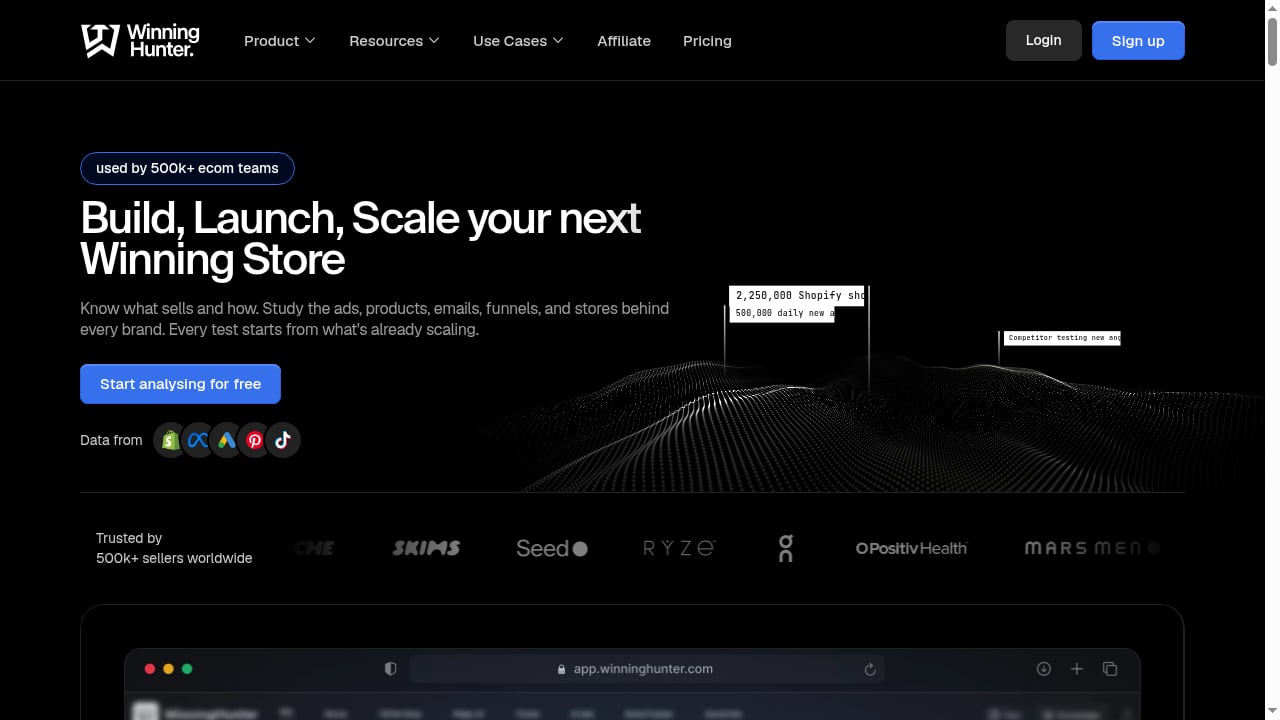
First viewport screenshot of winninghunter.com.
At its core, WinningHunter is two products bolted together:
- An ad library that aggregates ads across Meta, TikTok, Pinterest, and Google, with filters for niche, country, days running, page type, and store visitor estimates.
- A store and brand tracker that monitors Shopify stores and surfaces revenue estimates, active ads, and funnel structure, plus TikTok Shop analytics for top-selling products and creators.
It also exposes an API and MCP integration, so you can query the database from ChatGPT, Claude, or another AI assistant instead of clicking through the UI. That last piece matters more than it sounds: research speed is the whole value proposition here.
Who should consider it
First viewport screenshot of Ecommerce Insights: Ads, Products & Trends | Winning Hunter.
WinningHunter fits a specific buyer profile. If you recognize yourself below, it is worth a trial.
- Shopify sellers and dropshippers who validate several product ideas every week and need to reject weak ones fast.
- TikTok Shop operators who want to see which products and creators are moving before the niche saturates.
- DTC brands and agencies doing competitor ad research across multiple platforms and markets.
- AI-forward teams that would rather ask a model a question than build a filter stack.
Who should look elsewhere? Complete beginners who have not yet run a single product test, one-time researchers who need a single answer and not a workflow, and anyone expecting the tool to hand over guaranteed winners. No ad spy does that, and the marketing around "winning products" sets an expectation the data cannot meet.
Strengths worth paying for
First viewport screenshot of winninghunter.com.
Breadth of ad coverage in one place
Most competitors lean heavily on Meta. WinningHunter's pitch spans Meta, TikTok, Pinterest, and Google, which is useful if your creative research crosses platforms. A product that looks dead on Facebook may be scaling on TikTok, and having both in one filter set saves tab-hopping.
Store and funnel context, not just ads
The store tracker adds the layer that pure ad libraries miss: what the landing page, offer, and funnel look like behind the creative. For competitor teardowns, that context is often more instructive than the ad itself.
AI and MCP access
Querying the database through an AI assistant is a genuine workflow shift. Instead of manually stacking filters, you can ask a structured question and iterate. Teams that already work inside ChatGPT or Claude will feel the difference immediately; teams that do not will ignore it.
Fast rejection of bad ideas
The most honest use of WinningHunter is negative selection. It helps you cross products off a shortlist quickly. That sounds unglamorous, but it is where research time actually goes.
Limitations and accuracy concerns
This is where a credible review has to slow down.
Revenue estimates are estimates
The store tracker's revenue figures are modeled, not reported. Public discussion has been blunt about this. In a dropshipping community thread on sale tracker accuracy, sellers described the tool attributing six-figure monthly revenue to stores doing a fraction of that, in one case claiming roughly £220k for a site barely making one organic sale a month. Anecdotes are not a rigorous audit, but they are consistent enough to treat revenue numbers as directional signals, never as facts.
Ad longevity is a signal, not proof
An ad running for 60 days suggests it is not losing money, but it does not tell you the margin, the offer, or whether the advertiser is running it at a loss for testing. Treat long-running ads as hypotheses to investigate.
Manual verification is still mandatory
Trend freshness, supplier fit, shipping cost, and margin assumptions all sit outside the tool. Budget time for that work; the subscription does not remove it.
Plan limits shape the experience
Filter depth and feature access vary by tier, so the cheapest plan may not support the workflow you actually want. Check limits before committing to an annual term.
Pricing signals
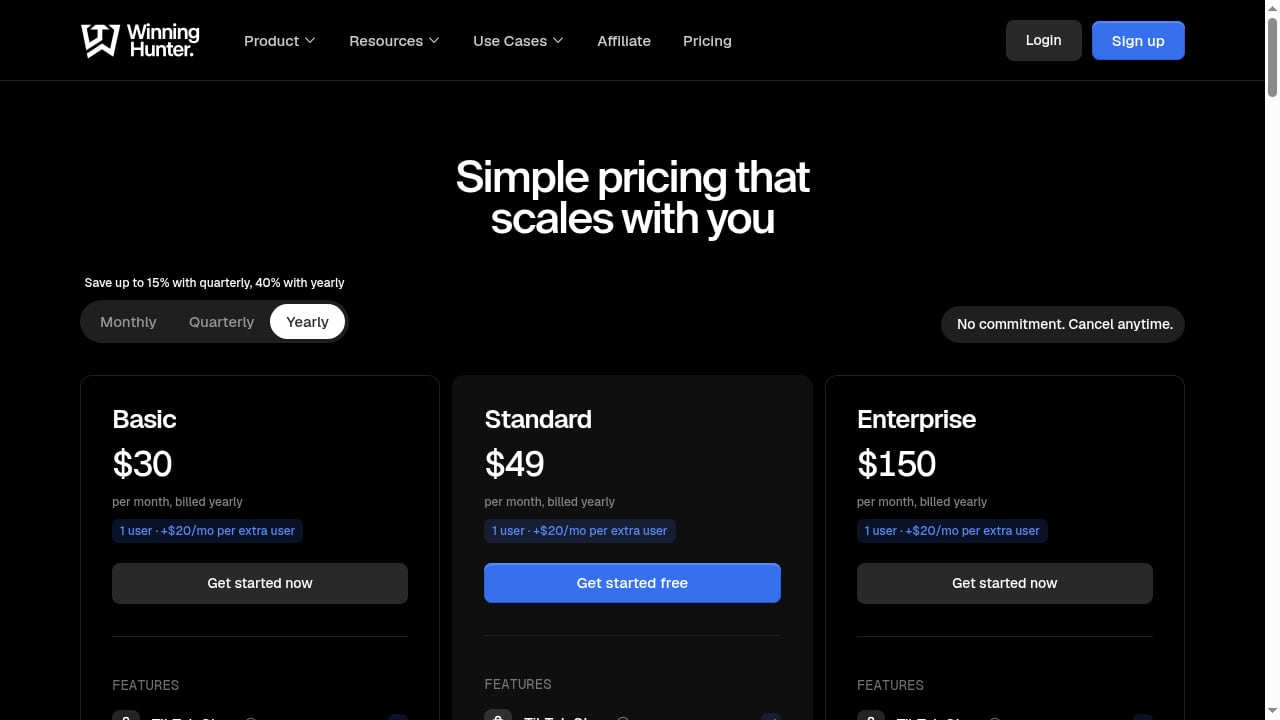
WinningHunter's entry point has been advertised around $30/month billed annually, with additional users at roughly $20/month each, scaling to Standard and Enterprise tiers. Independent review hubs have reported higher list prices at times, including Basic around $49, Standard around $79, and Enterprise around $249 per month. Pricing moves, discounts are common, and currency and billing terms change the effective cost.
The practical takeaway: do not budget from a blog post. Check the official pricing page on the day you buy, and prefer a monthly term for the first cycle unless you have already validated the workflow.
Setup and a realistic first workflow
Setup is light. Create an account, pick a niche and country, and start with a narrow filter rather than a broad browse. A workflow that respects the tool's strengths looks like this:
- Define a rejection rule before you open the tool. For example: no products under 30 days of ad activity, no stores with fewer than three active creatives, no categories you cannot source at a viable margin.
- Pull a shortlist using niche, country, price range, and days running.
- Cross-check the store for funnel quality, offer structure, and whether the catalog looks like a real brand or a test store.
- Verify outside the tool. Check the supplier, shipping time, and landed cost. Recalculate the margin yourself.
- Write one creative hypothesis per surviving product and move it into testing.
If that loop does not save you meaningful time in the first month, the subscription is not justified.
How it compares to alternatives
First viewport screenshot of winninghunter.com.
The honest comparison depends on your primary job.
- If you mainly need ad creative inspiration and swipe files, a dedicated ad library tool may serve you better. See our roundup of ad library and creative saver tools.
- If you need deep Shopify store spying, compare store-tracking depth before paying for ad coverage you will not use.
- If you are weighing broader options, our dropshipping analytics and competitor research ranking covers data coverage and pricing side by side.
- If TikTok and Meta ad intelligence is your core need, PrimeSpy's TikTok and Meta ad spy tool is a focused alternative worth benchmarking against WinningHunter's wider but shallower coverage.
Decision criteria: buy or skip
Ask yourself four questions before subscribing:
- How often do you research products? Weekly or more: the math works. Once a quarter: it does not.
- Which signal do you trust most? If you rely on revenue estimates, be cautious. If you rely on ad longevity, creative patterns, and funnel structure, the tool is more defensible.
- Will you use the AI/MCP layer? If yes, it is a differentiator. If no, you are paying for a feature you will ignore.
- Have you tested the workflow on a monthly plan? Do that before any annual commitment.
Related reading
- Top 10 Ad Creative Management & Competitor Ad Tracking Tools 2026 - We ranked the 10 best ad creative management and competitor ad tracking software for 2026 by platform coverage, data depth, workflow fit, and pricing.
- How to Use PrimeSpy with Proxies.sx for Ad Spy Research - Combine PrimeSpy ad intelligence with Proxies.sx 4G/5G mobile and residential IPs to verify competitor funnels by region, device, and connection type.
- PrimeSpy vs AdSpy vs Dropispy: 2026 Ad Spy Comparison - Compare PrimeSpy, AdSpy, and Dropispy on ad database, filters, platforms, pricing, and workflow fit to pick the right ad spy tool for 2026.
Sources and further reading
- Read Customer Service Reviews of winninghunter.com - Trustpilot - Reviews shaping this summary ... Customer Service is great! I forgot to cancel the subscription, was charged, but they gladly gave me a refund. TY winning hunter.
- Winning Hunter Review 2026: Pricing, Workflows, Alternatives & Verdict - Independent Winning Hunter Review 2026 hub covering pricing, workflows, alternatives, features, API facts, FAQ, and whether the tool is worth testing.
FAQ
Is WinningHunter accurate?
Ad data is generally more reliable than revenue estimates. Store revenue figures are modeled and have been disputed publicly by store owners. Use them as directional signals and verify independently.
Is WinningHunter good for beginners?
It is better suited to sellers who already run product tests regularly. Beginners may get more value from structured education first, then a tool once they have a repeatable process.
Does WinningHunter have a free trial?
Trial terms and account limits change. Check the official site for current entry conditions before signing up.
What is WinningHunter's MCP integration?
It lets AI assistants query the WinningHunter database directly, so you can run research prompts in ChatGPT, Claude, or similar tools instead of manual filtering.
Is WinningHunter worth it?
It is worth testing if product research is a weekly habit and you need faster rejection of weak ideas. It is not worth it if you expect guaranteed winners or only research occasionally.
Conclusion
WinningHunter is a legitimate research tool with a real workflow behind it: broad ad coverage, store-level context, TikTok Shop analytics, and an AI query layer that genuinely speeds things up. Its weakness is the same as its marketing: modeled revenue numbers invite overconfidence, and public seller reports suggest those figures can be badly wrong.
Buy it as a validation system, not an oracle. Test one real workflow on the lowest plan that supports it, verify every shortlisted product manually, and let the time savings decide. If the tool helps you say no to bad ideas faster, it has earned its subscription. If it only helps you browse, it has not.