
Minea AdSpy Review: Is It the Right Product Research Tool for Ecommerce and Dropshipping?
Minea is one of the most visible names in ecommerce ad research, and it is often described as a leading adspy tool for dropshipping and ecommerce products. That description is partly earned and partly marketing. Minea does not sell products or run campaigns for you. It compresses the messy work of finding ads, products, shops, and suppliers into searchable views, then adds filters, tracking, and AI-assisted analysis on top.
This review looks at what Minea actually does, where it fits in a real research workflow, what the pricing signals suggest, and when a different tool or a free alternative makes more sense. The goal is not to repeat the homepage claims, but to help you decide whether Minea will change what you ship and test.
What Minea is and what it is not
First viewport screenshot of Dropshipping with Minea: Blog of winning strategies.
Minea is a web-based product and advertising research platform for dropshippers and ecommerce operators. Its main workspace is divided into Ads, Products, and Shops, with additional layers for brand tracking, notifications, saved collections, supplier discovery, and AI-assisted search.
What it does well:
- Surfaces active and historical ads across Meta, TikTok, and Pinterest, with run dates, engagement signals, and spending-related estimates.
- Connects ads to the products and stores behind them, so you can inspect an offer instead of just a creative.
- Lets you filter by platform, country, language, date, engagement, and activity.
- Supports watchlists and notifications so a one-off search can become ongoing tracking.
- Adds AI tools such as Magic Search, ad analysis, and transcripts to reduce manual reading.
What it does not do:
- It does not show true conversion data such as CPA, ROAS, or profit per purchase. Those metrics are not publicly exposed.
- It does not manage your campaigns. You still build and run tests in Meta Ads Manager, TikTok Ads Manager, or another platform.
- It does not guarantee a winning product. Its "winning product" labels are clues to investigate, not sales guarantees.
- It does not replace supplier, shipping, returns, margin, and legal checks.
That distinction matters. Minea sits in the research layer. It helps you answer one practical question: what are other ecommerce sellers running right now, and what patterns keep showing up over time?
Who Minea is actually for
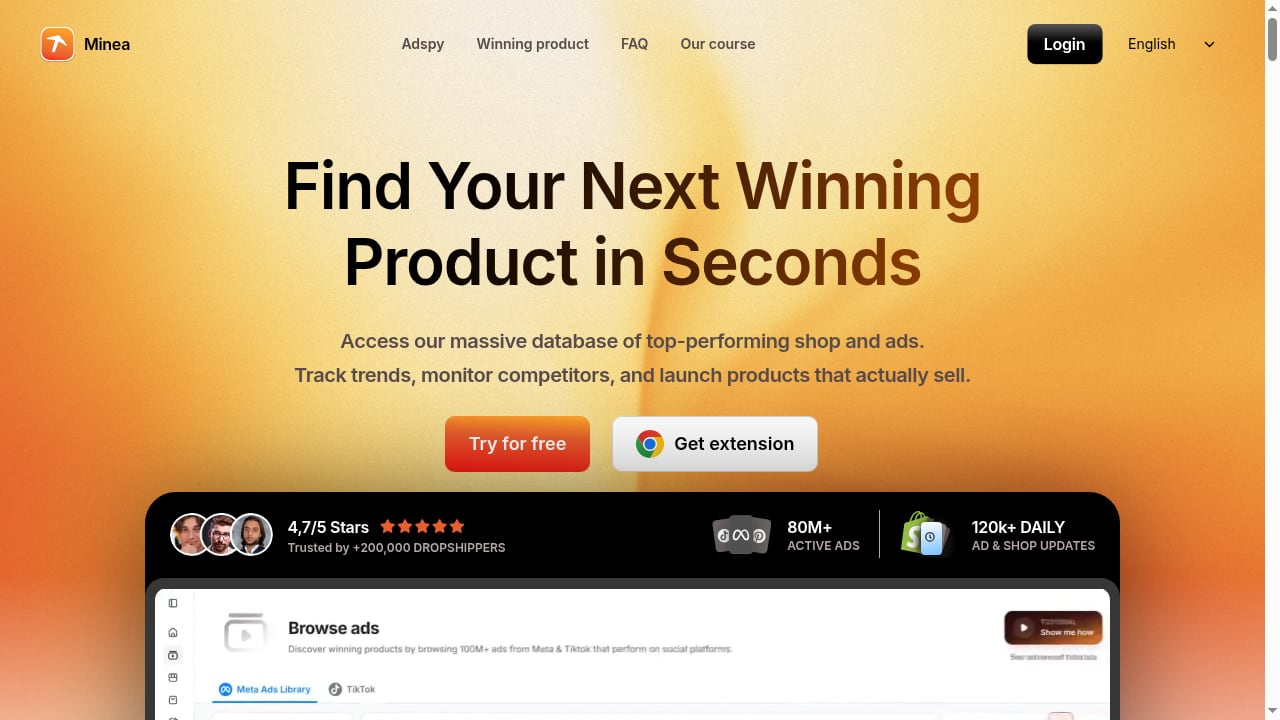
First viewport screenshot of Minea - Leading Adspy for Ecommerce and Dropshipping Products.
The strongest case for Minea is frequency. If product research is a weekly routine, Minea can replace hours of manual browsing. If it is an occasional curiosity, the subscription is harder to justify.
Minea tends to fit these users:
- Solo dropshippers testing several products a month. You can use it as a reconnaissance desk: search by market and problem, open the shop behind an ad, inspect the offer, save candidates, and return later to see whether the campaign is still alive.
- Small ecommerce teams qualifying candidates every week. Collections and tracking keep research in one place instead of scattering screenshots across chat apps.
- Creative strategists comparing hooks and formats. Ad analysis and transcript tools help you compare multiple videos without replaying every opening line.
- Operators who want the bridge from ad to commerce context. Seeing a creative, identifying the store, inspecting its catalog and offer, and searching for a supplier in one chain is genuinely convenient.
Minea is a weaker fit for:
- Brand teams that only want an inspiration board. A creative library or the free ad platforms may be enough.
- Beginners hoping software will choose a profitable business for them. Minea can show where attention appears to be gathering. It cannot tell you whether your margin survives returns.
- Marketers whose main channel is not covered well by Minea. If your strategy depends on Google or YouTube creatives, check coverage before subscribing.
One useful buying rule from independent discussions: Minea feels well suited to dropshippers because it exposes products and shops, but it can feel excessive for a brand selling its own catalog. If your weekly question is "What should we stock or test next?", Minea speaks your language. If it is "How are prestige skincare brands framing clinical proof?", a creative library may be enough.
Core features in practice
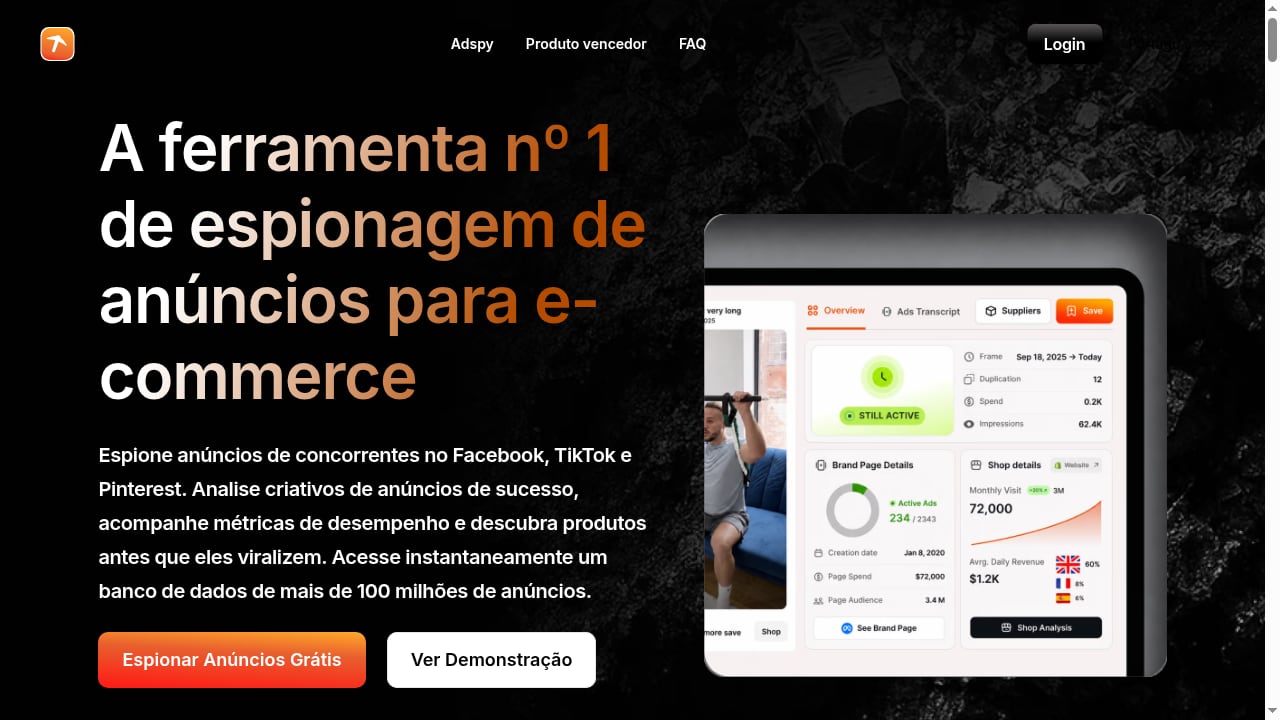
First viewport screenshot of Ad Spy Tool: Search Facebook & TikTok Ads Free.
Ad research
Minea's ad research surfaces creative, run dates, engagement, and spending-related signals across Meta, TikTok, and Pinterest. The practical value is not the raw feed. It is the ability to treat the database like a query engine.
A workable workflow:
- Pick your product or customer problem and write down three angles you want to test.
- Search each angle as a separate query using plain language customers use.
- Filter by language, platform, and ad type to remove noise.
- Save a short list of creatives, then extract what is repeatable: hook type, proof mechanism, offer structure, and landing page pattern.
- Turn those patterns into hypotheses for your own original ads.
Product and shop research
Product pages connect an item to stores and, where available, suppliers. Shop Spy steps back to inspect a seller's catalog, active promotions, prices, detected technology, and estimated performance. This is where Minea's ecommerce focus shows. You are not just watching ads; you are inspecting the commercial context around them.
AI-assisted search and analysis
Magic Search can locate related ads and products from a phrase or an image. Ad analysis and transcript tools pull structure from creatives. These features are useful for comparing ten videos quickly, but they are metered on lower plans, so map your real usage before subscribing.
Tracking and notifications
Brand tracking and notifications turn a one-off search into a watchlist. This is one of the more underrated features. A product that looked interesting last month may be saturated this month, and tracking helps you notice the shift.
Pricing signals and plan limits
Minea's current monthly pricing is simple on the surface:
- Starter: $49 per month
- Premium: $99 per month
- Business: $199 per month
Quarterly billing lowers the advertised effective monthly rates to roughly $39, $79, and $158. Minea also advertises a free starting route, so the sensible move is to test the exact search you perform in real life before subscribing.
What the tiers generally signal:
- Starter covers Meta ad, product, and shop listings, brand tracking, and limited monthly uses of AI analysis, transcripts, and Magic Search.
- Premium raises those allowances and expands tracking. It only pays off if the extra research changes decisions.
- Business makes the listed AI and notification allowances unlimited. Unlimited browsing can encourage collecting tabs without a testing process.
The recurring complaint in independent discussions is that credits or feature access can disappear faster than expected. The present pricing page describes usage as monthly allowances rather than the older credit-heavy presentation, but buyers should still map their workflow to the plan table. Run five representative searches. Open the details you normally inspect. Generate the transcripts you would actually use. If the meter becomes the loudest part of the product, upgrade only after calculating what the saved time is worth.
Setup and a practical weekly workflow
Minea is browser-based, so setup is mostly about defining your research process rather than installing software. A four-step hunt works well:
- Pattern. Find a repeated problem, hook, or format across several advertisers.
- Context. Open the stores. Check price, offer, longevity, and social proof.
- Friction. Verify supplier, shipping, returns, margin, and legal constraints.
- Test. Make an original angle and run a small, measured experiment.
A concrete weekly loop:
- Use Minea to shortlist products with momentum and stable pricing.
- Check the offer reality. Look at average product price to anchor your margin math when you build bundles.
- Sanity-check fulfillment. Confirm the supplier can ship reliably and that returns will not destroy your margin.
- Validate how sellers package the angle on Meta or TikTok.
- Launch clean tests with fewer creative blind spots.
This is where Minea behaves like an ad intelligence tool. The output is not a finished ad. The output is a hypothesis you can test.
Strengths and limitations
Strengths
- Combines ads, products, shops, and supplier discovery in one chain.
- Multi-platform coverage across Meta, TikTok, and Pinterest.
- Filters and tracking support a repeatable research routine.
- AI tools reduce manual reading and retrieval.
- Clean interface and time savings are commonly praised in public reviews.
Limitations
- Conversion data such as CPA and ROAS is not available.
- "Winning product" labels are clues, not guarantees.
- AI and search features are metered on lower plans.
- Public customer feedback is mixed. Trustpilot showed a 3.8 out of 5 score from 326 reviews when checked, with praise for time savings and support, and criticism citing outages, unclear feature expectations, and refund frustration.
- The crowd problem: every subscriber can see many of the same rising products. A high engagement count may reveal demand, or it may announce that the copying has begun.
Minea vs alternatives: decision criteria
First viewport screenshot of Ecommerce Affiliate Program #1 - Minea.
Minea is not the only option, and the right choice depends on your channel mix and workflow.
- If you need deep Meta history and a large searchable archive, a Meta-focused tool such as AdSpy may fit. See WinningHunter vs AdSpy: Which Ad Spy Tool Wins in 2026? for a closer comparison.
- If you want a broad view of ad intelligence platforms, Top 10 Ad Intelligence & Creative Research Tools 2026 compares coverage, spend estimates, tracking, and pricing.
- If you are TikTok-heavy, compare Minea against PiPiADS and similar tools before committing.
- If you want a free baseline, Meta Ad Library plus TikTok Creative Center, supplemented by spreadsheets and patience, can cover occasional checks.
Minea's distinction is the bridge from ad to commerce context. Whether it is worth paying for depends less on database size than on how often you traverse the whole chain. Someone checking three competitors once a quarter should keep the $49. Someone qualifying twenty candidates every Monday has a stronger case.
For a deeper look at how ad intelligence platforms differ on coverage and API access, PrimeSpy vs AdLibrary: Which Ad Intelligence Tool Wins? is a useful reference.
Related reading
- How to Use PrimeSpy with Dropship to Find Winning Products - Learn how to combine PrimeSpy ad intelligence with Dropship store research to validate winning products, spot rising stores, and scale profitable ads.
- PrimeSpy vs SocialPeta vs GetHookd: Ad Intelligence Compared - Compare PrimeSpy, SocialPeta, and GetHookd on ad coverage, tracking, pricing, and workflow fit to find the right ad intelligence platform for you.
Sources and further reading
- Minea (#1 Dropshipping AI Tool) Reviews - Trustpilot - The best product research tool for dropshipping and ecommerce. Find the best performing ads and products worldwide. #1 Adspy tool for Facebook Ads. #1 ...
- Dropshipping: Adspy, the solution for finding winners - Minea - AdSpy review 2026 for dropshipping. Strengths, limits, pricing, Meta ad analysis methods and more profitable alternatives for sellers.
- Minea - Minea is a web-based product and advertising research platform for dropshippers and e-commerce operators. It gathers ads, products and store signals into searchable views, then layers on filters, tracking, supplier discovery and AI-assisted analysis. It can cut hours of manual browsing, but its estimates and 'winning product' labels are clues to investigate, not sales guarantees.
FAQ
Is Minea worth the money?
It depends on frequency. If you research products weekly and use the ad-to-shop-to-supplier chain, Minea can save hours and justify the $49 Starter plan. If you research occasionally or only need inspiration, free ad libraries may be enough.
How much does Minea cost per month?
Current monthly pricing is $49 for Starter, $99 for Premium, and $199 for Business. Quarterly billing lowers the advertised effective monthly rates to roughly $39, $79, and $158.
Does Minea show conversion data like ROAS or CPA?
No. Minea shows ads, creative, run dates, engagement, and spending-related estimates. It does not show verified conversion data such as CPA or ROAS, because those metrics are not publicly exposed.
Which platforms does Minea cover?
Minea's ad research covers Meta, TikTok, and Pinterest, with product and shop research layered on top. Coverage can vary by market and language, so test your specific niche before subscribing.
Is Minea good for beginners?
It can be, if you already understand basic ecommerce economics and are willing to run small tests. It is not a shortcut to a guaranteed winning product. Beginners who expect software to choose a profitable business for them will be disappointed.
What is the biggest limitation of Minea?
The crowd problem. Every subscriber can see many of the same rising products, so a high engagement count may signal demand or saturation. The operators who search for persistent customer problems and offer gaps tend to get more original results than those who copy the top of a list.
Conclusion
Minea earns its keep when research is a routine, not an occasional curiosity. It is built around the working habits of ecommerce operators who need to compare creatives, watch stores, and reject weak ideas before paying for samples or traffic. The platform is less persuasive for a brand team that only wants an inspiration board, or for a beginner hoping software will choose a profitable business on their behalf.
Use Minea to spot a pattern worth testing. Copying the product at the top of a list is how twenty stores arrive at the same party wearing the same shirt. The tool shows you patterns. You still have to build something that fits your store, your margin, and your customer.