

Top 10 Ad Intelligence & Creative Research Tools 2026
Ad intelligence and creative research tools answer two different but connected questions: what is the market spending, and what creative is actually working. This guide ranks the ten products that do those jobs best in 2026, with transparent scoring, real pricing, and guidance on which one fits your workflow.
How we evaluated these tools
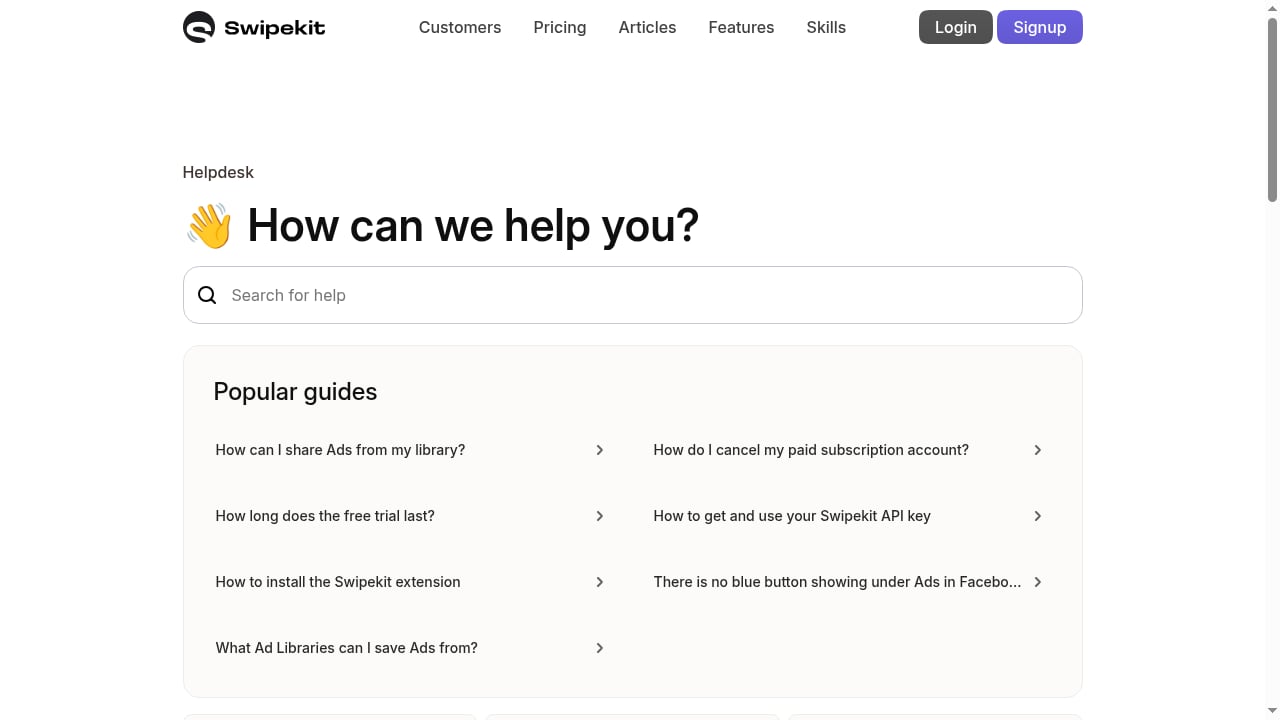
First viewport screenshot of Swipekit.
We scored every product on six dimensions, weighted by how much they change a real buying or creative decision:
- Channel and market coverage (20%) — which networks and countries are indexed, and how deep the archive goes.
- Data depth (20%) — whether the tool shows raw ads, estimated spend and impressions, or both.
- Creative research workflow (20%) — saving, tagging, briefs, transcripts, and how fast an ad becomes a usable idea.
- Tracking and alerts (15%) — competitor monitoring, new-ad detection, and notification reliability.
- Pricing transparency and value (15%) — published prices, entry cost, and what the cheapest usable plan actually includes.
- Actionability (10%) — whether the output feeds a live campaign, a brief, or just a report.
Every price below was read from the vendor's own pricing page in 2026. Where a vendor sells only through sales, we say so instead of guessing.
The 10 best ad intelligence and creative research tools in 2026
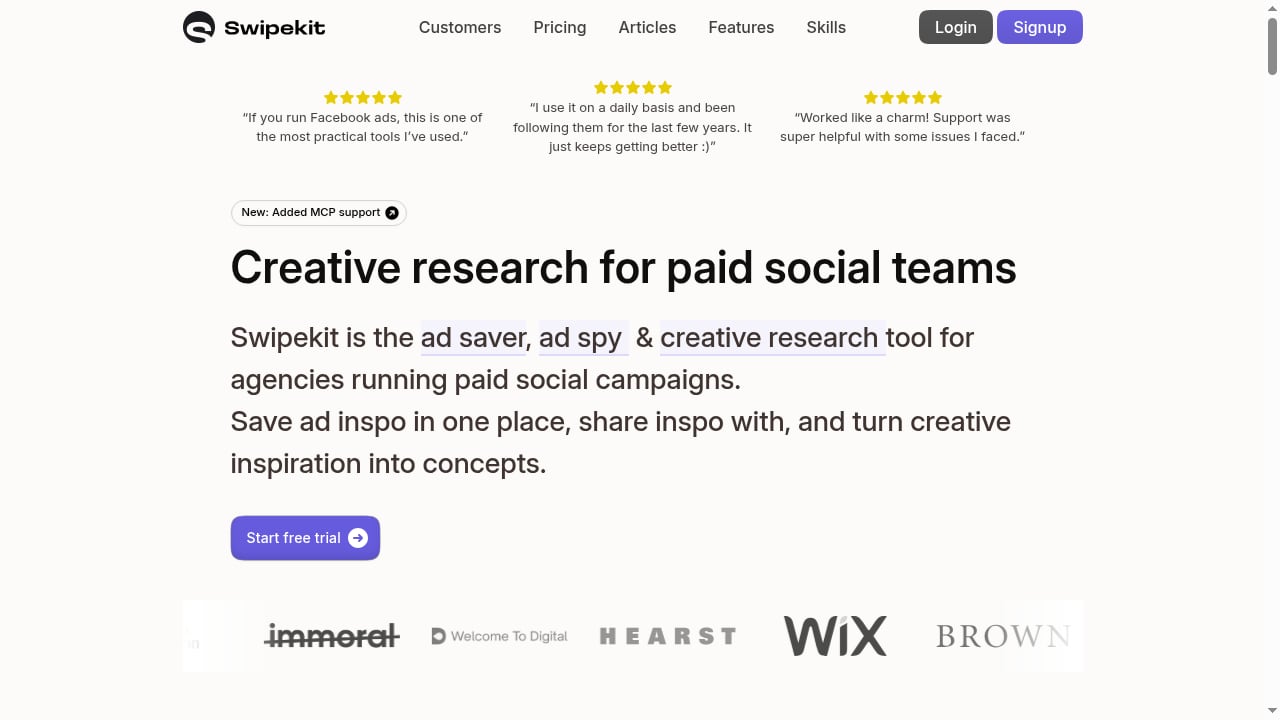
First viewport screenshot of Swipekit: Facebook Ad Library Downloader & Ad Research Tool.
1. AdClarity — best for cross-media spend estimates
AdClarity, from BIScience, tracks competitor audiences, ad spend, channels, campaigns, and creatives across social, display, video, connected TV, and linear TV. Reports include CPM benchmarks, share of voice, and regional market analysis.
Strength: the widest channel mix on this list, including TV, with self-serve plans a small team can buy. Limitation: entry plans cover one market and one channel, so a multi-country view needs Enterprise. Pricing: Basic $129/month (1 market, 1 channel, 3 months of history), Advanced $289, Team $349, Enterprise through sales.
2. Similarweb Ad Intelligence — best for display and search ads next to traffic data
Similarweb added Ad Intelligence to its web traffic platform. It covers display and search ads with estimated spend, impressions, campaigns, publishers, and first-seen and last-seen dates, updated daily.
Strength: ad spend and site traffic in one place, which helps connect a rival's campaign to its visits. Limitation: display- and search-first, so social creative depth is thinner than a social specialist. Pricing: no published price; packages sit behind contact sales.
3. Pathmatics — best for deep social spend estimates
Pathmatics is Sensor Tower's digital ad intelligence product. It estimates spend and impressions on Facebook, Instagram, YouTube, Snapchat, Pinterest, Reddit, and more, across social, display, video, and mobile.
Strength: the deepest social spend estimates here, with side-by-side competitor comparisons and category rankings. Limitation: an enterprise tool sold through sales, so it suits planners and agencies more than a solo buyer. Pricing: no published price.
4. SocialPeta — best for mobile app and game advertisers
SocialPeta monitors ads across app and web ecosystems in one dashboard, with real-time tracking and creative trend analysis. Its homepage leads with mobile game creatives, which is where it is strongest.
Strength: broad mobile ad intelligence for apps and games, with creative trend detection. Limitation: less relevant for brands that advertise mainly on search or the open web. Pricing: no published price.
5. Adbeat — best for display, programmatic, and native ads
Adbeat tracks display, programmatic, and native ads, with the publishers and ad networks that ran them. You can search by advertiser, ad, or publisher, filter by desktop or mobile, and see ads in 35 countries.
Strength: publisher placement data, so you see where a rival buys, not only what it runs. Limitation: estimated ad spend and 3 years of history are Enterprise features. Pricing: Standard $249/month (90 days of data), Advanced $399/month (1 year of data and competitor alerts), Enterprise on a call.
6. SpyFu — best for search ads intelligence
SpyFu is the search ads specialist. It shows the keywords a competitor buys on Google, the ad copy it has tested, and more than 10 years of history.
Strength: the longest search ad history here at the lowest price. Limitation: search only, with no social or display creative. Pricing: Basic $39/month ($29 billed annually), Pro + AI $119/month after a $59 first month, Team $249/month.
7. PowerAdSpy — best for wide social coverage at a low entry price
PowerAdSpy indexes ads from 11 networks, including Facebook, Instagram, YouTube, Google, Pinterest, Reddit, Quora, LinkedIn, and native. You filter by keyword, advertiser, engagement, and date.
Strength: wide social coverage at a low entry price. Limitation: it shows ads, not spend estimates, and the full network set needs the top plan. Pricing: Basic $69/month (Facebook and Instagram), Standard $99, Platinum $279, Palladium $399 for all 11 networks.
8. Foreplay — best for saving and tracking social creative
Foreplay combines Discovery, an ad search engine with over 100 million ads, with Spyder, which tracks competitor advertising around the clock. Saved ads go into boards your team can tag, share, and turn into briefs.
Strength: the fastest path from a competitor ad to a shared creative brief. Limitation: no market spend estimates. Pricing: Basic $59/month ($49/month yearly), Workflow $175/month ($149/month yearly), Agency $459/month ($389/month yearly).
9. Atria — best for AI creative strategy on bigger budgets
Atria pairs an ad library with AI agents that analyze your own ad accounts and suggest what to make next. Radar acts as a 24/7 AI strategist, and the platform covers competitor brand following, AI concepts, scripts, ad copy, and image generation.
Strength: research, analytics, and AI production in one place, with MCP access in Claude, ChatGPT, and Cursor. Limitation: most AI runs on credits, and the useful competitor insights start on the Plus plan. Pricing: Core $159/month ($129/month yearly), Plus $599/month ($479/month yearly), Business $1,199/month ($959/month yearly).
10. Swipekit — best for budget swipe files for agencies
Swipekit calls itself creative research for paid social teams. It is an ad saver and ad spy tool built for agencies, with a Chrome extension that saves ads from the libraries you already use.
Strength: save ads from the Meta Ad Library, Instagram, TikTok, and LinkedIn, with Brand Tracker for 24/7 competitor Meta ad tracking, automated transcripts, AI scripts, whitelabel share links, MCP, and API access on every plan. Limitation: you still do the finding yourself, and tracking stops at 15 brands. Pricing: Basic $26/month (5 seats, 5 tracked brands, 150 AI scripts), Plus $46/month, Agency $66/month. The first 14 days are free with no card.
How to choose between them
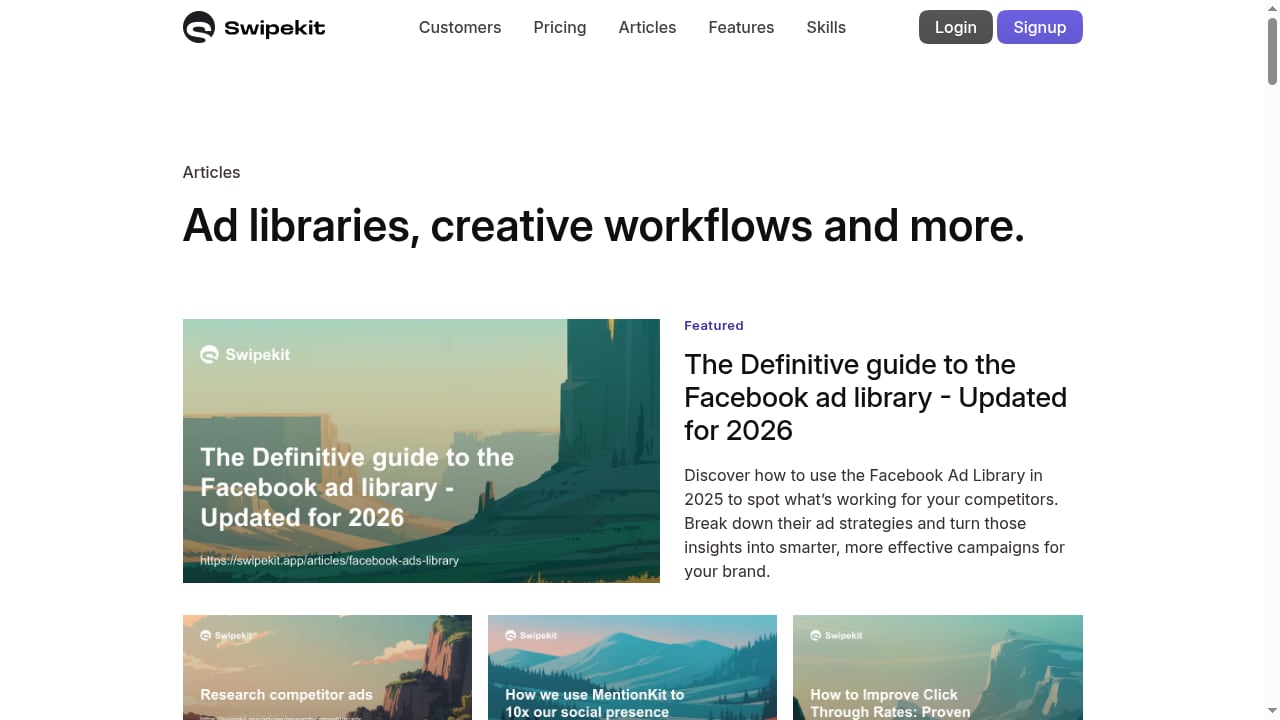
First viewport screenshot of Swipekit.
The right tool depends on the question you need answered most often:
- Sizing a market or planning budget: AdClarity, Similarweb, or Pathmatics.
- Finding creative angles for a brief: Foreplay, Atria, or Swipekit.
- Search and PPC intelligence: SpyFu.
- Mobile app and game user acquisition: SocialPeta.
- Display and native placement research: Adbeat or PowerAdSpy.
Most teams end up with one spend-intelligence tool and one creative-research tool, because no single product is strong on both sides of the category. If your workflow spans dropshipping product validation and ad research, see how to use PrimeSpy with Dropship to find winning products, which covers the adjacent step of validating a product before you scale creative.
Practical example: turning research into a brief
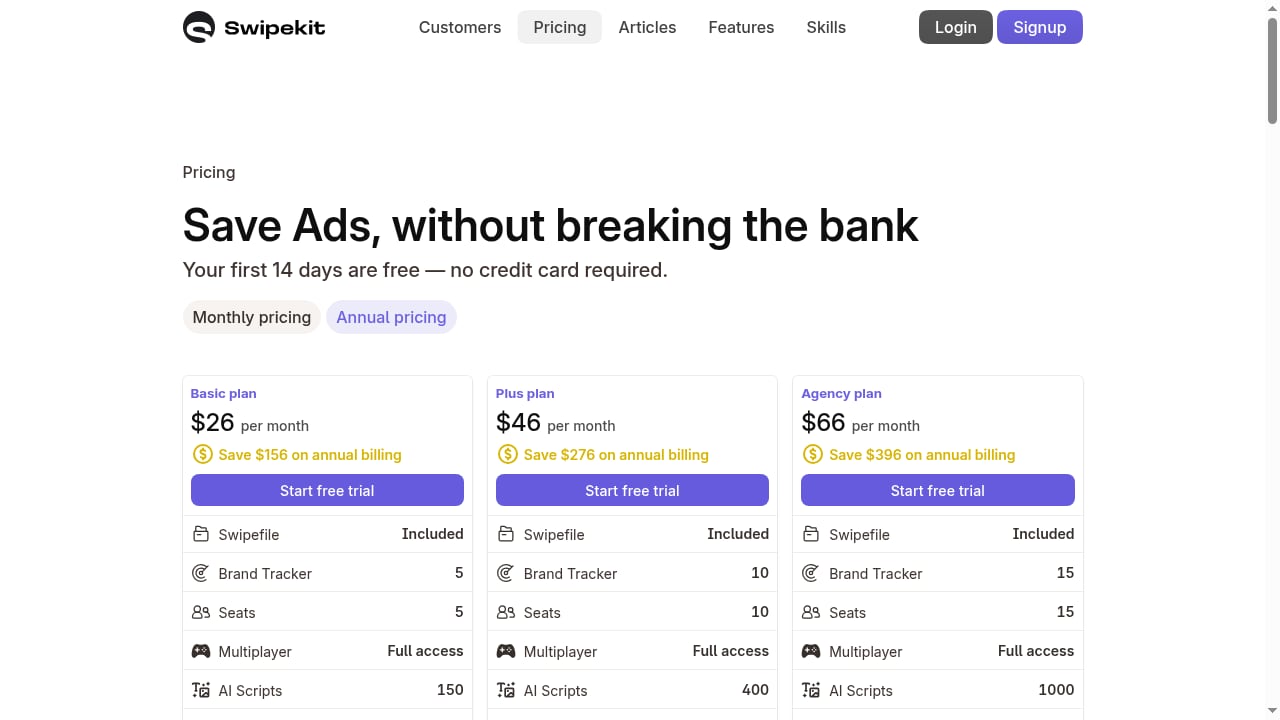
First viewport screenshot of Swipekit.
A skincare brand wants to refresh its Meta creative. The workflow looks like this:
- Use a spend tool like AdClarity or Pathmatics to confirm which competitors are increasing social investment.
- Use a creative tool like Foreplay or Swipekit to save the top ads from those brands into a shared board.
- Pull transcripts and hooks, then group them by angle: ingredient proof, before-and-after, founder story.
- Write the brief with the winning angle, the format, and the hook, and hand it to production.
The gap most teams hit is step 2 to step 3: saving ads is easy, but turning them into a structured brief takes a workflow, not just a library.
Where PrimeSpy fits in this stack
PrimeSpy is an ad spy and ad intelligence platform for performance marketers, ecommerce brands, dropshipping sellers, and agencies. It is not ranked in this Top 10 because it belongs to the adjacent ad spy and competitor tracking category rather than the spend-estimation and creative-research category above. Where it becomes relevant is when your research needs to move into live competitor monitoring: it offers a searchable database of over 120 million ads, smart search by keyword, URL, or advertiser, EU-specific filters, and 24/7 ad trackers with email notifications. If you are comparing that layer against the tools here, the PrimeSpy vs SocialPeta vs GetHookd comparison breaks down coverage, tracking, and pricing side by side.
Related reading
- How to Use PrimeSpy with Dropship to Find Winning Products - Learn how to combine PrimeSpy ad intelligence with Dropship store research to validate winning products, spot rising stores, and scale profitable ads.
- PrimeSpy vs SocialPeta vs GetHookd: Ad Intelligence Compared - Compare PrimeSpy, SocialPeta, and GetHookd on ad coverage, tracking, pricing, and workflow fit to find the right ad intelligence platform for you.
- PrimeSpy vs AdLibrary: Which Ad Intelligence Tool Wins? - Compare PrimeSpy and AdLibrary on ad coverage, tracking, pricing, and API access. Find out which ad intelligence platform fits your workflow in 2026.
Sources and further reading
- The 10 Best Ad Creative Research Tools in 2026 - Looking for the best ad creative research tools? We compared 10 options for 2026, from ad libraries to free tools, on features, channels and pricing.
- 10 Best Ad Intelligence Tools in 2026 (Spend, Creative and Search) - The 10 best ad intelligence tools for 2026, from AdClarity and Pathmatics spend data to SpyFu search history, with September 2026 prices and how to pick one.
- Best Creative Analytics Tools for Meta Ads in 2026 - The best creative analytics tools for Meta ads in 2026, ranked on what changes after the readout: the decision taken on each ad and the profit behind it.
FAQ
What is the difference between ad intelligence and creative research tools?
Ad intelligence tools estimate spend, impressions, and share of voice across a market. Creative research tools index and organize the ads themselves so a team can find angles and build briefs. Many products lean toward one side, so most teams buy one of each.
Are spend estimates accurate?
Treat every spend figure as a directional estimate. Vendors model impressions and spend from public libraries, crawlers, and consumer panels, so the numbers show share and trend rather than an invoice.
Which tool is best for a small agency on a budget?
Swipekit starts at $26/month with five seats and a 14-day free trial, which makes it the cheapest way to stop losing ads. Foreplay is the next step up if you need briefs and deeper tracking.
Do I need a paid tool if the Meta Ad Library is free?
The free library shows what is running but not which ad is winning, and inactive ads drop out. Paid tools add ranking, history, and cross-channel coverage that a free library cannot provide.
Can I use these tools for TikTok and YouTube research?
Yes. BigSpy covers up to 11 channels, PowerAdSpy indexes 11 networks, and SocialPeta is strong on mobile. For YouTube specifically, VidTao is a dedicated option, though it was not ranked here because it focuses on a single channel.
Conclusion
The 2026 ad intelligence and creative research market splits cleanly: spend trackers on one side, creative workflows on the other. AdClarity and Pathmatics lead on market-level spend, Foreplay and Swipekit lead on turning saved ads into briefs, and SpyFu remains the search specialist. Pick the tool that answers your most frequent question first, then add the second layer when your workflow demands it.
For a wider view of the category, including platforms that overlap with this list, see our comparison of the top 10 social media ad intelligence platforms 2026.