
How to Use PrimeSpy with Copyfy: From Winning Ad to Live Shopify Store
Most dropshipping stores fail for the same reason: the product was never validated before money went into ads. You can spot a promising product with an ad spy tool, but then you still need a store to sell it. That gap between "I found a winner" and "my store is live" is where the PrimeSpy + Copyfy combination earns its keep.
PrimeSpy handles the research layer: it surfaces Facebook and TikTok ads that are already spending, shows you the hooks, offers, and landing pages behind them, and lets you track competitors over time. Copyfy handles the build layer: it turns a product link into a structured Shopify store with product pages, images, and copy generated by AI. Used together, they compress the distance between signal and launch.
This guide walks through the full workflow, the setup steps, and the practical decisions you will make along the way.
Why pair an ad spy tool with an AI store builder
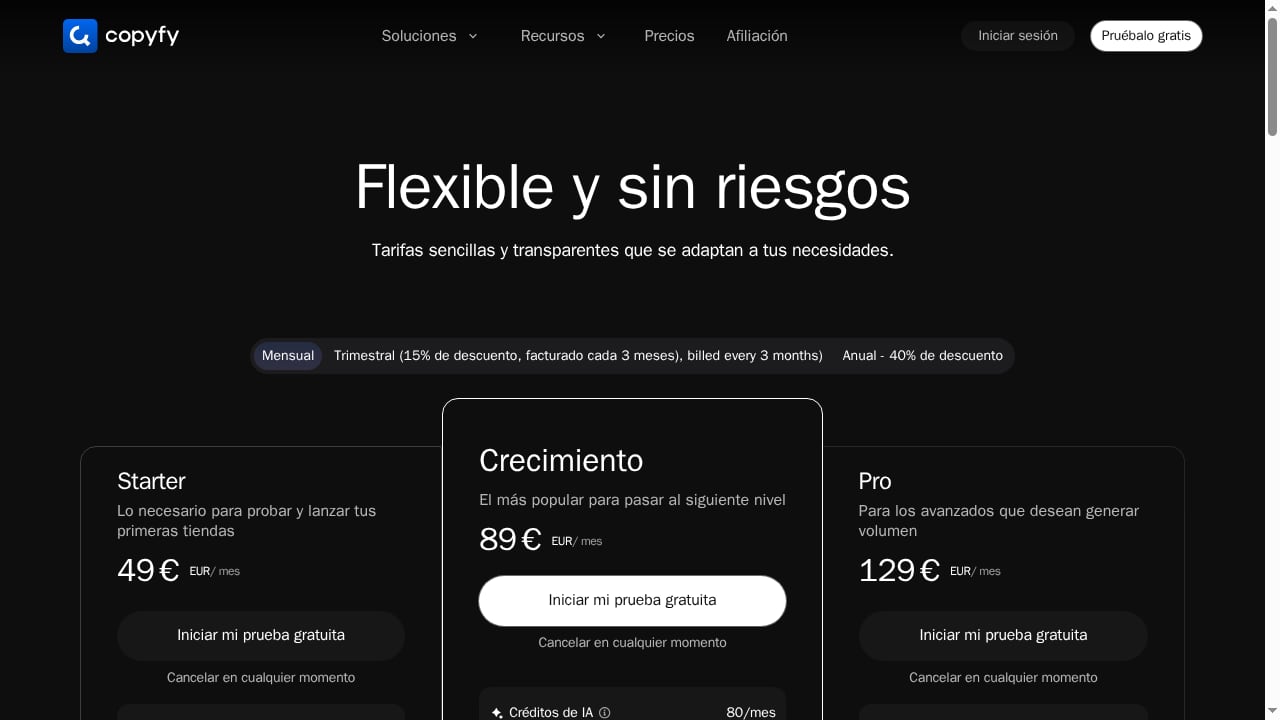
First viewport screenshot of Precios de Copyfy | Elige tu plan.
Ad research and store building are usually treated as separate jobs. In practice they feed each other, and splitting them across disconnected tools creates friction:
- Research without a build path stalls. You save 40 ads, download creatives, and then spend a week assembling a store by hand while the trend cools.
- Building without research wastes budget. You launch a beautiful store for a product nobody is actively advertising, and your first test campaign teaches you what a spy tool could have told you for free.
- Timing matters more than polish. In dropshipping, the person who tests fastest usually wins the window. A validated product plus a same-day store beats a perfect store built three weeks late.
PrimeSpy and Copyfy sit on opposite ends of that pipeline. PrimeSpy tells you what the market is already paying for. Copyfy turns that decision into a sellable storefront.
What each tool actually does
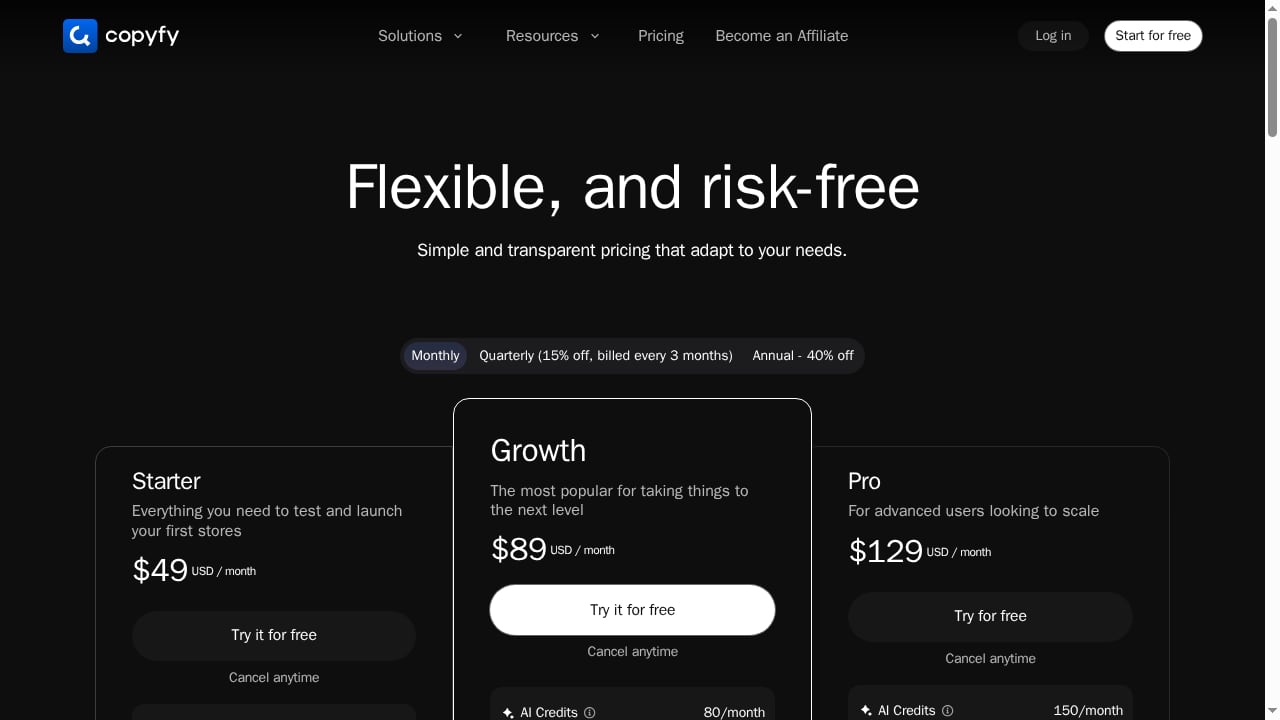
First viewport screenshot of Copyfy pricing | Choose your plan.
PrimeSpy: the research and validation layer
PrimeSpy is a multi-platform ad spy and ad intelligence tool covering Facebook, TikTok, and the Meta Ad Library. Its core job is to replace guesswork with observable data.
Key capabilities you will use in this workflow:
- Smart search by keyword, URL, advertiser name, or product to find relevant ads across platforms.
- Advanced filters for platform, country, language, ad format, CTA, landing page, running time, reach, spend signals, placements, and duplicates.
- Ad detail analysis showing the creative, hook, offer, funnel, and landing page behind a running ad.
- Ad trackers and monitoring that watch competitors, products, or advertisers over time and flag new launches and creative changes.
- Daily top products and trend signals for ongoing product discovery.
- Saved ads and creative downloads so you can build a swipe file instead of a browser tab graveyard.
Pricing is credit-based: a free trial with 500 credits, and a Pro plan at $9.99/month with 20,000 credits, unlimited creative downloads, full ad analytics, and priority support. That entry price makes it reasonable to run research continuously rather than in one-off bursts.
Copyfy: the build and launch layer
Copyfy is an AI-powered e-commerce platform aimed at dropshippers and Shopify store owners. It does two things that matter here:
- Product and store research — analyzing successful products, ads, and stores to surface what is currently working.
- AI store generation — turning a product link into a complete Shopify store with pages, product details, images, and design optimized automatically.
Copyfy runs on subscription plans with AI credits and search allowances that scale by tier, and it publishes educational content on dropshipping, product research, store creation, and marketing.
The combined workflow, step by step
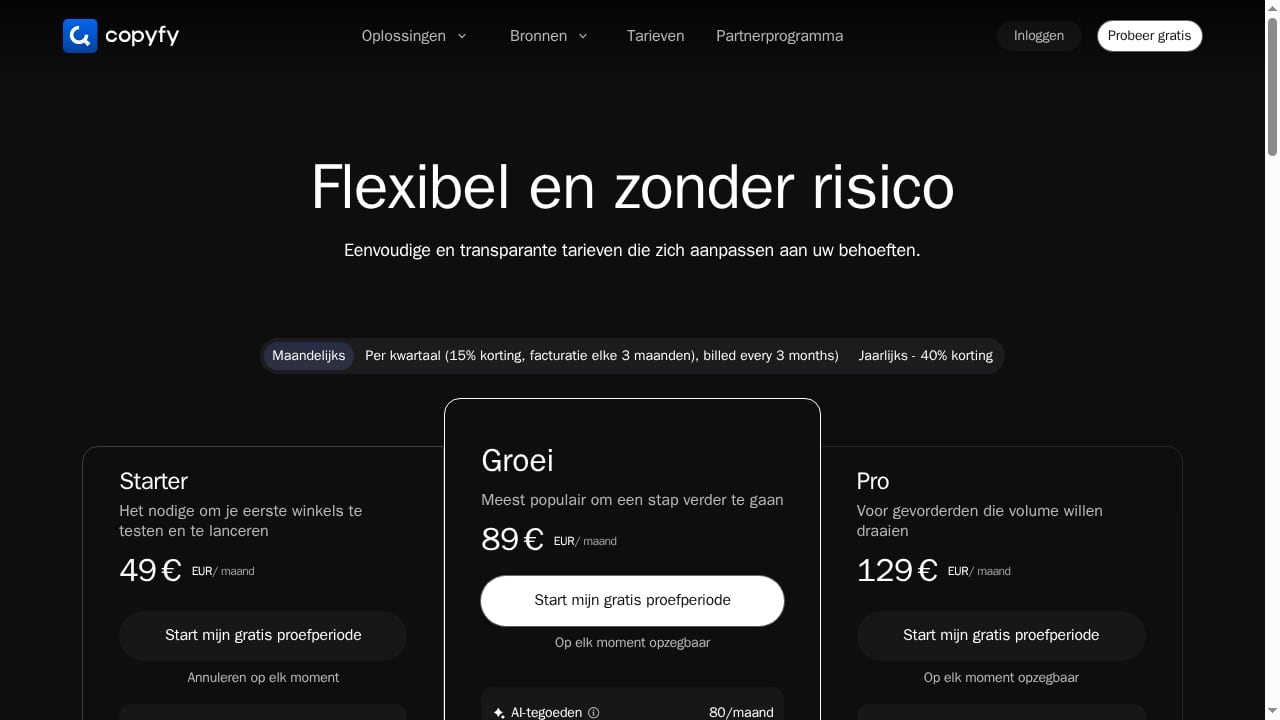
First viewport screenshot of Copyfy-prijzen | Kies je abonnement.
Step 1: Define a narrow research question in PrimeSpy
Do not open PrimeSpy and browse. Start with a specific question, because filters only help if you know what you are filtering for.
Good starting questions:
- "Which home and kitchen products have ads running longer than 30 days in the US right now?"
- "What hooks are TikTok Shop sellers using for portable blenders this month?"
- "Which advertisers in the pet niche launched new creatives in the last 14 days?"
Enter a keyword, a competitor URL, or an advertiser name, then apply filters. Running time is the single most useful filter for validation: an ad that has been live for weeks is usually profitable, while a three-day-old ad is an experiment.
Step 2: Read the ad, not just the product
Open the ads that survive your filters and study the full unit:
- The hook in the first three seconds of the video or the first line of the copy
- The offer structure — bundle, discount, free shipping threshold, guarantee
- The landing page the ad points to and how it frames the product
- The creative format — UGC, studio, static, carousel, and how many variants the advertiser is running
- Duplicate patterns that reveal which angle the advertiser is scaling
This is where PrimeSpy's ad detail view does the heavy lifting. You are not looking for a product to copy; you are looking for a validated demand signal and the language that converts it.
Step 3: Score the opportunity before you commit
Before moving to Copyfy, run a quick checklist:
| Signal | What it suggests |
|---|---|
| Multiple advertisers running the same product | Proven category demand, but more competition |
| One advertiser scaling heavily with many duplicates | Strong winner, harder to differentiate |
| Ads running 30+ days with steady creative refreshes | Durable product, not a spike |
| Rising new launches in the last 14 days | Early trend, better margin window |
| High reach and spend signals with weak creative | Room to win on better creative |
If the product passes, save the ad and any related searches in PrimeSpy so you can monitor it after launch.
Step 4: Hand the product to Copyfy
Once you have a validated product, the build phase starts. Copyfy's core function is converting a product link into a full store: structure, product images, descriptions, and offer layout.
Practical setup steps:
- Take the product URL from your validated winner (supplier page or product source).
- Start a store creation in Copyfy and let the AI generate the store structure, product images, description, and offer.
- Review the generated product page against the ad angles you collected in PrimeSpy. The AI writes generic benefit copy; your ad research tells you which specific pain point and hook are actually converting.
- Rewrite the headline and opening paragraph of the product page to match the winning hook language you observed.
- Adjust pricing and bundle structure to mirror or improve on the offer you saw in the ad.
- Connect your Shopify account and publish.
That last review step is the difference between a store that looks fine and a store that matches the traffic you are about to send it.
Step 5: Keep the loop running
After launch, the workflow does not stop. Use PrimeSpy's ad trackers to monitor:
- The competitors you originally found, watching for new creatives and offer changes
- Your own product category, watching for new entrants
- Adjacent angles that might justify a second creative test
Copyfy's store analysis side lets you track other stores and products in parallel, so you can see whether the niche is heating up or cooling down. If competitors are refreshing creatives aggressively, that is your cue to test new angles rather than scale the current one.
A practical example: portable blender niche
First viewport screenshot of Blog Copyfy.
Suppose you search PrimeSpy for "portable blender" and filter to TikTok and Facebook ads running more than 21 days in English-speaking markets.
You find six advertisers. Three have been running the same UGC-style video for over a month with multiple duplicates, which suggests it is profitable. Two are running a bundle offer (blender plus extra blades) at a higher price point. One launched a new angle five days ago focused on gym users rather than smoothie drinkers.
What that tells you:
- The product is validated. Six advertisers is not a fluke.
- The bundle offer is the current competitive frame, so a single-unit offer will struggle on price perception.
- The gym angle is fresh and underused, which is your differentiation opportunity.
Now you take the product link into Copyfy, generate the store, and then rewrite the product page headline around the gym angle instead of the generic smoothie angle. Your store now matches a specific, less contested demand signal rather than the crowded mainstream one.
That is the entire value of the combination: PrimeSpy tells you which angle is underserved, and Copyfy lets you build the store around that angle the same day.
Where each tool stops and the other starts
It helps to be clear about the boundaries, because neither tool replaces the other.
| Job | PrimeSpy | Copyfy |
|---|---|---|
| Find running Facebook and TikTok ads | Yes | Partial (ad analysis) |
| Filter by reach, spend, running time | Yes | No |
| Track competitors over time | Yes | Partial (store tracking) |
| Analyze store-level performance | No | Yes |
| Generate a Shopify store from a product link | No | Yes |
| Generate product images and copy | No | Yes |
| Validate demand before building | Yes | Partial |
If your bottleneck is "I do not know what to sell," start with PrimeSpy. If your bottleneck is "I know what to sell but building takes too long," start with Copyfy. If both are true, use them in sequence.
Common mistakes in this workflow
- Copying the ad instead of the insight. The goal is to understand why an ad works, then express that reason in your own creative and store copy.
- Skipping the store review step. AI-generated product pages are a starting point. The ad research you did is the differentiator; use it.
- Building before validating. A polished store for an unvalidated product is an expensive way to learn nothing.
- Ignoring running time. New ads are noise. Long-running ads are signal.
- Never revisiting the research. Trends decay. If you set up trackers and never check them, you are flying blind again within a month.
Related reading
- PrimeSpy vs GetHookd vs Adspo: Best Ad Spy Tool 2026 - Compare PrimeSpy, GetHookd, and Adspo on pricing, ad research, creative tools, and workflow fit to choose the right ad intelligence platform.
- PrimeSpy vs SpreshApp: Which Ad Spy Tool Fits in 2026? - PrimeSpy vs SpreshApp compared: pricing, credits, platform coverage, AI search, and workflow fit for dropshippers, agencies, and DTC brands in 2026.
- Koala Inspector Review 2026: Features, Pricing & Verdict - Hands-on Koala Inspector review: what the Shopify spy extension detects, free vs $22/mo Premium, token limits, accuracy, and who should skip it.
Sources and further reading
- I Used AI to Spy on 100+ Ads & Found a Winner in 60 Seconds - 🚀 Test Copyfy for FREE + Get 30% OFF with code "KRRISH30":👉https://copyfy.io 🔥 Stop guessing what sells! In this video, I secretly spied on 100s of winnin...
- PrimeSpy: Powerful Facebook & TikTok ad spy tool for winning ads, creative insights, and competitor tracking. - PrimeSpy: PrimeSpy is a powerful Facebook and TikTok ad spy tool and ad library built to help marketers find winning ads, monitor competitors in real time, and turn creative insights into better campaign decisions. With PrimeSpy, users can discover high-performing creatives, spot rising product angles, track fast-moving sellers, save ads and searches, study hooks, offers, funnels, and landing pages, and build a repeatable workflow for ongoing competitor ad research. Instead of guessing what to test next, PrimeSpy helps teams see what competitors are running, which ads are gaining traction, and where new creative or product opportunities are emerging.
- Copyfy | Find winning products and build your store with AI in 5 minutes - Analyze high-performing products, ads, and stores, then build an optimized Shopify store with Copyfy AI.
FAQ
Do I need both PrimeSpy and Copyfy to run this workflow?
No. Each tool works independently. PrimeSpy is useful for research and competitor tracking on its own, and Copyfy can build stores from products you found anywhere. The combination is for people who want to shorten the gap between finding a validated product and having a store ready to sell it.
How much does PrimeSpy cost compared to Copyfy?
PrimeSpy uses a credit model: a free trial with 500 credits and a Pro plan at $9.99/month with 20,000 credits, unlimited creative downloads, full ad analytics, and priority support. Copyfy runs on subscription tiers with AI credits and search allowances that scale with the plan. Together they are a low-cost research-and-build stack compared with hiring for either job.
Can I use PrimeSpy to research products for Copyfy's store builder?
Yes, and that is the intended pairing. PrimeSpy surfaces the ads and products that are actively spending, and Copyfy turns a chosen product link into a store. The research output becomes the build input.
Which platforms can I research with PrimeSpy?
PrimeSpy covers Facebook, TikTok, and the Meta Ad Library, with filters for platform, country, language, ad format, CTA, landing page, running time, reach, spend signals, placements, and duplicates.
How long does the full workflow take?
The research phase depends on how narrow your filters are; a focused search with running-time and country filters can surface candidates in minutes. The build phase in Copyfy is designed to be fast, with store structure, images, copy, and offer generated automatically. Realistically, a validated product can go from research to a published store in a single working session, with the store review step being the part worth slowing down for.
Is this workflow only for dropshipping?
No. The same research-then-build pattern applies to ecommerce brands testing new categories, TikTok Shop sellers, and anyone launching a product where ad spend is the main demand signal. The tools support ecommerce, dropshipping, apps, games, short drama, AI SaaS, and arbitrage use cases.
Conclusion
The PrimeSpy and Copyfy combination solves a specific, expensive problem: the delay between spotting a validated product and having somewhere to sell it. PrimeSpy gives you the evidence — running ads, spend signals, hooks, offers, and competitor behavior. Copyfy gives you the store — structure, images, copy, and offer, generated from a product link.
Use PrimeSpy to answer "what is working and why." Use Copyfy to answer "how fast can I sell it." Review the AI-generated store against your ad research before publishing, keep your trackers running after launch, and the loop becomes repeatable rather than a one-time experiment.
If you are still deciding which ad spy tool fits your workflow, it is worth comparing options before committing to a research stack.