
Hawky Review: Can AI Agents Really Run Your Performance Marketing?
Performance marketing teams are drowning in manual tasks—pulling reports, refreshing fatigued creatives, and guessing why a campaign’s CPA suddenly spiked. Hawky enters this chaos with a bold proposition: an agentic AI platform that doesn’t just analyze data, but actively buys media, generates on-brand creatives, and answers account questions in plain English. This review examines whether Hawky delivers on those promises, who should use it, and where it still falls short.
What Is Hawky?
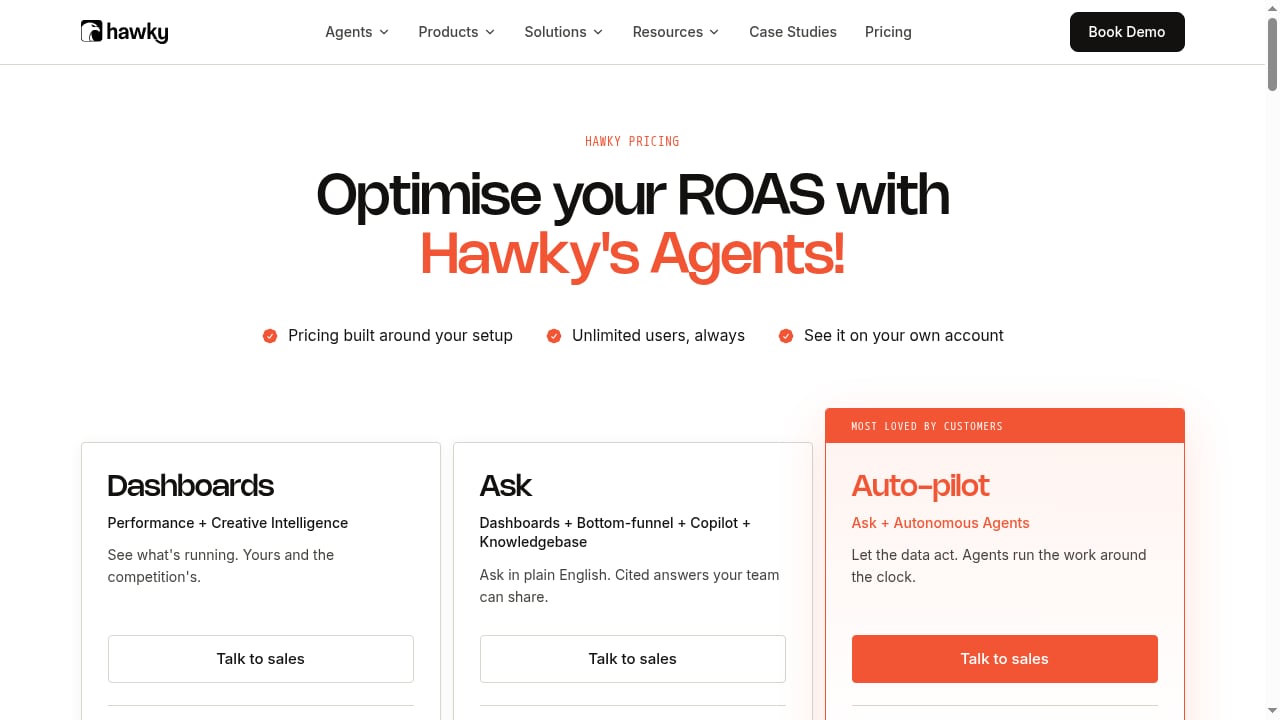
First viewport screenshot of Hawky Pricing | AI Agents for Performance Marketing.
Hawky is an AI-native creative intelligence and performance marketing platform. It deploys always-on AI agents and a conversational copilot to help brands and agencies manage paid media across Meta, Google, and TikTok. Instead of toggling between dashboards, Hawky centralizes ad performance, competitor intelligence, and creative production into one interface.
The core idea: stop making creative decisions based on opinions and start scaling what actually works. Hawky analyzes element-level performance—hooks, CTAs, visuals—and recommends specific actions. Its built-in creative studio then generates image and video variants in seconds, all while respecting your brand guidelines.
Who Is Hawky For?
Hawky targets three primary user groups:
- Performance marketing teams at DTC brands that spend heavily on Meta and Google and need to scale creative output without scaling headcount.
- Digital agencies managing multiple ad accounts who want to standardize reporting, reduce client CPA, and accelerate creative iteration.
- Creative strategists and directors who need a data-backed way to brief designers and validate which creative elements drive ROAS.
It’s less suited for solo entrepreneurs with tiny ad budgets, or teams that rely exclusively on non-digital channels. The platform assumes a baseline of ongoing paid media activity.
Key Features and How They Work
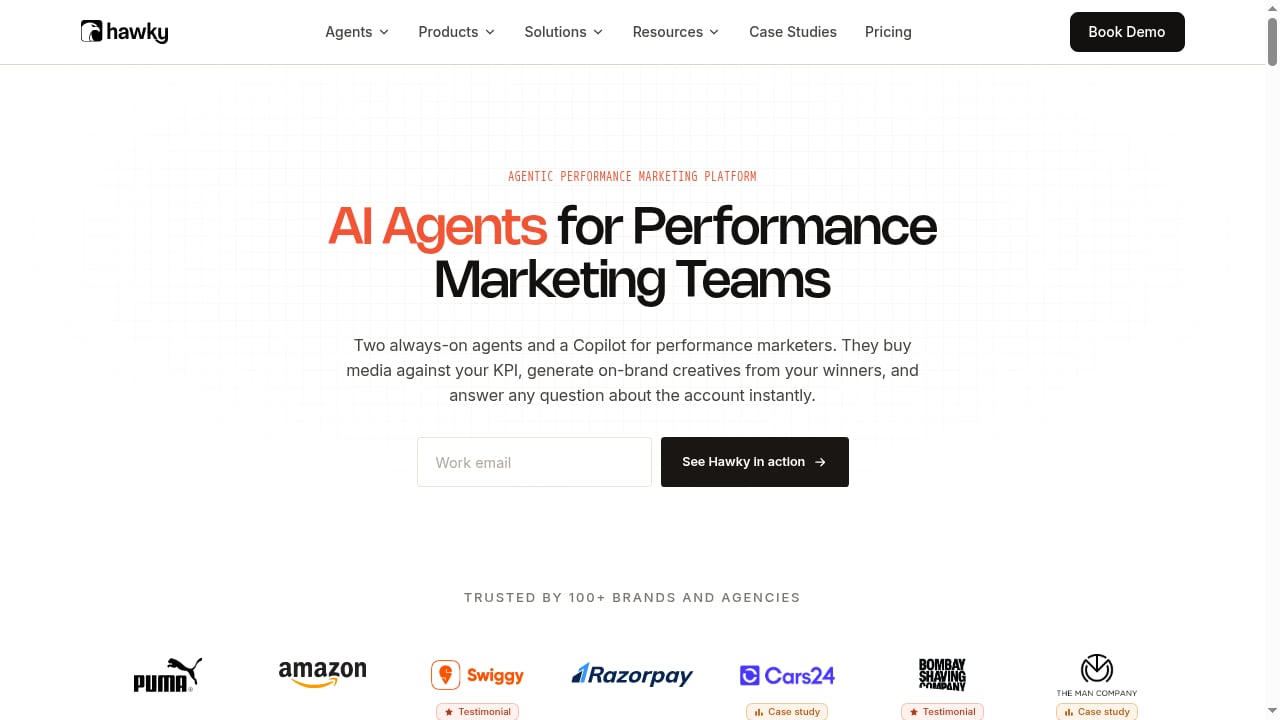
First viewport screenshot of AI Agents for Performance Marketing Teams.
AI Agents for Media Buying
Hawky’s agents don’t just suggest bid adjustments—they execute them. The platform connects directly to your ad accounts and can optimize budgets, pause underperforming ads, and scale winners based on KPIs you define. This is a step beyond typical analytics tools that stop at recommendations.
Copilot for Instant Answers
Think of this as a ChatGPT for your marketing data. You can ask questions like “Why did our CPA increase 22% last Tuesday?” and the copilot pulls real-time data from Meta, Google Analytics 4, and your CRM to give a plain-language explanation. It surfaces the specific campaign, ad set, or creative element responsible.
Creative Intelligence and Generation
Hawky breaks down every ad into its components—hook, body copy, visual style, CTA—and scores them. When it detects creative fatigue, it alerts you before performance tanks. The chat-first creative studio then generates fresh variants, automatically adapting aspect ratios and translating copy for different markets. Case studies mention outputs of over 1,000 creatives per month.
Competitor Tracking
You can monitor competitor ad launches, creative refreshes, and offer changes. Hawky automatically tags and categorizes competitor creatives, letting you filter by theme, hook type, or visual style. This matters because you can spot patterns—like a competitor testing a new UGC format—and respond with your own data-backed variant.
Unified Dashboards and Attribution
Hawky integrates with Meta, Google Ads, TikTok, GA4, and CRM systems. Its dashboards don’t just display metrics; they explain why metrics changed and recommend next steps. Attribution data connects creative performance to actual revenue, not just platform-reported conversions.
Strengths: Where Hawky Excels
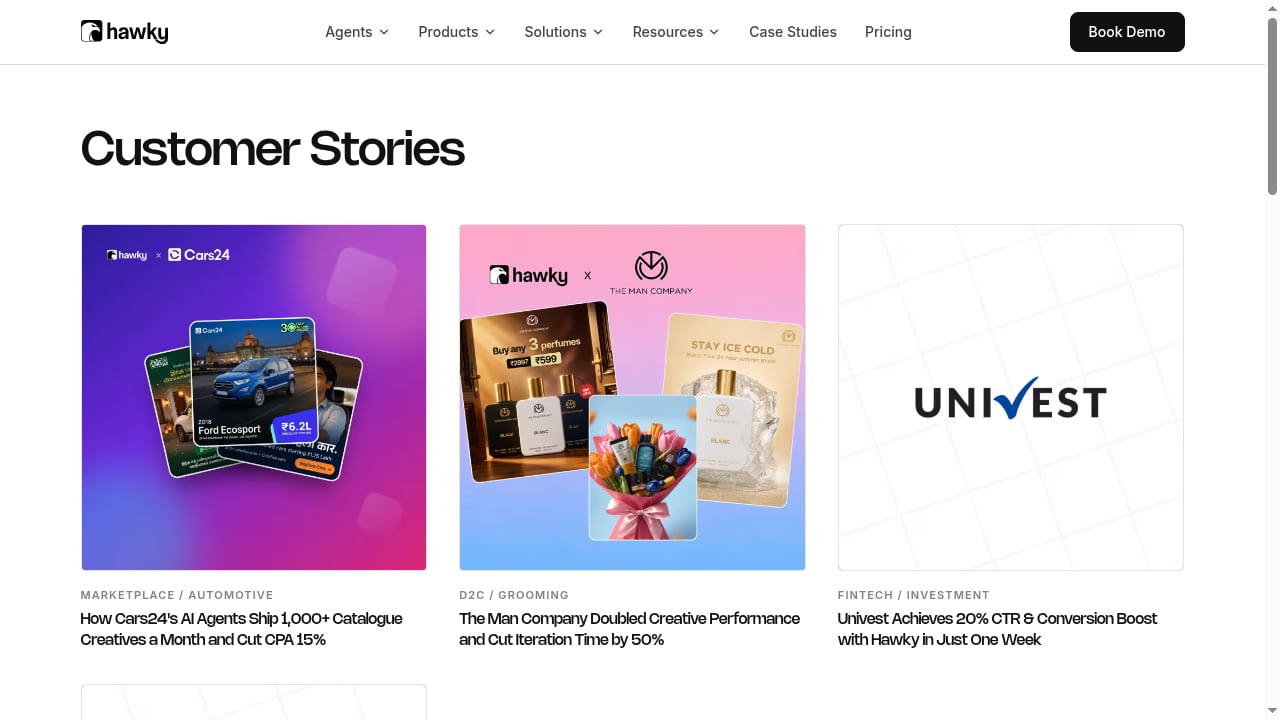
First viewport screenshot of Case Studies | Proven Results with Creative Intelligence - Hawky.
CPA Reduction Evidence – Public case studies cite 15–20% CPA reductions. This isn’t magic; it’s the result of faster creative iteration and automated budget shifts that human teams often delay.
Creative Velocity – The ability to generate on-brand variants in 3–5 seconds changes the testing cadence. Teams that previously launched 10 creatives a week can now test 50, learning faster what resonates.
Natural Language Interface – The copilot lowers the barrier to data analysis. Junior team members can get answers without building complex reports, and senior strategists can validate hypotheses quickly.
Cross-Platform Unification – Managing Meta, Google, and TikTok from one dashboard with consistent attribution logic reduces the “swivel chair” problem that plagues media buyers.
Limitations and Considerations
Platform Maturity – Hawky is a relatively young platform. Crozdesk scores it 46/100, reflecting limited press buzz and a smaller user base compared to established marketing analytics suites. Expect ongoing feature refinement.
Pricing Transparency – Hawky doesn’t publish fixed pricing. The Standard plan starts at a custom rate for one user, 100 analyzed creatives, and two competitors. Enterprise plans are negotiated. This makes it hard to evaluate cost without a sales call.
Learning Curve for Agents – Fully autonomous media buying requires trust. Teams must define clear guardrails and KPIs. During initial setup, you’ll likely run agents in a semi-automated mode, approving recommendations before execution.
Creative Generation Boundaries – While the AI generates solid variants, breakthrough creative concepts still benefit from human ideation. Hawky accelerates production but doesn’t replace a creative strategist’s intuition.
Setup and Onboarding
Based on available information, Hawky’s onboarding involves:
- Ad account integration – Connect Meta, Google, TikTok, GA4, and CRM via API.
- Brand guideline configuration – Upload logos, color palettes, and tone-of-voice docs so generated creatives stay on-brand.
- Competitor list setup – Define which competitors to track; Hawky begins monitoring their ad activity.
- KPI definition – Set target CPA, ROAS, or other metrics that agents will optimize toward.
- Copilot calibration – The system learns your account structure and common queries.
Most teams should budget a week for full configuration before agents go fully live.
How Hawky Compares to Alternatives
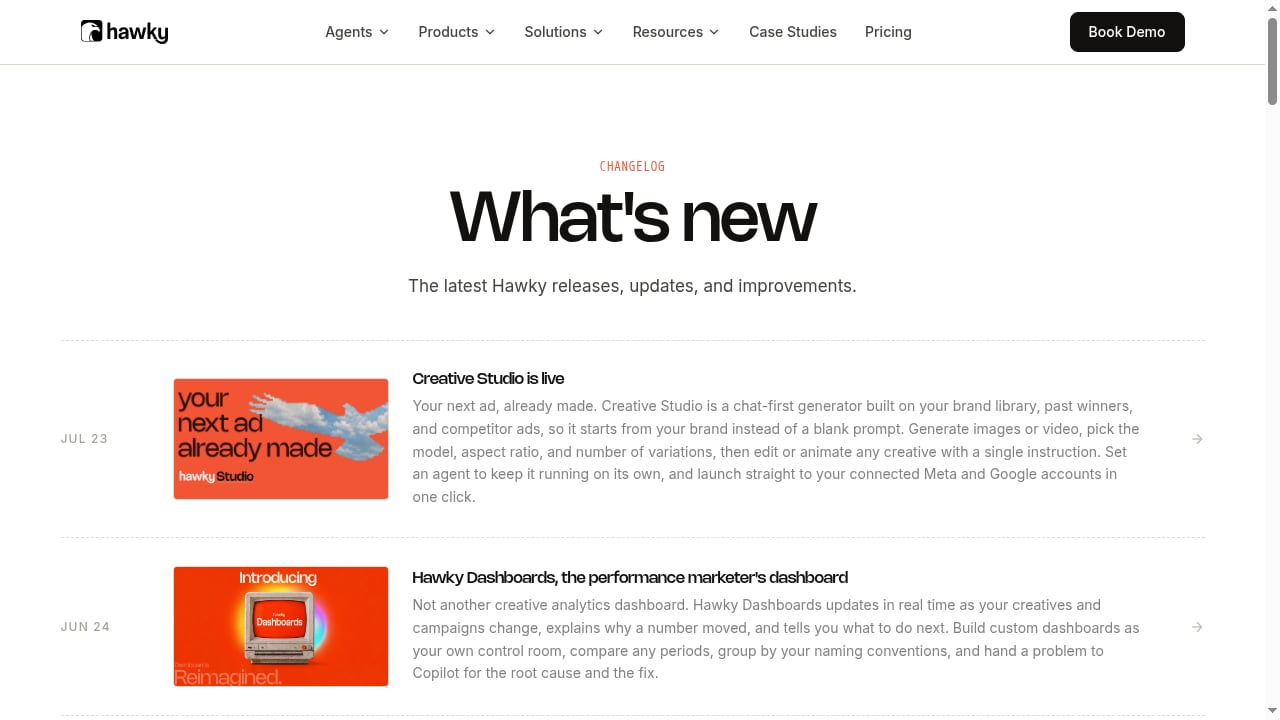
First viewport screenshot of Changelog | New features and updates from Hawky.
Hawky occupies a unique intersection of creative intelligence, media buying automation, and competitor analysis. Most alternatives excel in one area:
- Ad spy tools like those covered in our PrimeSpy vs Winning Hunter vs Pipiads comparison focus on competitor creative discovery but lack media buying execution.
- Creative workflow platforms help teams produce assets but don’t connect to ad accounts for performance feedback.
- Marketing analytics suites aggregate data but rarely generate creatives or execute budget changes.
Hawky’s agentic approach—actually taking action on your behalf—is its main differentiator. If you need pure competitive intelligence, a dedicated ad spy tool may suffice. If you want a unified system that closes the loop from insight to creative to optimization, Hawky’s breadth is compelling.
Decision Criteria: Is Hawky Worth It?
Consider Hawky if:
- You spend at least $50,000/month on paid social and search.
- Your team struggles to produce enough creative variants to combat fatigue.
- You want to reduce reliance on manual reporting and media buyer guesswork.
- You need a single source of truth across Meta, Google, and TikTok.
Look elsewhere if:
- Your ad spend is small and the subscription cost would eat into margins.
- You only advertise on one platform and don’t need cross-channel unification.
- You prefer to keep media buying fully manual for strategic control.
Related reading
- Minea Login & Access Guide: Start Your Ad Spy Research - Step-by-step Minea login and account setup guide. Learn how to access the ad spy dashboard, understand credits, and start finding winning products.
Sources and further reading
- Hawky.ai | Software Reviews & Alternatives - Hawky.ai Review: 'Hawky is an AI-native Creative Intelligence platform built to analyze ad performance, decode competitor strategies, and generate winning creatives, backed by campaign data.'
- Cartoon Research | Walky Talky Hawky (1946) is another one that was originally a commentary but now redone as a review | Facebook - Walky Talky Hawky (1946) is another one that was originally a commentary but now redone as a review! The first Foghorn short and also one of the best even if Foghorn isn’t quite there yet (but...
- Walky Talky Hawky (Short 1946) - It's a hilarious short with great lines and gags, and colorful, well-drawn animation. One of director Bob McKimson's best. Lively music from Carl Stalling.
Frequently Asked Questions
What platforms does Hawky integrate with?
Hawky integrates with Meta (Facebook and Instagram), Google Ads, TikTok, Google Analytics 4, and major CRM systems. This covers the core performance marketing channels for most DTC brands and agencies.
Can Hawky actually buy media automatically?
Yes. Hawky’s AI agents can adjust budgets, pause ads, and scale winning campaigns based on your predefined KPIs. You control the level of autonomy—from fully automated to recommendation-only mode.
How does Hawky’s creative generation work?
You describe what you need in natural language, or ask the copilot to generate variants of a winning ad. The system applies your brand guidelines and produces image or video assets in multiple aspect ratios. You can refine outputs in a built-in editor before pushing them live.
Does Hawky replace my media buyer or creative team?
Not entirely. Hawky augments human teams by automating repetitive tasks—budget shifts, reporting, resizing creatives. Media buyers shift toward strategy and exception handling. Creative teams focus on big ideas while Hawky handles iteration at scale.
What does Hawky cost?
Hawky uses custom pricing. The Standard plan covers one user, 100 analyzed creatives, and two competitors. Enterprise plans scale from there. You’ll need to contact sales for a quote.
How accurate is Hawky’s competitor tracking?
Hawky monitors competitor ad launches, creative refreshes, and offer changes across major platforms. It automatically tags creatives by element, making it easier to spot patterns. Accuracy depends on the platforms’ ad libraries and the competitors you configure.
Final Verdict
Hawky is not a minor productivity tool—it’s an ambitious attempt to rewire how performance marketing teams operate. The combination of agentic media buying, creative intelligence, and a conversational copilot addresses real pain points: slow creative iteration, fragmented data, and reactive optimization.
The platform’s youth shows in limited third-party reviews and opaque pricing, but the underlying concept aligns with where the industry is heading. For teams spending enough to justify the investment, Hawky can reduce CPA, increase creative output, and free marketers to focus on strategy rather than spreadsheet wrangling.
If you’re evaluating tools to sharpen your competitive edge, also explore our guide on how to use PrimeSpy with SwipeWell for winning ad ideas to build a complementary creative research workflow.