
Google Ads Explained: How It Works, Costs, and Campaign Types
Google Ads is Google's advertising platform where businesses bid to place search, display, shopping, video, and app ads in front of people using Google Search, YouTube, Google Play, and millions of partner sites. It launched in October 2000 as Google AdWords and was renamed Google Ads in 2018. If you want traffic fast, it is still one of the most direct paid channels available — but only if you understand how the auction, the campaign types, and the costs actually work.
This guide breaks down the mechanics, compares the main campaign types, and shows how to research what competitors are running before you commit budget.
What Is Google Ads and How Does It Work?

Google Ads Explained: How It Works, Costs & Campaign Types - What Is Google Ads and How Does It Work?.
Google Ads is a pay-per-click (PPC) and cost-per-view (CPV) auction system. Advertisers choose keywords, audiences, or product feeds, set bids, and Google decides which ads to show based on bid amount, ad quality, and expected relevance to the user.
You pay when someone clicks your ad (PPC) or, for some video formats, when they view it (CPV). Ads can run locally, nationally, or internationally, and text ads are deliberately designed to resemble organic search results — which is why ad placement and ad copy quality matter so much.
A few structural facts worth knowing:
- Targeting is partly cookie-based and partly keyword-based. Google uses signals like browsing history (via the Topics API in Chrome) plus the keywords you select to match ads to pages and queries.
- The network extends beyond Google Search. Your ads can appear across Google's partner network, whose members receive a share of the revenue generated.
- Conversion tracking is central. Enhanced conversions exist to make measurement more accurate, and Google has historically pursued offline conversion data partnerships to close the loop between ad clicks and real purchases.
A short history that explains today's product
Google launched AdWords in 2000 and initially managed campaigns for advertisers itself. A self-service portal followed for small businesses. In 2007, Google acquired DoubleClick for $3.1 billion, gaining ad-serving technology and industry relationships — a deal that later drew antitrust scrutiny. In 2018, Google retired the DoubleClick and AdWords brands and consolidated everything under Google Ads, covering Search, YouTube, Google Play, and AdSense publisher inventory.
The Main Google Ads Campaign Types Compared

Google Ads Explained: How It Works, Costs & Campaign Types - The Main Google Ads Campaign Types Compared.
Google Ads is not one product — it is a set of campaign types, each built for a different objective. Choosing the wrong one is one of the most common ways to waste budget.
| Campaign type | Where ads appear | Best for | Main trade-off |
|---|---|---|---|
| Search | Google Search results | High-intent buyers actively searching | Depends heavily on keyword choice, bids, and landing page relevance |
| Display | Websites, apps, and placements in the Google Display Network | Reach, awareness, remarketing | Lower purchase intent than Search |
| Shopping | Search and shopping surfaces | Retail and ecommerce product promotion | Requires a maintained Google Merchant Center feed |
| Video | YouTube and video partner inventory | Awareness, consideration, conversions | Needs strong video assets; direct conversion impact is harder to measure |
| App | Search, Google Play, YouTube, and other Google properties | App installs and in-app actions | Only relevant if you have a mobile app |
| Demand Gen | YouTube, YouTube Shorts, Discover, Gmail | Demand generation and engagement | Relies on audience signals and creative rather than manual keywords |
| Performance Max | Search, YouTube, Display, Discover, Gmail, Maps | Broad reach from a single automated campaign | Less manual control and transparency than separate campaign types |
Search campaigns: intent first
Search campaigns show text ads to people typing queries. The advantage is intent — someone searching "buy running shoes" is closer to purchase than someone scrolling a feed. The catch is that results depend on keyword selection, bidding strategy, and how well your landing page matches the promise of the ad.
Shopping campaigns: built for product catalogs
Shopping campaigns display product images, prices, and merchant details. They pull from Google Merchant Center, so your feed quality directly affects performance. For ecommerce advertisers, this is often the highest-intent format available, but it only works if you sell physical products and can keep a clean feed.
Performance Max and Demand Gen: automation takes over
In 2024, Google introduced AI-powered tools including the "Ads Power Pair" of Search and Performance Max, using first-party data, machine learning, and automated asset creation to improve bidding, targeting, and reach. Performance Max serves across multiple Google channels from one campaign using Smart Bidding. Demand Gen leans on audience signals and creative assets instead of manual keywords.
The trade-off is consistent: automation buys you reach and simplicity, but you give up granular control and some transparency. Many advertisers run Performance Max alongside Search rather than replacing it.
AI is now baked into the platform
Google has continued shipping AI features — including AI-powered ad tools for Indian marketers, ads appearing in AI Overviews, and a "Generated for you" feature in Product Studio that creates brand-aligned images and videos from merchant catalogs and trending campaign concepts. In January 2026, Google launched the "Ads Decoded" podcast focused on AI-driven measurement and optimization.
How Google Ads Pricing and Bidding Actually Work
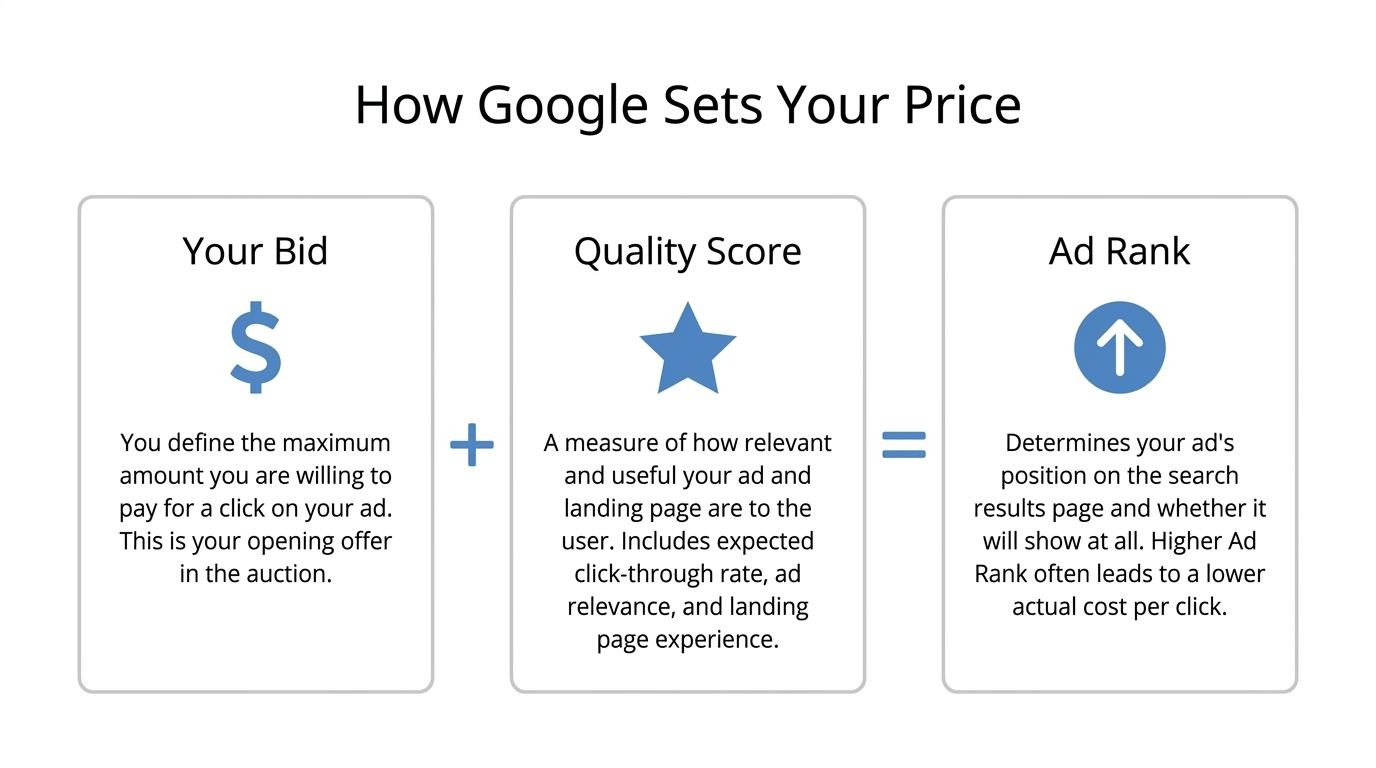
Google Ads Explained: How It Works, Costs & Campaign Types - How Google Ads Pricing and Bidding Actually Work.
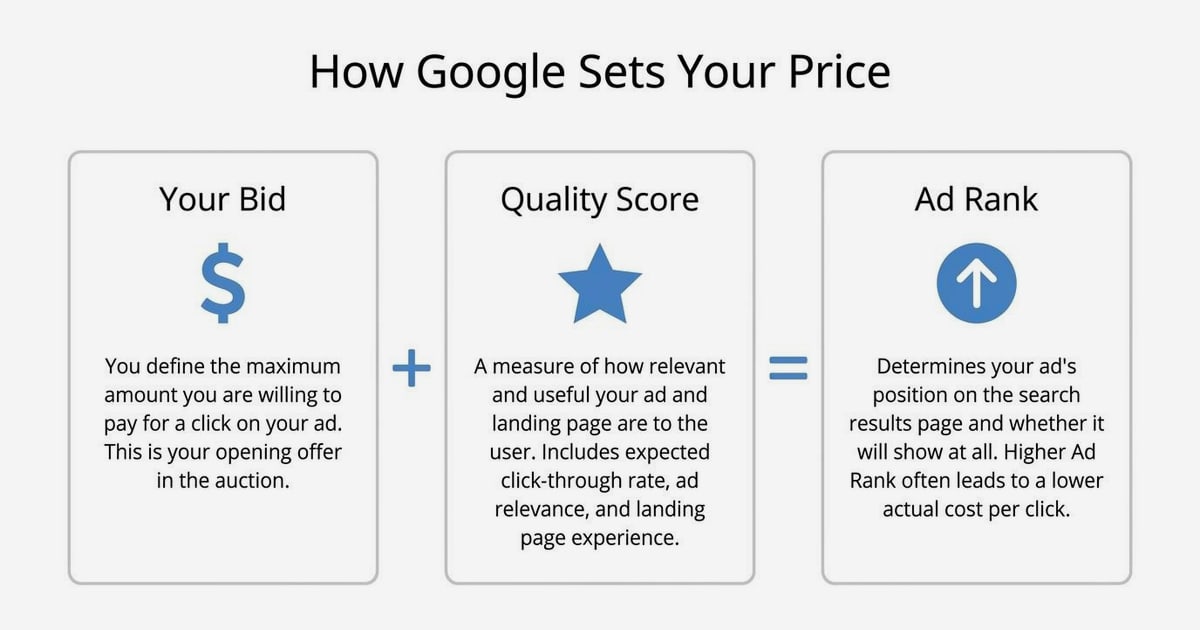
Google Ads runs on an auction, not a fixed price list. You set bids, but what you pay depends on competition, ad quality, and the expected value of your ad to the user.
Key cost mechanics:
- PPC: You pay per click on search, display, and shopping ads.
- CPV: You pay per view for certain video formats.
- Quality signals matter: Relevant ads and landing pages can win placements against higher bids.
- Budget is a ceiling, not a guarantee: You set daily budgets, but spend fluctuates with demand.
What actually drives your cost up
- Keyword competition. Commercial keywords in crowded niches cost more per click.
- Weak landing pages. Poor relevance lowers your ad quality and raises effective costs.
- Broad targeting without negative keywords. You pay for irrelevant clicks.
- Feed problems in Shopping. Missing or inaccurate product data limits eligibility and performance.
A practical budgeting approach
- Start with a small daily budget on one campaign type — usually Search if you have clear commercial keywords.
- Track conversions properly before scaling. Without conversion data, Smart Bidding has nothing to optimize toward.
- Expand into Shopping or Performance Max only after you know your baseline cost per acquisition.
- Review search terms weekly and add negatives aggressively.
Policy Restrictions You Should Know Before Launching
Google Ads Explained: How It Works, Costs & Campaign Types - Policy Restrictions You Should Know Before Launching.
Google sets a "family status" for ads — family safe, non-family safe, or adult — which determines when, where, and in which country an ad can appear. Beyond that, rules vary by market:
- Hard alcohol advertising restrictions were relaxed starting in December 2008 (branding) and December 2010 (sales).
- Student essay-writing services were banned from June 2007.
- Gambling and casino keywords are prohibited in Poland; alcohol keywords are prohibited in Thailand and Turkey; abortion service keywords are restricted in Russia and Ukraine.
- Adult-related services or products have been prohibited worldwide since June 2014.
- In March 2020, Google blocked all face mask keywords from ad targeting to prevent pandemic profiteering.
If you operate in a regulated vertical, check country-level policy before building campaigns — not after they get disapproved.
Researching Competitor Ads Before You Spend
One of the most underused tactics in paid search is looking at what competitors are already running. Their ad copy, offers, and creative angles tell you what the market responds to — and what you should avoid repeating.
Google's own transparency surfaces, like the Ads Transparency Center, let you see ads from verified advertisers. For social and cross-platform creative research, tools like PrimeSpy let you search ads by keyword, URL, or advertiser across Facebook, TikTok, and the Meta Ad Library, with filters and metrics like reach, spend, and duplicate counts. That kind of ad intelligence pairs well with Google Ads research: you see which creative angles are being scaled elsewhere, then adapt the messaging for your own search and shopping campaigns.
If you sell on Shopify, combining ad research with sales-data validation is a stronger workflow than either alone — see how to use PrimeSpy with PPSPY to check whether an ad angle is backed by real demand before you bid on it.
A simple pre-launch research checklist
- Identify 5–10 competitors and note their recurring offers and hooks.
- Check which formats they lean on: search text, shopping listings, or video.
- Look for gaps — keywords they ignore, objections they never address.
- Draft ad copy that answers a real objection rather than repeating the category cliché.
- Set up conversion tracking before the first click.
Common Mistakes That Waste Google Ads Budget
- Skipping conversion tracking. Without it, automated bidding optimizes toward the wrong signal.
- Running too many campaign types at once. You cannot diagnose what works.
- Ignoring search terms. Broad match without negatives bleeds money.
- Sending all traffic to the homepage. Match the landing page to the query.
- Treating Performance Max as a set-and-forget switch. It needs asset variety and clean conversion data.
- Never reviewing competitor creative. You end up bidding on the same angles as everyone else.
Related reading
- PrimeSpy vs AdsLibrary vs Winning Hunter: 2026 Comparison - PrimeSpy vs AdsLibrary vs Winning Hunter compared on ad coverage, creative workflow, ecommerce data, pricing, and team fit for 2026.
- CTV Advertising: How It Works, Costs, and Strategy - Learn what CTV advertising is, how connected TV ads work, targeting and measurement options, costs, and how to research CTV and social ad creatives.
- How to Use PrimeSpy with DropshipHunt: Ad Spy to Shopify - Learn how to use PrimeSpy with DropshipHunt: find validated winning ads, then build and launch AI Shopify product pages in minutes.
Sources and further reading
- Google Ads - This article is about the Google service aimed at advertisers. For the Google service aimed at publishers, see AdSense.
FAQ
Is Google Ads the same as AdWords?
Yes. Google AdWords was renamed Google Ads in 2018, when Google also retired the DoubleClick brand to simplify entry points for advertisers and ad sellers.
How much does Google Ads cost?
There is no fixed price. Costs depend on your industry, keyword competition, ad quality, and bidding strategy. You control daily budgets, but actual spend varies with auction demand.
Which Google Ads campaign type is best for ecommerce?
Shopping campaigns are usually the strongest fit for product sellers because they show images, prices, and merchant details. Search campaigns work well alongside Shopping for high-intent queries, and Performance Max can extend reach across channels.
Do I need a website to run Google Ads?
For most campaign types, yes — you need a landing page that matches your ad and supports conversion tracking. App campaigns are the exception, since they drive installs and in-app actions.
Can I see what ads my competitors are running?
Yes. Google's Ads Transparency Center shows ads from verified advertisers, and third-party ad intelligence tools can reveal social and cross-platform creative, including spend and reach signals.
What is Performance Max in Google Ads?
Performance Max is a goal-based automated campaign that uses Google AI and Smart Bidding to serve ads across Search, YouTube, Display, Discover, Gmail, and Maps from a single campaign. It offers broad reach but less manual control than separate campaign types.
Conclusion
Google Ads rewards clarity: pick the campaign type that matches your objective, track conversions from day one, and control costs through relevance rather than brute-force bidding. Search gives you intent, Shopping gives you product visibility, and Performance Max gives you automated reach — but none of them fix a weak offer or a mismatched landing page.
Before you spend, spend an hour researching. Look at what competitors run, note the angles that repeat, and find the gaps. Whether you use Google's transparency tools or a dedicated ad spy platform like PrimeSpy, the goal is the same: replace guesswork with evidence, then let the auction decide who wins.