
Winning Hunter Review: Ecommerce Ad Spy & Product Research Tested
Finding a profitable product or a scalable ad strategy without data is like throwing darts in the dark. Winning Hunter promises to turn the lights on. This all-in-one ecommerce intelligence platform aggregates over 300 million ads and 5 million stores, aiming to replace guesswork with evidence. But does it deliver for dropshippers, agencies, and established brands? This review examines its core modules, pricing signals, real-world accuracy, and where it fits—and where it doesn’t—in your research stack.
Who Should Use Winning Hunter
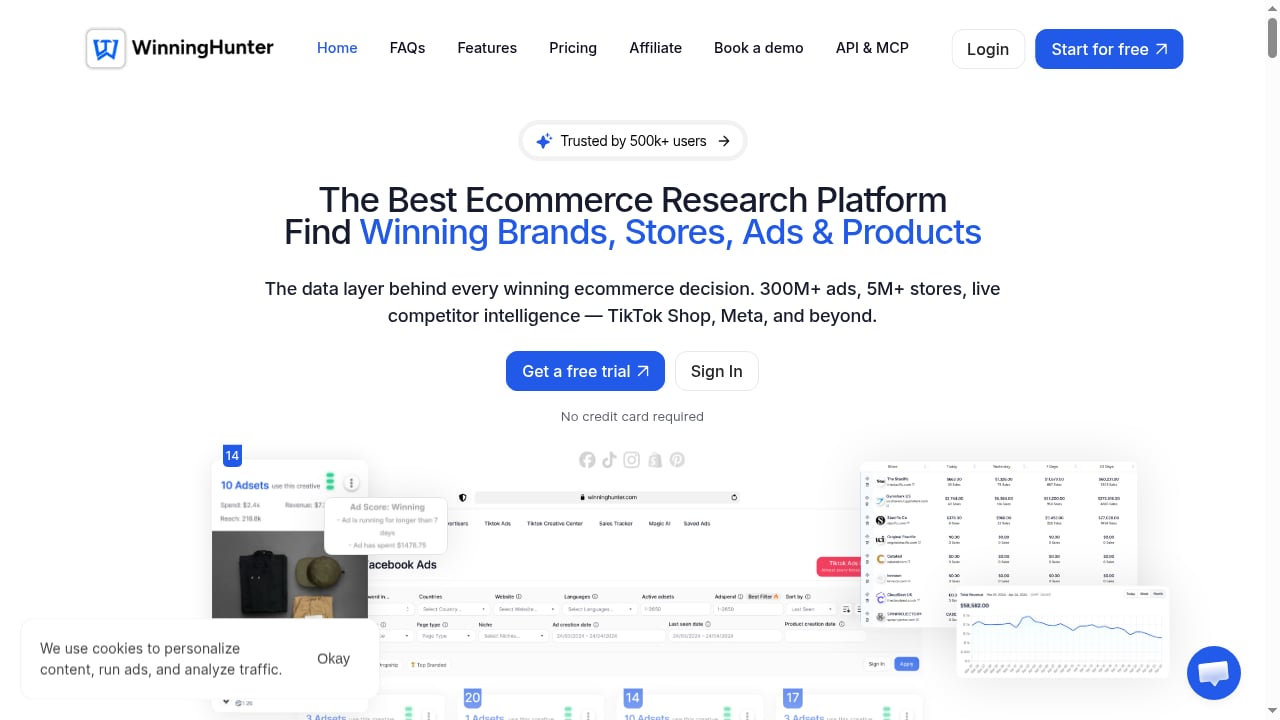
First viewport screenshot of Winning Hunter - All-In-One Ecommerce Spytool.
Winning Hunter is built for anyone whose income depends on spotting ecommerce trends early. The platform’s feature set serves a few distinct personas particularly well.
Dropshippers and Solo Entrepreneurs
If you test products regularly, the cost of a failed Facebook or TikTok campaign adds up fast. Winning Hunter lets you filter ads by engagement metrics, ad spend estimates, and days running. Instead of testing ten duds, you focus on creatives already proving themselves. The built-in saturation checker—branded as Magic AI—helps you avoid markets where a dozen stores already sell the same item with identical angles.
Creative Directors and Media Buyers
For those managing ad budgets across Meta and TikTok, the ability to see competitor ad sets, landing page flows, and creative variations in one dashboard shortens the swipe file process. You can reverse engineer why a specific video hook outperformed another, then adapt that structure to your own brand’s voice.
Agencies and Affiliates
Agencies managing multiple client stores benefit from the store tracker, which estimates revenue and traffic for any Shopify or TikTok Shop storefront. This replaces manual spreadsheet tracking and helps prioritize outreach to brands showing consistent growth. The API access also allows larger teams to pipe competitor data into internal dashboards.
Core Features and How They Perform
First viewport screenshot of WinningHunter Insights Methodology: How We Analyze Dropshipping & Ad Spy Tools.
Winning Hunter organizes its toolset around three main workflows: ad discovery, product validation, and store monitoring. Here’s how each holds up under real use.
Ad Library: Search, Filter, Validate
The ad library is the platform’s backbone. You can search by keyword, store name, or niche, then layer filters for platform (Facebook, Instagram, TikTok, Pinterest), ad spend range, days running, and engagement metrics. An ad running for 30+ days with consistent spend signals a profitable funnel. The library adds roughly 50,000 Facebook ads, 100,000 TikTok ads, and 20,000 Pinterest ads daily, so data freshness is a strength.
In practice, the ad spend filter is the standout. Instead of guessing whether a competitor is scaling, you see estimated spend brackets. This helps separate genuine winners from ads that got a quick engagement spike and died. The interface loads quickly, though filtering across multiple platforms simultaneously can feel slightly clunky on slower connections.
Product and Saturation Analysis
Magic AI attempts to quantify market saturation by showing how many stores sell a similar product and in which countries. It’s a useful directional signal, not a definitive answer. If Magic AI flags high competition in the US but low competition in Germany, that’s a prompt to research further—not a guarantee of success. The tool works best when combined with manual checks on Google Trends and supplier platforms.
Store Tracker and Sale Tracker Accuracy
The store tracker estimates revenue and traffic for individual storefronts. This is where user feedback gets mixed. Winning Hunter claims its sale tracker now achieves 80–100% accuracy after recent fixes. On platforms like Reddit, some users have questioned this figure, noting that estimated sales don’t always align with known order volumes for their own test stores. Trustpilot reviews, however, frequently praise the tool’s ability to surface “rare winning products” and highlight responsive support.
Realistically, treat the sale tracker as a relative strength indicator rather than an absolute ledger. A store showing $50,000 in estimated monthly revenue is almost certainly outperforming one showing $2,000. Use the data to prioritize which stores to study, not to make inventory commitments based on exact numbers.
Pricing Signals and Plan Structure
Winning Hunter operates on a subscription model with a free tier that requires no credit card. The free plan gives limited access to the ad library, enough to test the interface and run a few searches before committing. Paid plans unlock unlimited usage across all tools, including the store tracker, Magic AI, and advanced filters.
While exact pricing tiers shift periodically, the platform typically offers monthly and annual billing with a discount for annual commitments. Compared to enterprise-grade alternatives like AdClarity—which focuses heavily on display and video ad intelligence with a steeper learning curve—Winning Hunter positions itself as more accessible for ecommerce-specific workflows. If you’re evaluating options, our PrimeSpy vs Adplexity Social comparison breaks down how different ad spy tools stack up on pricing and platform coverage.
Setup and First Steps
First viewport screenshot of How to Find Winning Products for Dropshipping.
Getting started with Winning Hunter is straightforward. After signing up, you land on the ad library dashboard. Here’s a quick sequence to run your first winning product search:
- Choose your platform. Start with Facebook or TikTok, depending on where your target audience spends time.
- Apply the ad spend filter. Set a minimum threshold—ads spending at least a moderate amount daily for 14+ days.
- Narrow by niche. Enter a product category keyword or a competitor store name.
- Scan creatives. Look for ads with high engagement rates and a clear hook. Open the landing page to study the funnel.
- Check saturation. Run Magic AI on the product to see competitor density across countries.
- Validate the store. Use the store tracker to estimate the seller’s revenue trajectory.
This workflow takes about 10 minutes once you’re familiar with the filters. Beginners may need a few sessions to interpret ad spend data confidently, but the learning curve is gentler than platforms built primarily for media buyers.
Strengths and Limitations
No tool covers every use case perfectly. Here’s an honest breakdown of where Winning Hunter excels and where it falls short.
Strengths
- Platform breadth. Covers Meta, TikTok, and Pinterest in one subscription, reducing the need for multiple tools.
- Daily data refresh. High ad ingestion volume keeps the library relevant for fast-moving trends.
- Spend-based filtering. Moves beyond vanity metrics to signal actual advertiser commitment.
- Free tier available. Lets you evaluate core features without entering payment details.
- Responsive support. Multiple Trustpilot reviews mention helpful, patient assistance from team members like Jino.
Limitations
- Sale tracker precision. Estimates are useful directionally but shouldn’t be treated as audited financials. Cross-reference with other signals.
- Saturation analysis depth. Magic AI provides a snapshot, not a deep competitive audit. It won’t replace manual due diligence.
- No native marketplace integrations. Unlike some competitors, Winning Hunter doesn’t connect directly to supplier platforms; it’s purely an intelligence layer.
- Interface complexity for multi-platform searches. Filtering across Facebook and TikTok simultaneously can feel less fluid than single-platform tools.
How Winning Hunter Compares to Alternatives
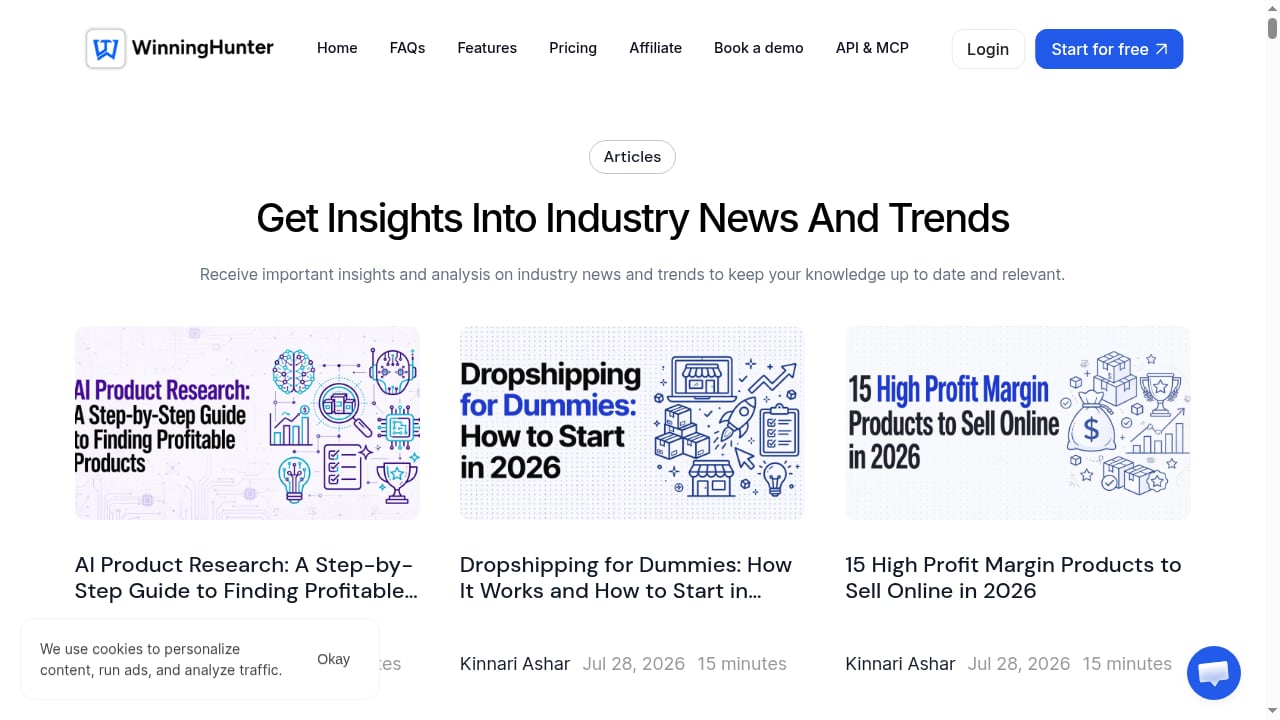
First viewport screenshot of Winning Hunter Blog | Dropshipping Tips & Product Research Insights.
The ad spy and ecommerce intelligence market is crowded. Here’s how Winning Hunter fits relative to tools you might be considering.
- Winning Hunter vs. PrimeSpy: PrimeSpy focuses heavily on multi-platform ad intelligence with strong data freshness. Our PrimeSpy vs Dropispy comparison details why platform coverage often decides the winner. Winning Hunter counters with its integrated store tracker and Magic AI saturation features, which PrimeSpy doesn’t emphasize as strongly.
- Winning Hunter vs. Niche Scraper: Niche Scraper combines product scraping with ad spy features and is popular among beginners. Our Niche Scraper review tests whether it still holds up. Winning Hunter offers a larger ad library and more granular spend filters, but Niche Scraper’s hand-picked product lists appeal to those who want curated suggestions.
- Winning Hunter vs. AdClarity: AdClarity serves enterprise media buyers with deep display and video ad intelligence. If you need that level of cross-channel detail, our AdClarity setup guide walks through the initial configuration. Winning Hunter is more accessible for ecommerce operators who don’t need enterprise-grade media planning tools.
Related reading
- PrimeSpy vs AdFox: Which Ad Spy Tool Wins in 2026? - PrimeSpy vs AdFox: detailed comparison of features, pricing, and platform coverage. See why PrimeSpy wins for ecommerce and dropshipping ad intelligence.
- PrimeSpy vs SellerCenter vs AdClarity: 2026 Comparison - Compare PrimeSpy, SellerCenter, and AdClarity for ad intelligence and dropshipping. See features, pricing, and which tool fits your strategy in 2026.
Sources and further reading
- Is WinningHunter's sale tracker really accurate? - WinningHunter claims on its site that they’ve fixed the sale tracker and now have an accuracy rate of 80-100%. Are there any successful dropshippers ...
- Read Customer Service Reviews of winninghunter.com - Super nice tool to find some rare winning products! Also, their support team is absolutely fantastic and helpful, Jino was very patient and friendly. Useful.Read more
- Winning Hunter - All-In-One Ecommerce Spytool - The All-in-One Ecommerce intelligence platform to find winning ads, products, stores. Across Shopify and Tiktok Shop. Know what is working in ecommerce right now. Reverse engineer brands.
FAQ
Is Winning Hunter suitable for complete beginners?
Yes. The interface is designed for users without media buying experience. The free tier lets you practice searches and interpret ad metrics before paying. The learning resources on the site cover product research and competitor spying workflows step by step.
How accurate is the sale tracker?
Winning Hunter states 80–100% accuracy after recent updates. In practice, treat the numbers as directional estimates. A store showing high estimated revenue is likely performing well, but exact figures may differ from actual sales data. Always combine sale tracker data with other validation methods.
Does Winning Hunter work for TikTok Shop research?
Yes. The platform tracks TikTok ads and TikTok Shop stores specifically. You can filter by TikTok as a platform and analyze trending products and creatives within the TikTok ecosystem.
Can I cancel my subscription anytime?
According to the platform’s terms, you can cancel anytime. The payment page highlights “Cancel anytime — 100% risk free” and supports multiple payment methods.
Is there an API available?
Yes. Winning Hunter offers API access for users who want to integrate ad and store data into their own tools or dashboards. This is particularly useful for agencies and larger teams.
Final Verdict
Winning Hunter earns its place as a solid all-in-one ecommerce intelligence platform. It combines a large, frequently updated ad library with store tracking and saturation analysis, covering the full cycle from product discovery to competitor validation. The free tier lowers the barrier to entry, and the platform’s focus on actionable filters—especially ad spend—helps users move from browsing to decision-making faster.
It’s not a magic wand. The sale tracker, while improved, should inform your research rather than dictate it. And saturation analysis still requires human judgment. But for dropshippers, creative teams, and agencies who want one dashboard to monitor Meta, TikTok, and Pinterest activity, Winning Hunter delivers strong value relative to its price point. If you’re comparing tools across the broader ad intelligence landscape, our PrimeSpy vs AdsLibrary vs SellerCenter comparison can help you weigh platform-specific strengths before committing.
Start with the free plan, run a few product searches using the ad spend filter, and see if the data quality matches your research needs. In a market where timing matters, having 300 million ads at your fingertips beats flying blind.