
Top 10 Ad Intelligence Platforms 2026: Ranked & Tested
Ad intelligence platforms in 2026 do not sell secret data. They sell a faster, cleaner layer on top of public ad libraries — and the gap between a good layer and a bad one is now the difference between a 45-minute creative brief and a wasted afternoon.
This ranking covers ten platforms that genuinely belong to the ad intelligence category. We scored each on platform coverage, per-ad data richness, search and filtering, workflow features, and verified pricing. Where vendors do not publish pricing, we say so rather than guess. One adjacent tool, PrimeSpy, appears later as a complementary option for Meta and TikTok ad tracking — it is not part of this ranking.
How We Evaluated These Platforms
Every tool was assessed against the same buyer workflow: find a specific advertiser, surface their longest-running creatives, compare across platforms, and export or share the result. Our criteria:
- Platform coverage: Meta, TikTok, Google, YouTube, LinkedIn, display, and native networks.
- Data depth: raw ad records versus enriched signals such as run duration, format, hook, and landing page.
- Search and filters: keyword, advertiser, URL, region, and format filtering.
- Workflow: saved boards, team sharing, alerts, exports, and API access.
- Pricing transparency: published rates verified against vendor pages in 2026.
One caveat applies to every tool below: spend estimates are modeled, not disclosed. Treat them as directional signals. Ad longevity is the most reliable field available, because advertisers switch off ads that lose money.
1. SocialPeta — Best Overall Ad Intelligence Platform
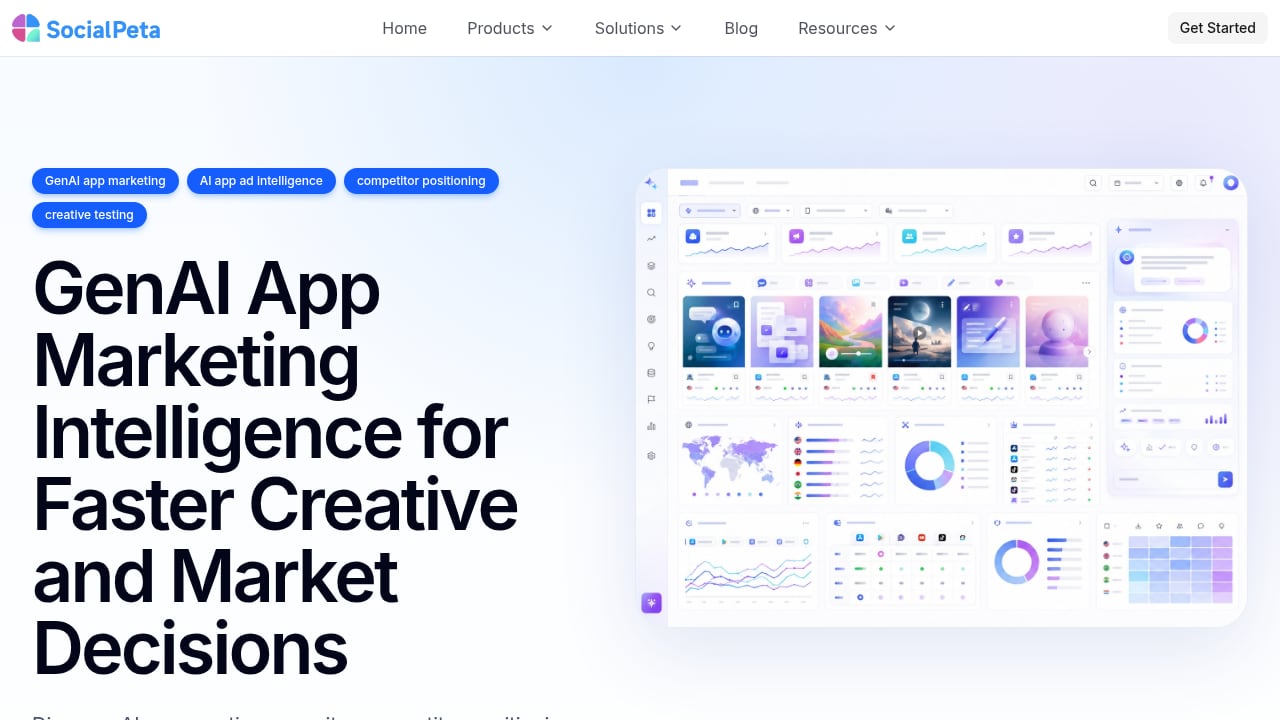
First viewport screenshot of GenAI App Marketing Intelligence Platform.
SocialPeta is the most complete general-purpose ad intelligence platform in this ranking. It tracks ad creatives and app advertising trends across major social and mobile networks, with AI-assisted creative analysis and market signal detection.
Why it ranks first: breadth plus depth. SocialPeta covers both social ad creatives and mobile app advertising, which matters for teams running app install campaigns alongside ecommerce or brand campaigns. Its AI layer surfaces creative patterns rather than just listing ads.
Best for: growth teams, app marketers, and agencies that need one workspace for social and mobile ad research.
Watch: coverage varies by region, so verify your target markets before committing.
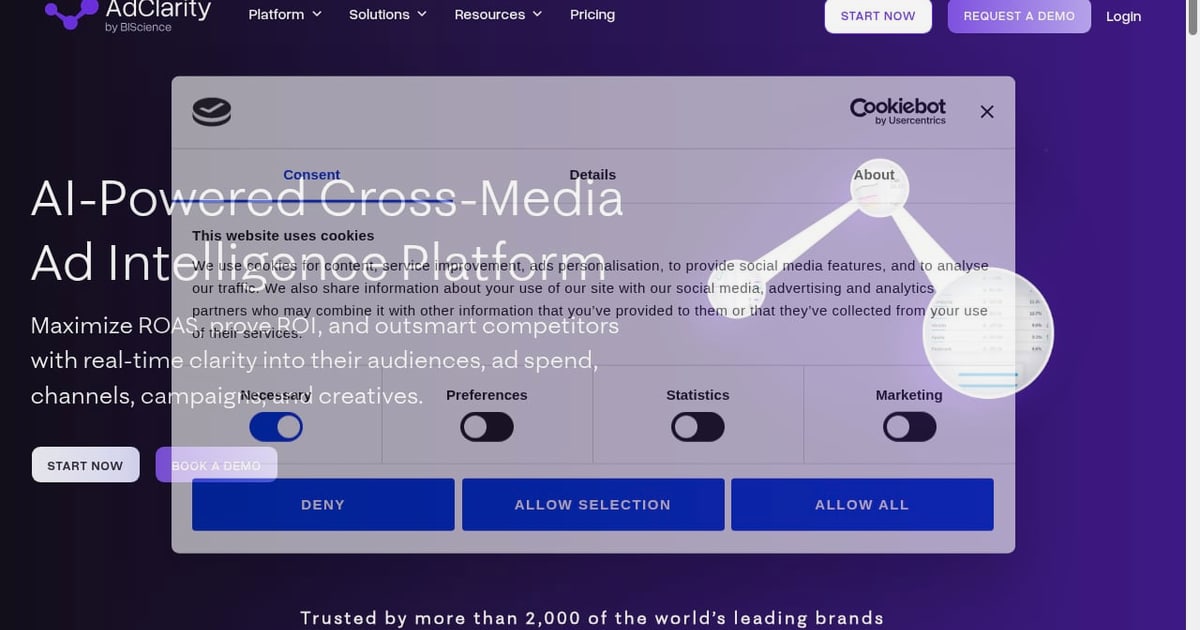
2. AdClarity by BIScience — Best for Display and Programmatic Intelligence
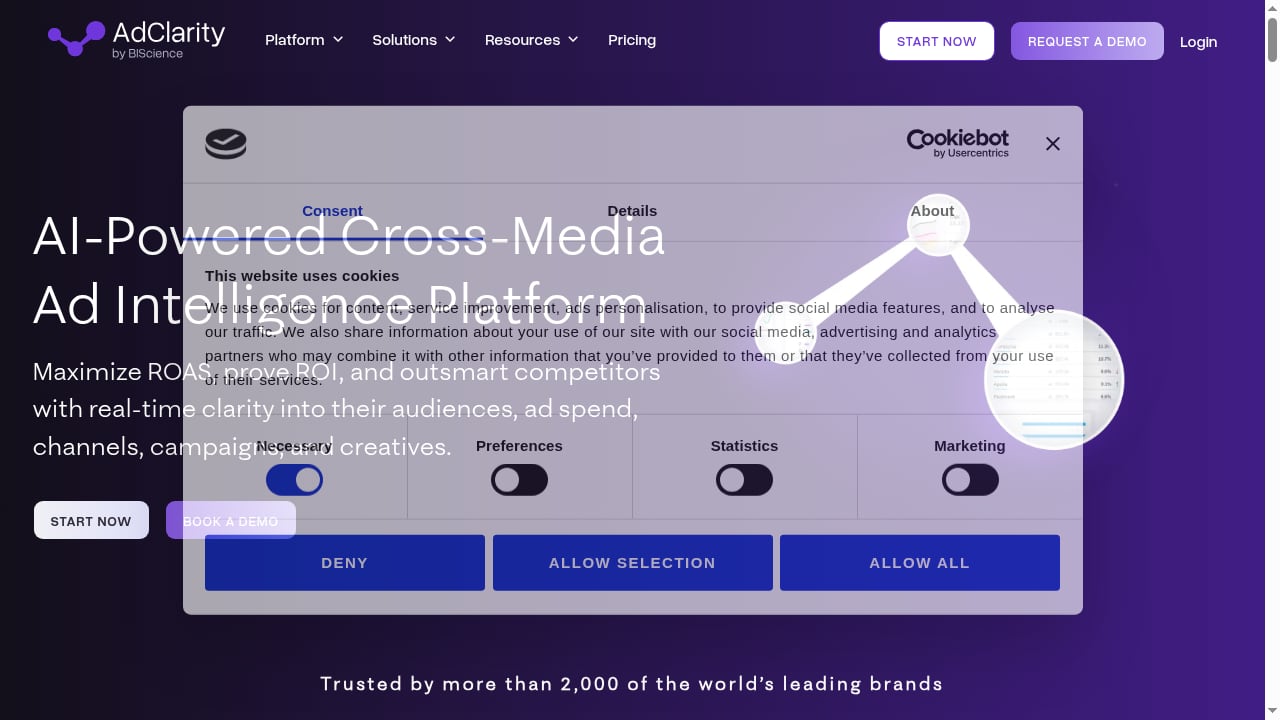
First viewport screenshot of AdClarity – The world leading Ad Intelligence Platform by BIScience.
AdClarity benchmarks competitor marketing activity across display, video, social, mobile apps, and ecommerce websites. It is one of the few platforms in this category with genuine display and programmatic depth rather than a social-first database.
Why it ranks here: if your competitors spend on display and video networks, AdClarity shows activity that Meta-focused tools simply cannot see.
Best for: brand marketers, media planners, and agencies benchmarking display and video spend.
Watch: it is less suited to fast-moving ecommerce creative testing than social-first tools.
3. AdFox — Best for Cross-Platform Creative and Ecommerce Research
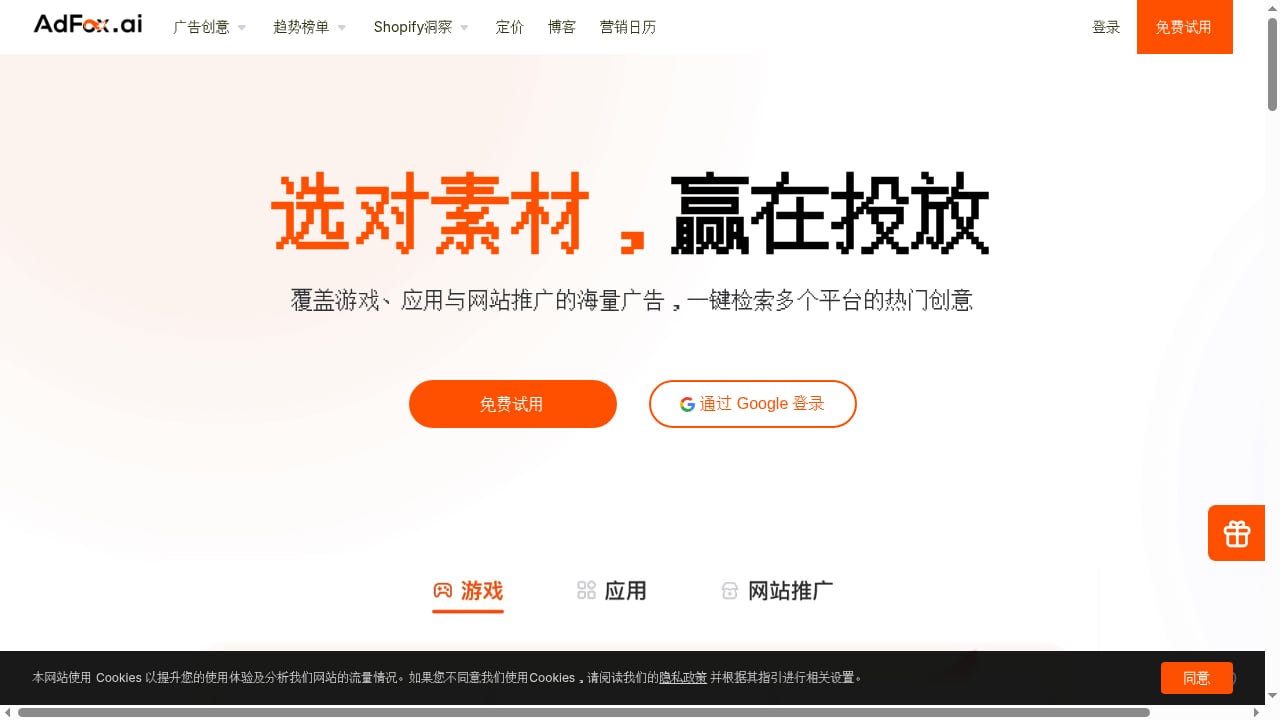
First viewport screenshot of AdFox - Global Ad Intelligence Platform.
AdFox (formerly GoodsFox) aggregates ad creatives and campaign data from more than 30 advertising platforms across 130+ regions, covering games, mobile apps, and websites. Its feature set includes an ad library with filters for style, time, region, and performance; Google Search Ads; W2A landing pages; top charts for apps and websites; traffic rankings; Shopify insights; and trending product directories.
Why it ranks here: the combination of creative search and ecommerce signals is unusually practical. A seller can move from a trending product to the ads promoting it without switching tools.
Best for: growth marketers, performance marketers, brand managers, and agencies making data-driven advertising decisions.
Pricing: 3-day free trial, monthly, quarterly, and annual plans, plus custom enterprise options. An affiliate program offers 20% recurring commissions.
4. Similarweb Digital Intelligence — Best for Enterprise Brand Research
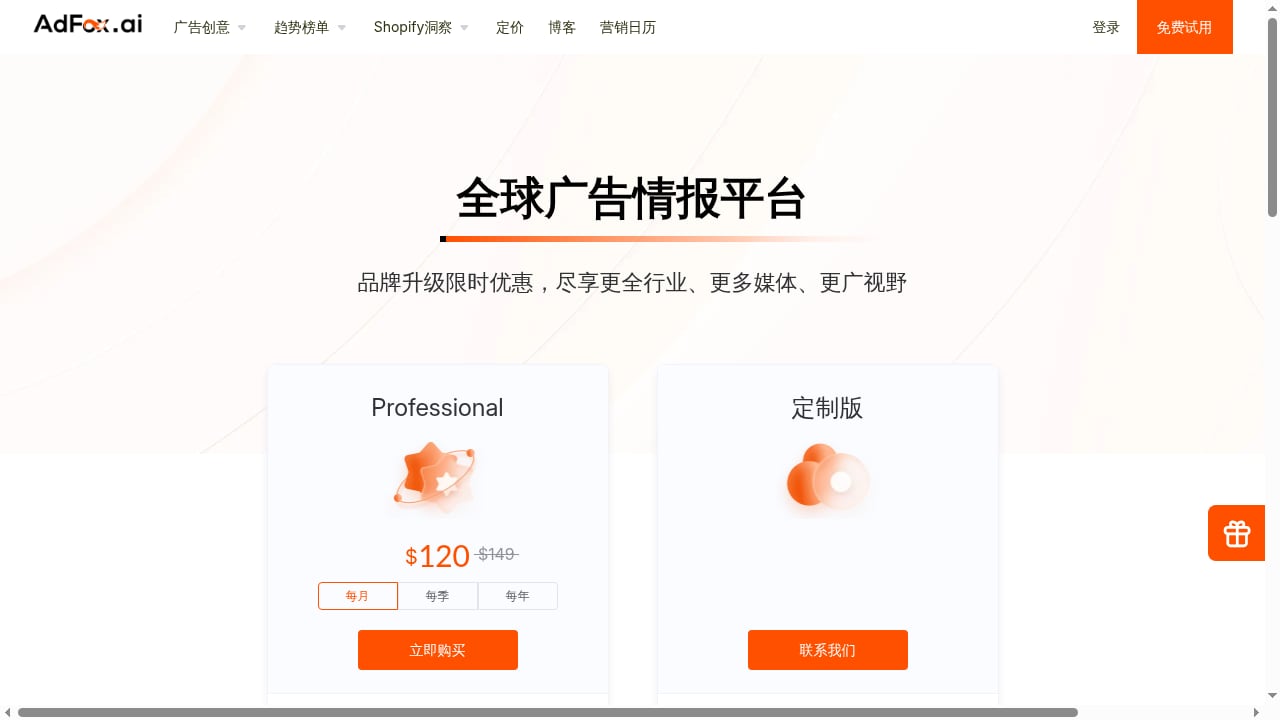
First viewport screenshot of Pricing - AdFox (Formerly GoodsFox).
Similarweb covers display, programmatic, and paid search with high brand-level data depth and enterprise API access. It is built for large-scale market and competitor analysis rather than quick creative inspiration.
Why it ranks here: few platforms match its brand-level benchmarking across paid and organic channels.
Best for: enterprise research teams and brands that need market-level intelligence.
Watch: custom pricing and a heavier onboarding curve.
5. Semrush .Trends — Best Add-On for SEO Teams Doing Paid Research
Semrush .Trends adds display, programmatic, and paid search intelligence to an existing Semrush subscription. For teams already using Semrush for organic research, it is the lowest-friction way to add competitor ad visibility.
Why it ranks here: integration value. You keep one dashboard for organic and paid competitor research.
Best for: SEO and content teams expanding into paid media analysis.
Watch: it is an add-on, not a standalone ad intelligence platform.
6. SpyFu — Best for PPC-Focused Teams
SpyFu focuses on Google Ads and Bing Ads, with keyword-level competitor research and historical ad data. It answers a specific question well: what search terms is this competitor bidding on, and how has that changed?
Why it ranks here: search ad intelligence is a distinct discipline, and SpyFu does it at an accessible price (from around $39/month).
Best for: PPC managers and search-focused agencies.
Watch: no meaningful social or display coverage.
7. Pathmatics by Sensor Tower — Best for CPG and Large Brand Advertisers
Pathmatics delivers display, video, social, and mobile ad intelligence at high brand-level depth, with enterprise API access. It is a staple for large advertisers tracking share of voice.
Why it ranks here: its spend and placement modeling is among the most established in the display space.
Best for: enterprise CPG and brand advertisers.
Watch: custom pricing puts it out of reach for small teams.
8. Minea — Best for Ecommerce and Dropshipping Product Research
Minea combines ad search with product discovery, optimized for finding winning products on Meta and TikTok before launch. Pinterest coverage is a genuine differentiator for fashion and home goods.
Why it ranks here: it fits the ecommerce research workflow — product first, ads second — better than generalist tools.
Best for: dropshippers and DTC founders doing early product validation.
Pricing: from around $49/month, with quarterly and annual options.
Watch: limited coverage outside Meta, TikTok, and Pinterest; if you are not in ecommerce, much of the value is unused.
9. BigSpy — Best Budget Option for Multi-Network Breadth
BigSpy markets a very large ad database across Facebook, Instagram, TikTok, YouTube, Twitter, Pinterest, Yahoo, Unity, and AdMob, with a free tier and low entry pricing.
Why it ranks here: network breadth at a price point that undercuts most competitors.
Best for: solo buyers who need occasional cross-network ad inspiration.
Watch: we could not verify its pricing table in 2026 — the page failed to render for our check. Confirm the current price in a browser before committing. The interface is also less polished than the leaders.
10. AdLibrary — Best for Multi-Platform Research and API Workflows
AdLibrary covers eight platforms — Facebook, Instagram, TikTok, YouTube, Snapchat, Pinterest, LinkedIn, and Google — in one unified search interface, with an AI enrichment layer that adds hook category, format type, offer type, CTA language, and emotional angle to each ad. A Business-tier API supports programmatic research.
Why it ranks here: the enrichment layer turns browsing into structured competitor ad research, and the API is a real differentiator for agencies and AI workflow builders.
Best for: agencies and multi-platform research teams.
Pricing: Starter from €29/month (50 credits), Pro €179/month (300 credits), Business API €329/month.
Watch: credits are consumed by search and AI enrichment, so heavy users should model usage before choosing a tier.
Comparison: Which Platform Fits Your Workflow?
First viewport screenshot of Policy Center.
| Buyer type | Best fit | Why |
|---|---|---|
| App and social growth teams | SocialPeta | Social plus mobile app ad intelligence in one workspace |
| Display and brand marketers | AdClarity, Pathmatics | Display, video, and programmatic depth |
| Ecommerce and dropshipping | AdFox, Minea | Product discovery paired with ad research |
| PPC and search teams | SpyFu | Google and Bing keyword-level competitor data |
| SEO teams adding paid research | Semrush .Trends | Add-on inside an existing Semrush workflow |
| Agencies needing API access | AdLibrary | Enriched fields and programmatic access |
| Budget-conscious solo buyers | BigSpy | Broad network coverage at low cost |
A practical rule: start with the free official libraries — Meta Ad Library, TikTok Creative Center, and Google Ads Transparency Center — and only pay once you can name the specific thing they fail to do for you. Paid platforms buy cross-platform search, saved workflow, and team collaboration, not fundamentally different data.
Where Adjacent Tools Fit
Some workflows need a lighter, faster layer alongside a full ad intelligence platform. PrimeSpy is an ad spy and competitor tracking tool for performance marketers, ecommerce brands, and agencies, with a searchable database of over 120 million ads across Meta and TikTok, smart search by keyword, URL, or advertiser, and 24/7 monitoring with email alerts. It is not part of this ranking, but if your bottleneck is real-time Meta and TikTok tracking rather than broad market intelligence, it is worth evaluating as a complement. You can see how it compares in our PrimeSpy vs Minea vs SocialPeta breakdown.
If your research extends into product sourcing, our Top 10 e-commerce product research and dropshipping spy platforms covers that adjacent category.
Related reading
- How to Use PrimeSpy with AdCreative.ai for High-Converting Ads - Combine PrimeSpy ad intelligence with AdCreative.ai generation to research winning ads, produce scored variants, and scale high-converting creative.
- PrimeSpy vs SpreshApp: Ad Spy Tools Compared for 2026 - PrimeSpy vs SpreshApp compared on ad database size, platform coverage, tracking, filters, and pricing to help you choose the right ad spy tool.
- Competitive Intelligence for Online Marketers Review: Ad Spy Tested - Hands-on review of Competitive Intelligence for Online Marketers: native and push ad spying, pricing signals, setup, strengths, limits, and who it fits.
Sources and further reading
- Best Ad Spy Tools in 2026: 10 Platforms Compared - Four of the ten best ad spy tools are free, official, and run by the ad platforms themselves — which changes what the paid six are actually selling. Real 2026 pricing where vendors publish it, an honest note where they don't, and the coverage wall that limits every tool on this list. Verified 2026-08-11.
- Best Ad Intelligence Tools in 2026: Compare Top Platforms - PrimeSpy - Discover the best ad intelligence tools for competitor research, creative analysis, campaign monitoring, and paid media optimization. Compare features, use cases, and pricing.
- Best Advertising Intelligence Tools 2026: 9 Compared Across Platform Coverage, Data Depth, and Real Workflow Fit - 9 best advertising intelligence tools compared by platform coverage, data depth, and workflow fit — with a clear winner for every buyer type and use case.
FAQ
What is an ad intelligence platform?
It is software that collects and organizes advertising data from public ad libraries, transparency centers, and network crawlers, then adds search, filtering, and analysis so marketers can study competitor campaigns and creative trends.
Are ad intelligence platforms worth paying for in 2026?
Only if you can name what the free official libraries fail to do for you. Paid tools add cross-platform search, saved boards, team collaboration, alerts, and API access. If you research one channel occasionally, the free libraries may be enough.
Can ad intelligence tools show real competitor ad spend?
No. Spend figures are modeled estimates, not disclosures. Use them for directional comparison only. Ad run duration is the most reliable performance signal available.
Which platform is best for ecommerce sellers?
AdFox and Minea are the strongest fits, because both pair product discovery with ad research. AdFox adds broader regional and platform coverage; Minea is more focused on Meta, TikTok, and Pinterest.
Do I need an API for ad intelligence?
Only for programmatic research at scale — for example, feeding enriched ad data into internal dashboards or AI pipelines. AdLibrary and Similarweb offer API access at higher tiers.
Conclusion
The best ad intelligence platform in 2026 depends on which problem you actually have. SocialPeta leads for general social and app research, AdClarity and Pathmatics for display and brand intelligence, AdFox and Minea for ecommerce, and SpyFu for search. Start with the free official libraries, define the gap they leave, then pay for the platform that closes it. Verify pricing directly with each vendor before you commit, and treat every spend estimate as a signal rather than a fact.