
Top 10 Ad Creative Intelligence & Management Platforms 2026
Ad creative intelligence and management platforms sit between two older categories: ad spy tools that show you what competitors run, and creative automation tools that mass-produce variants. The tools that matter in 2026 do something harder — they collect creative, tag and score it against real performance, store it in a searchable library, and push the next brief or variant back into your ad account.
This review ranks ten platforms that genuinely belong to that category. Every entry was evaluated against the same criteria, and every claim below is tied to documented features or published pricing rather than marketing language.
How we evaluated these platforms
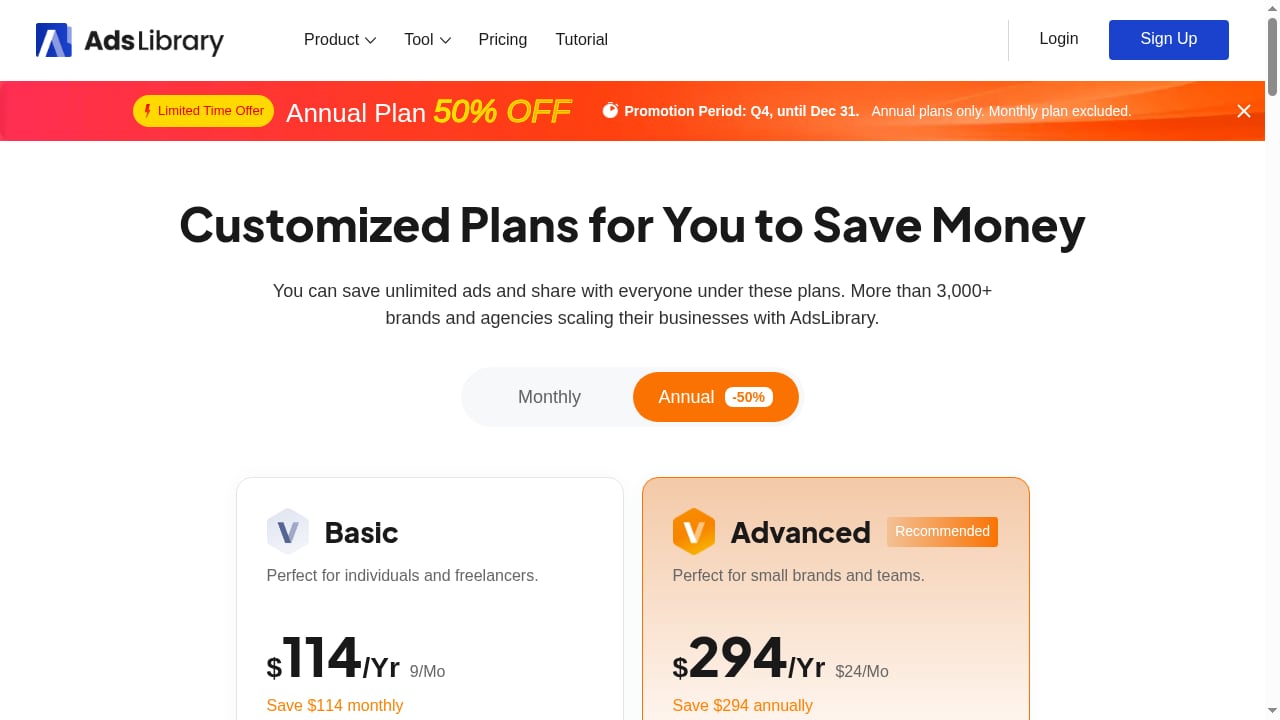
First viewport screenshot of AdsLibrary Pricing: Choose a Plan to Save & Manage Ads from Facebook, TikTok & Instagram.
We scored each product on six criteria:
- Creative intelligence depth — does it tag hooks, angles, formats, and elements, and connect them to performance metrics?
- Management and workflow — can teams save, group, annotate, brief, and approve creative in one place?
- Ad library coverage — which networks and libraries it reads from (Meta Ad Library, TikTok Creative Center, YouTube, Instagram, and others).
- Data grounding — does scoring come from your own account data, a third-party model, or competitive data only?
- Team and collaboration features — sharing, permissions, exports, and handoff to design or media buying.
- Pricing transparency — published tiers versus custom-quote-only enterprise pricing.
One deliberate exclusion: PrimeSpy is an ad intelligence and competitor tracking tool, not a creative intelligence and management platform. It belongs in a different category and is not ranked here. It appears later only where it is genuinely useful as a complementary research layer.
Quick comparison
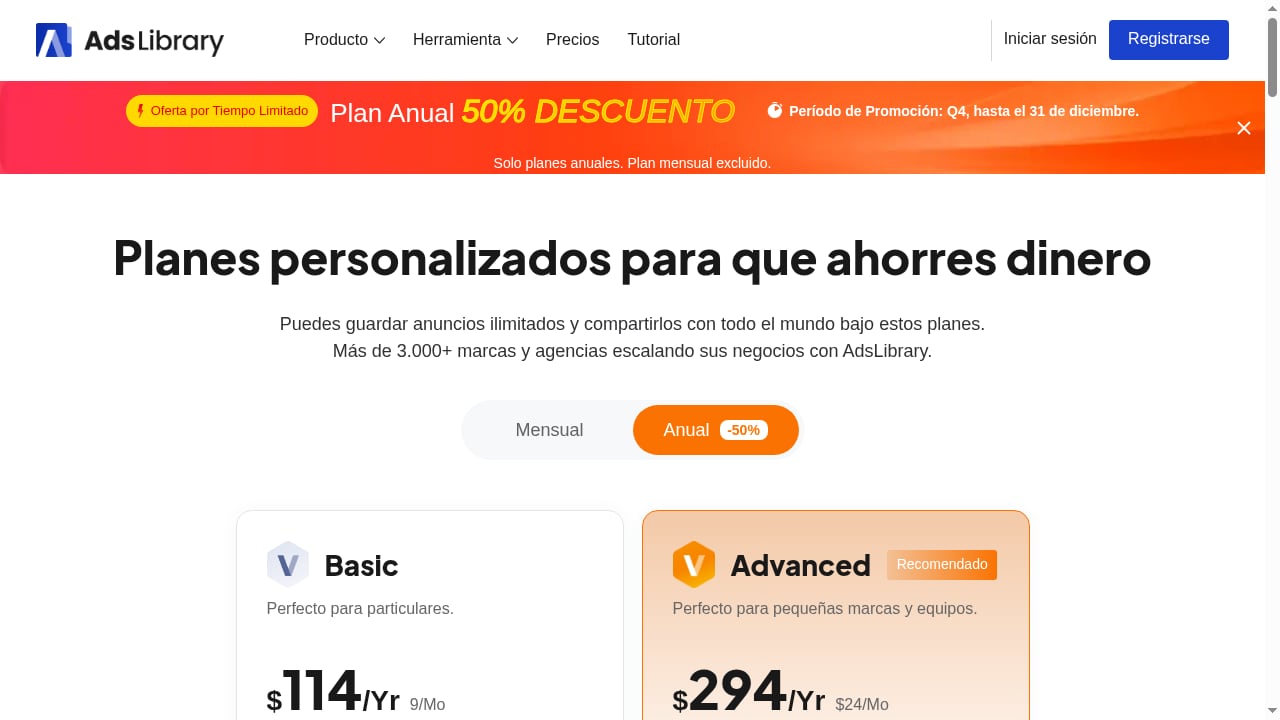
First viewport screenshot of AdsLibrary Pricing: Choose a Plan to Save & Manage Ads from Facebook, TikTok & Instagram.
| Platform | Best for | Starting price | Core strength |
|---|---|---|---|
| Atria | Performance marketers on Meta | $129/mo | Creative grading tied to your own ad spend |
| Segwise | Multi-network UA and app teams | Custom | Element-level tagging across 15+ networks and MMP data |
| Foreplay | Agencies and creative strategists | Published tiers | Swipe files and queryable competitor ad library |
| AdsLibrary | Media buyers saving and sharing ads | Free tier | Saving ads from Ad Library, TikTok Creative Center, and IG into groups |
| Smartly | Enterprise paid social | Custom | Creative-to-media automation at scale |
| AdCreative.ai | High-volume static production | ~$29/mo | Bulk variant generation with predictive scoring |
| Pencil | DTC brands on Meta and TikTok | From $119/mo | Predictive scoring plus video concept generation |
| Creatopy | Design teams needing brand control | From $45/mo | Template-to-export scale with locked brand kits |
| Marpipe | Multivariate creative testing | From $499/mo | Structured variant testing at scale |
| Celtra | Global brands and programmatic | Custom | Enterprise DCO across many media platforms |
Prices reflect published figures as of 2026 and should be confirmed with each vendor.
1. Atria — best for creative decisions grounded in your own ad spend
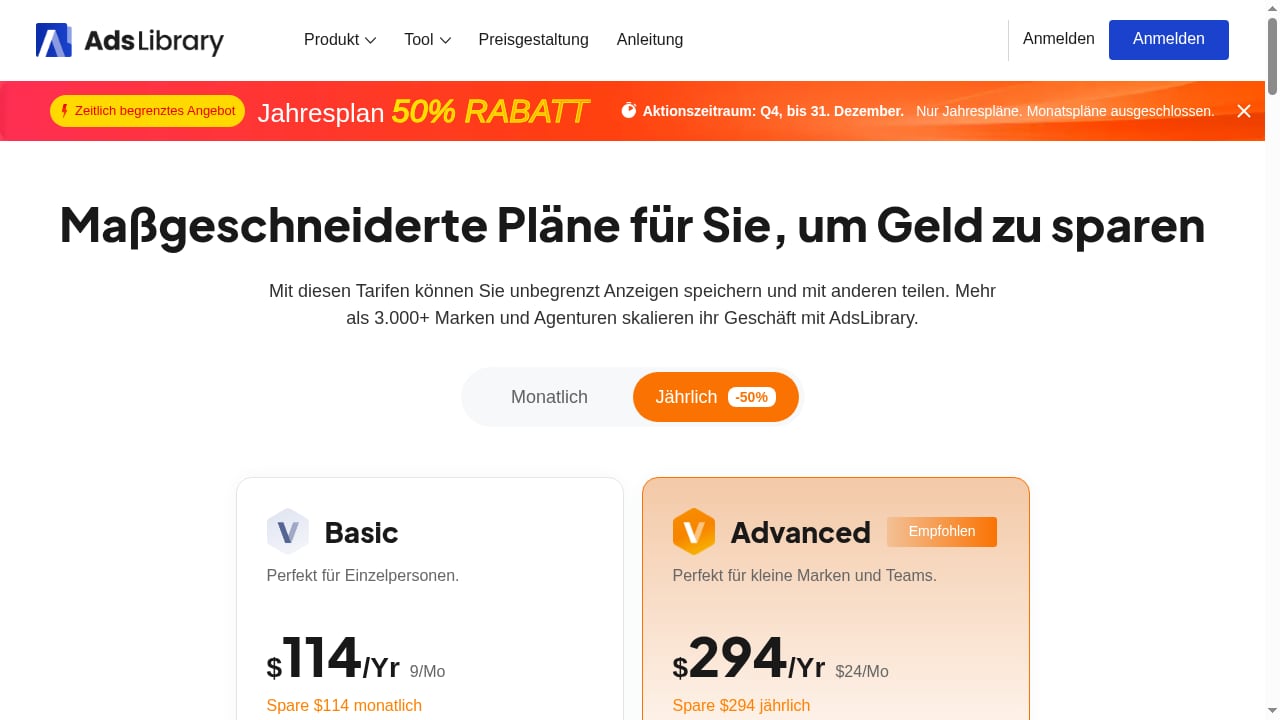
First viewport screenshot of AdsLibrary Pricing: Choose a Plan to Save & Manage Ads from Facebook, TikTok & Instagram.
Atria is an AI creative intelligence and workflow platform for paid social. Its differentiator is sequencing: instead of starting from a blank template, it analyzes what is already converting in your Meta account and builds the next round from that.
Key capabilities
- Automatic tagging of hook, persona, USP, and format as ads come in
- An always-on grading engine that scores every live ad in plain language and flags hook fatigue
- Winning-formula generation that produces new concepts, scripts, and images from top performers
- Bulk launch to Meta with automated scaling of winners and pausing of underperformers
Trade-offs: reporting and automation are Meta-first, so teams running other networks still need a second tool for that data. The intelligence layer also depends on connecting an account with real spend history — new advertisers get less from it initially.
Pricing: from $129/month. See our Atria review for a hands-on breakdown of strengths and billing considerations.
2. Segwise — best for element-level creative intelligence across networks
Segwise runs a full loop: connect ad networks and attribution partners, tag every element of every ad, then generate the next round from winning patterns.
Key capabilities
- Connections to 15+ ad networks and MMPs, including Meta, TikTok, Google, and major attribution providers
- A tagging agent that labels hook lines, on-screen CTAs, audio, characters, and playable ad elements
- Every tag mapped to CPI, ROAS, CTR, and installs, so patterns become numbers rather than hunches
- A strategy chat that answers questions from your own account data, plus fatigue alerts by email or Slack
- Competitor tracking that applies the same tagging to rival ads
Trade-offs: the value scales with creative volume. Teams testing only a handful of creatives per month will not generate enough data for element-level patterns to be reliable.
Pricing: custom.
3. Foreplay — best for competitor research and swipe files
Foreplay is a creative research tool built around saving competitor ads, organizing swipe files, and writing briefs from what you find.
Key capabilities
- A large searchable library of competitor ads across Meta, TikTok, YouTube, and more
- Each saved ad retains assets, copy, CTAs, and transcripts
- Query access that lets AI assistants pull from the library when drafting briefs
- Brief-building workflow that turns saved ads into production direction
Trade-offs: it reads the market, not your account. If your question is which of your own ads is fatiguing, Foreplay will not answer it.
Pricing: published tiers; confirm current rates with the vendor.
4. AdsLibrary — best for saving, grouping, and sharing ads from multiple libraries

First viewport screenshot of AdsLibrary: Save Ads from Ad Library, TikTok, YouTube & IG.
AdsLibrary is the practical choice for media buyers who need a clean way to capture ads from Meta Ad Library, TikTok Creative Center, YouTube, and Instagram, then organize them into groups and share them with a team.
Key capabilities
- Saving ads from Ad Library, TikTok Creative Center, and Instagram in one place
- Grouping saved ads by client, angle, format, or campaign
- Team sharing so strategists and buyers work from the same reference set
- A workflow aimed at improving ad creative through structured reference rather than scattered screenshots
Trade-offs: it is a capture and organization layer, not an analytics engine. It will not score your live ads or connect creative elements to ROAS on its own.
Pricing: free tier available.
5. Smartly — best for enterprise creative-to-media automation
Smartly connects creative production directly to ad delivery across Meta, Google, Pinterest, Snap, and TikTok.
Key capabilities
- Dynamic creative optimization feeds that map product IDs to headlines and image matrices
- Automated variant serving at scale, suited to catalogs with hundreds or thousands of SKUs
- A connected workflow where creative and media buying share one system
Trade-offs: pricing and implementation complexity put it out of reach for smaller teams. Setup takes weeks, and the ROI math generally assumes substantial monthly ad spend.
Pricing: custom enterprise.
6. AdCreative.ai — best for high-volume static variants
AdCreative.ai generates static ads, banners, and social creatives in bulk from a brand kit, then scores each one for predicted performance before launch.
Key capabilities
- Bulk generation of sized creatives with copy variations included
- Predictive scoring trained on the vendor's own conversion dataset
- Fast turnaround from product image to dozens of variants
Trade-offs: the score comes from a model, not your account history, so treat it as a pre-filter rather than a verdict. It also generates strictly inside the brief you provide — weak briefs produce many variants that miss in the same direction.
Pricing: from roughly $29/month.
7. Pencil — best for DTC brands wanting predictive scoring plus video concepts
Pencil targets DTC brands running Meta and TikTok, combining predictive creative scoring with a video concept generator.
Key capabilities
- A scoring model trained on ecommerce ad performance
- Storyboarded video variants generated from a text brief
- Learning-phase tracking that flags when a creative has enough signal to inform the next brief cycle
Trade-offs: the predictions are only as good as the brief behind them, and the tool is strongest for product-based campaigns rather than brand or service advertising.
Pricing: from $119/month.
8. Creatopy — best for design teams that need brand-governed production
Creatopy is a design-team tool first and an AI tool second. Its strength is production discipline across many formats.
Key capabilities
- Automated resizing across dozens of placements
- Brand-lock systems that keep fonts, colors, and logos consistent
- AI copy assistance and template-to-export workflows
Trade-offs: it is built for production, not creative intelligence. It will not tell you which angle is winning in your category.
Pricing: from $45/month.
9. Marpipe — best for structured multivariate creative testing
Marpipe focuses on testing creative at scale, generating automated variants for structured experiments.
Key capabilities
- Multivariate variant generation for creative experiments
- A testing framework that isolates which elements drive results
- Meta-focused delivery
Trade-offs: the price point and testing-first design suit teams with a real experimentation budget, not casual testing.
Pricing: from $499/month.
10. Celtra — best for enterprise DCO across many media platforms
Celtra handles enterprise-grade dynamic creative optimization and creative production across a wide range of media platforms.
Key capabilities
- Cross-format DCO with brand safety controls
- DSP integrations and rich media support
- Performance-linked variant generation for global campaigns
Trade-offs: enterprise pricing and implementation overhead. It is not a self-serve tool for small teams.
Pricing: custom enterprise.
Where ad intelligence tools fit alongside these platforms
Creative intelligence platforms answer what is working in your account. Ad intelligence tools answer what is working in the market. Most teams need both, and they are not substitutes.
This is where a tool like PrimeSpy becomes relevant as an adjacent research layer rather than a ranked member of this category. It searches a large database of ads across Meta and TikTok, tracks competitor activity, and surfaces new creatives and landing page changes with monitoring and notifications. Teams use it to validate angles before briefing a creative intelligence platform, or to spot competitor refreshes between campaign cycles. If you are comparing that layer against alternatives, our PrimeSpy vs AdSpyder comparison covers coverage, tracking, and pricing differences.
For a broader view of how research, testing, and attribution tools combine, see our performance marketing tools stack guide.
How to choose in 2026
Ask four questions before you buy:
- What data does it run on? Your own account data produces grounded recommendations. A third-party model produces directional guesses. Competitive data produces market context. Know which one you are buying.
- Do you need answers or actions? Analysis tools tell you which hook performed best. Action tools pause ads, shift budget, or ship variants. Many teams need one of each.
- How many creatives do you ship per month? Element-level intelligence needs volume to find patterns. Below roughly ten thousand dollars in monthly spend, lean on platform-native automation and a strong research workflow instead.
- Who touches the tool? A solo media buyer needs speed and capture. A team of five needs sharing, permissions, and briefs. An enterprise needs governance and approvals.
A practical starting stack for most teams: a capture and organization layer for reference ads, one creative intelligence platform tied to your own performance data, and a research tool for market context.
Related reading
- How to Use PrimeSpy with MagicBrief (2026 Workflow) - Learn how to pair PrimeSpy ad intelligence with MagicBrief creative workflows before the July 2026 shutdown, plus Canva Grow migration steps.
- PrimeSpy vs Adplexity Social vs Swipekit: 2026 Comparison - Compare PrimeSpy, Adplexity Social, and Swipekit for Facebook Ad Library downloads, competitor tracking, creative research, and pricing in 2026.
Sources and further reading
- The 9 Best Ad Creative Automation Platforms I Tested for 2026 - Creative automation platforms generate ad variations at scale, cutting design time. I researched and tested dozens, and here are the 9 best for 2026.
- Best AI Agents for Ad Creative and Performance Marketing in 2026 - What is an AI agent for ad creative and performance marketing? An AI agent for ad creative and performance marketing reads your own ad account data and does one of two jobs. It answers questions about your creatives, or it changes your creatives and campaigns.
- Automated Ad Creation Platforms Compared: 10 Best in 2026 - Compare 10 automated ad creation platforms side-by-side — features, pricing tiers, best use cases, and where adlibrary fits into the stack for media buyers in 2026.
FAQ
What is an ad creative intelligence and management platform? It is software that collects ad creative, tags and scores it against performance data, stores it in a searchable library, and supports the workflow around it — saving, grouping, briefing, sharing, and generating the next round of variants.
How is this different from a creative automation tool? Automation tools multiply a brief into variants. Intelligence platforms decide which brief is worth multiplying, using tagging, scoring, and performance data. The best 2026 tools do both, but the intelligence layer is what separates them.
Is PrimeSpy part of this category? No. PrimeSpy is an ad intelligence and competitor tracking tool. It belongs in the ad spy and competitive analysis category, and it is useful alongside these platforms as a market research layer.
Do I need more than one tool? Usually yes. Capture, intelligence, and research solve different problems. Teams that try to cover all three with one product typically end up with strong data and a weak workflow, or the reverse.
What should I check before paying? Confirm which networks are actually supported, whether scoring uses your account data or a vendor model, how exports and team sharing work, and whether pricing is published or quote-only.
Conclusion
The 2026 creative intelligence category rewards teams that connect three things: a clean capture workflow, element-level tagging tied to real performance, and a fast path from insight to new variants. Atria and Segwise lead on intelligence depth, Foreplay and AdsLibrary lead on capture and research workflow, and Smartly, Celtra, and Marpipe serve teams whose bottleneck is scale or structured testing.
Start with the question you cannot currently answer — which angle is winning, what competitors are running, or how to produce the next hundred variants — and buy the tool that closes that specific gap first.