
Proven SaaS Review 2026: Revenue Intelligence and Ad Spy for SaaS Builders
Most SaaS validation advice tells you to talk to 30 people, run a $47 ad test, or mine one-star reviews for pain points. Those methods work, but they share a blind spot: none of them tell you whether a market is already making money. Proven SaaS attacks that gap directly. It is a competitive intelligence platform that tracks 14,500+ SaaS products earning between $10k and $500k in monthly recurring revenue (MRR), then layers ad spy and audience data on top so you can see what is working before you build.
This review covers what Proven SaaS actually does, where its data is strong, where it is thin, what the pricing signals suggest, and how to decide whether it belongs in your research stack.
What Proven SaaS does
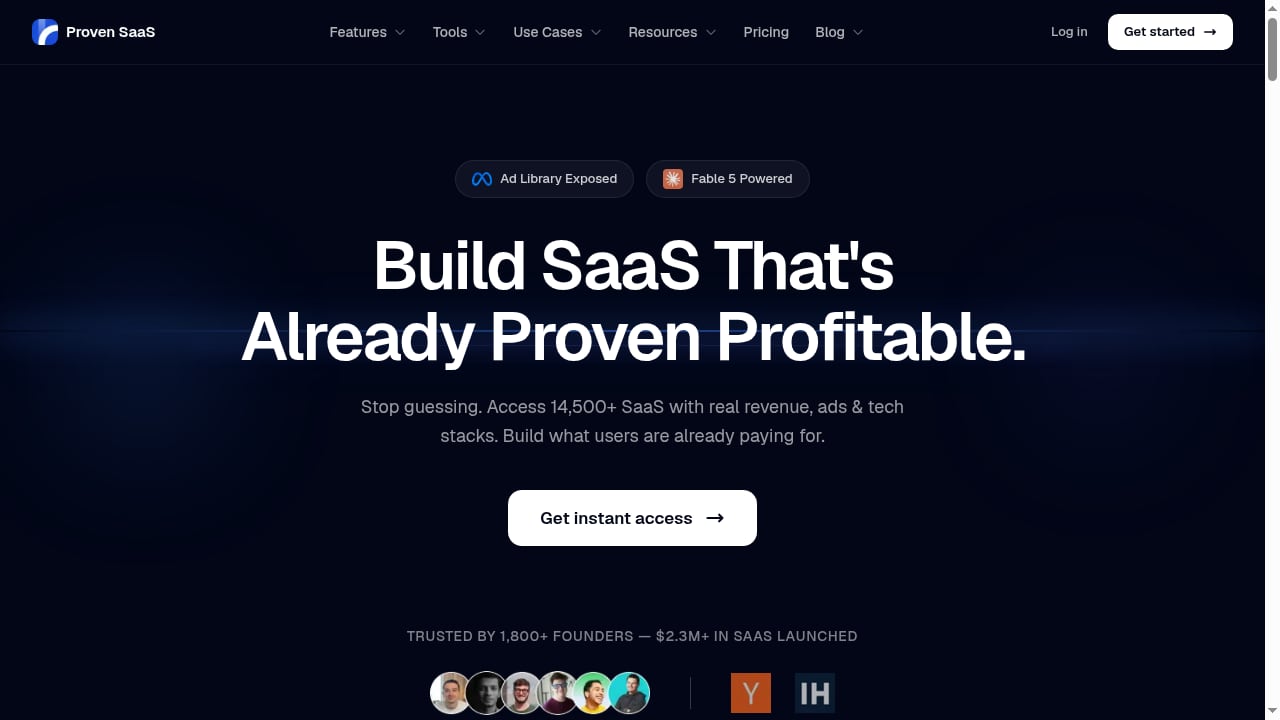
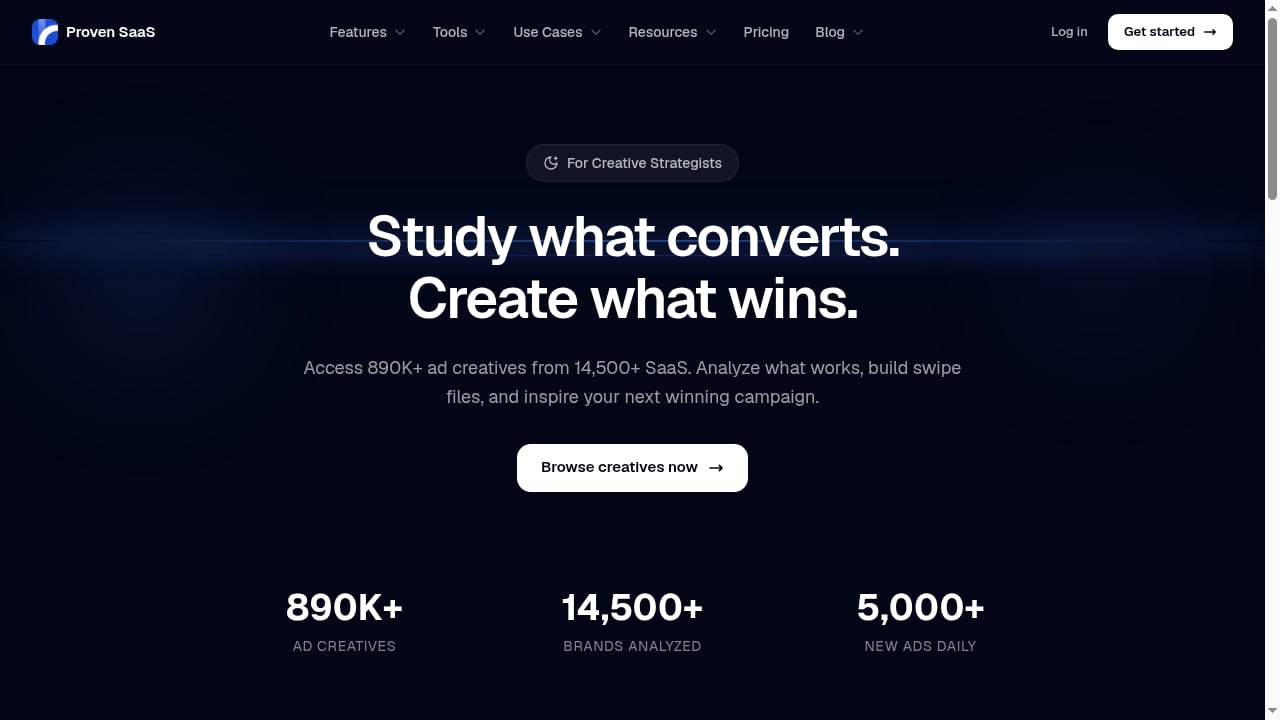
First viewport screenshot of proven-saas.com.
Proven SaaS sits at the intersection of two categories: SaaS revenue intelligence and ad spy. The core promise is simple — stop guessing which SaaS ideas are profitable and study companies that already clear real revenue.
Revenue Intelligence
The flagship feature estimates competitor MRR and ARR. Instead of relying on founder tweets or public launch posts, you get modeled revenue bands for thousands of products. The $10k–$500k MRR filter is deliberate: it excludes hobby projects and mega-SaaS outliers, focusing on the range where indie founders and small studios actually compete.
Ad Library and Facebook Ad Spy
The platform includes a library of winning ad creatives plus a Facebook Ad Spy tool. You can inspect the ads competitors run, how long they have been active, and which angles they repeat. Long-running creatives are the closest thing to public proof that an ad pays for itself.
Audience Insights
Demographics, geographies, and targeting signals help you understand who a competitor's ads reach. This is useful for media buyers and creative strategists who need to reverse-engineer a funnel, not just copy a headline.
The supporting toolkit
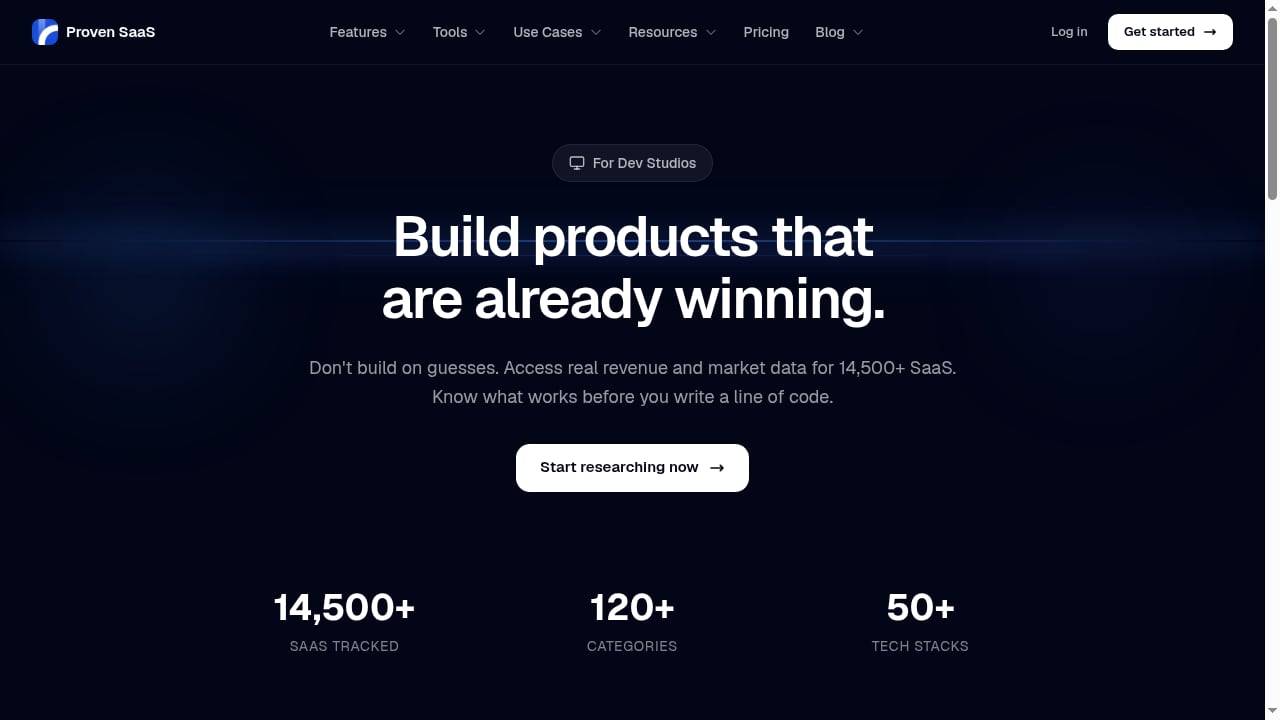
Proven SaaS bundles several utilities: an Ad Spend Estimator, Competitor Finder, Niche Validator, Revenue Calculator, and Ad Creative Analyzer. There is also an API for teams that want to build on the data, plus company profiles, benchmarks, and guides.
Who Proven SaaS is for
First viewport screenshot of proven-saas.com.
| User type | Primary use case | Value level |
|---|---|---|
| SaaS founders pre-build | Validate a niche against real revenue data | High |
| Dev studios and agencies | Source product ideas for clients or internal bets | High |
| Media buyers | Spy on competitor SaaS ad strategies | Medium–high |
| Creative strategists | Study winning ad formats and angles | Medium |
| Enterprise competitive intel teams | Deep market mapping | Low |
SaaS founders and indie hackers
If you are choosing between three product ideas, revenue bands are a faster filter than interviews. A niche with a dozen $30k–$80k MRR competitors is a different bet than one with two $200k leaders and no middle class.
Dev studios and agencies
Studios that ship client products benefit from repeatable market scans. The Competitor Finder and Niche Validator shorten the discovery phase before a paid engagement.
Media buyers and creative strategists
For teams running SaaS ads, the Ad Library and Ad Spend Estimator answer a practical question: what does it cost to compete in this category, and which creative formats keep running?
Strengths
- Revenue-first framing. Most ad spy tools show you ads. Proven SaaS shows you ads next to estimated revenue, which is the context that matters for SaaS.
- A focused MRR band. The $10k–$500k range is where validation is most actionable. You are not studying Stripe or Notion; you are studying companies you could realistically compete with.
- Bundled workflow. Discovery, validation, ad research, and spend estimation live in one subscription instead of four.
- API access. Teams that want to feed data into dashboards or internal tools have a path beyond the UI.
- Useful benchmarks. Company profiles and category benchmarks help you sanity-check your own growth assumptions.
Limitations
- Estimates are estimates. MRR figures are modeled, not audited. Treat them as directional bands, not accounting. A product showing $50k MRR might be at $35k or $70k.
- SaaS-only scope. If you sell ecommerce products or run lead-gen campaigns, the dataset will feel narrow. Ecommerce researchers should look at dedicated product research tools instead — see our roundup of ecommerce spy and product research software.
- Ad coverage skews to Meta. The Facebook Ad Spy is the headline; teams running TikTok-first or Google-first acquisition will get less from it.
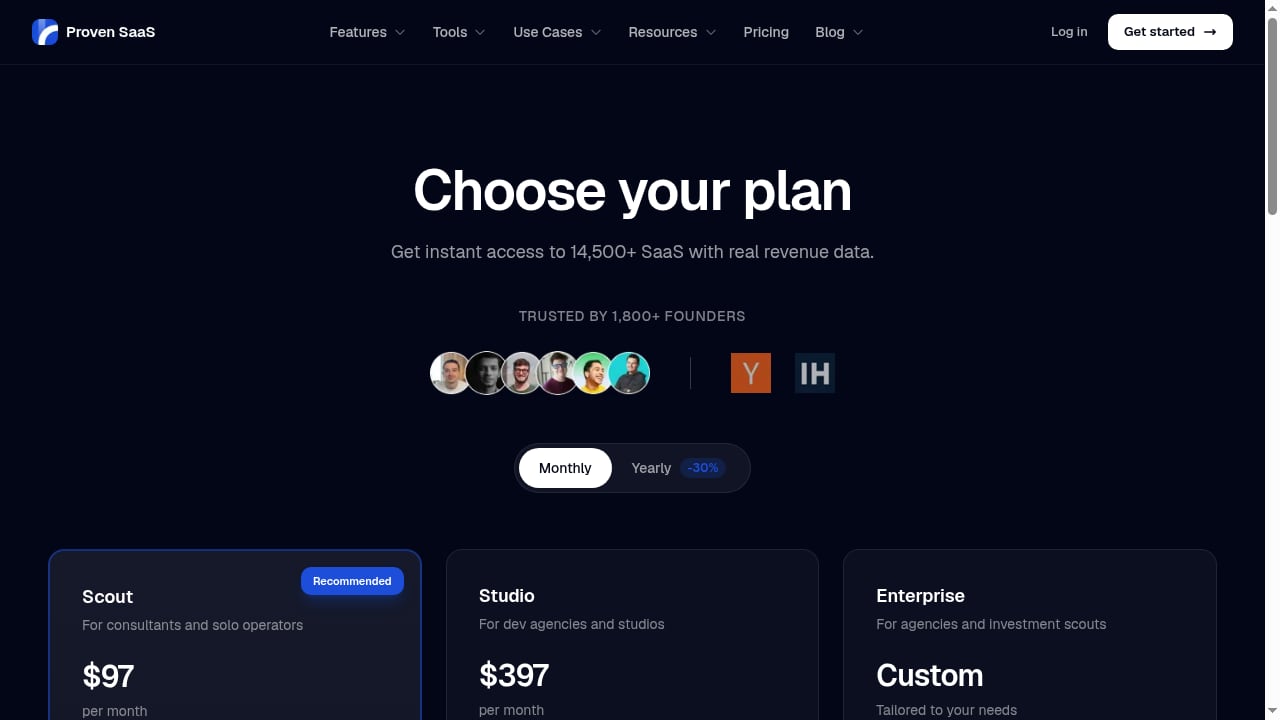
- Pricing opacity. Subscription-based pricing is confirmed, but specific tiers are not published in the material available. Budget for a sales conversation or trial before committing.
- Data is not a substitute for customer conversations. Revenue data tells you a market exists. It does not tell you why customers churn or what they wish existed.
Pricing signals
Proven SaaS is subscription-based. Because public tier details are not documented, the honest guidance is to evaluate it on cost-per-validated-idea rather than sticker price.
A practical frame: if one avoided dead-end build saves you even two weeks of development, the subscription pays for itself. If you are only casually browsing ideas, the value is lower. Teams that run multiple validations per quarter get the most leverage.
Compare that with the alternative research paths. A small Google Ads validation test can cost under $50 but takes days to read. A review-site mining project takes hours of manual tagging. Proven SaaS compresses both into a searchable dataset — that is what you are paying for.
Setup and first workflow
Getting value from Proven SaaS depends on asking narrow questions. A reasonable first session:
- Pick a category you understand. Do not start with the biggest market. Start where you can judge whether the products are good.
- Filter by MRR band. Look for a cluster of competitors in the $20k–$100k range. A healthy middle class signals a market with room for another entrant.
- Pull competitor ad creatives. Note which hooks repeat across companies. Repetition across independent advertisers is stronger evidence than one company's long-running ad.
- Estimate ad spend. Use the Ad Spend Estimator to gauge whether paid acquisition is viable at your price point.
- Cross-check with reviews. Read negative reviews of the top three competitors to find the gap the revenue data cannot show.
- Write a one-page thesis. State the niche, the wedge, the price point, and the acquisition channel. If the data cannot support all four, keep searching.
For teams that also run consumer or ecommerce campaigns, pairing SaaS intelligence with broader ad spy workflows is useful. Our guide to PrimeSpy's TikTok and Meta ad spy tool covers the creative-research side in more depth.
How Proven SaaS compares with alternative validation methods
First viewport screenshot of proven-saas.com.
| Method | Cost signal | Speed | Blind spot |
|---|---|---|---|
| Proven SaaS | Subscription | Fast | Modeled revenue, SaaS-only |
| Customer interviews | Time only | Slow | Small sample, polite answers |
| Small ad test | Low cash | Medium | Tests message, not market size |
| Review mining | Time only | Slow | Skews to unhappy users |
| Public launch data | Free | Fast | Survivorship bias |
The strongest approach combines them. Use Proven SaaS to shortlist markets, then run interviews and a small ad test to confirm demand. That mirrors the scrappy validation playbook many founders describe — test cheaply, then commit. You can read a detailed founder account of that approach in this $47 Google Ads validation story.
Decision criteria: should you buy Proven SaaS?
First viewport screenshot of proven-saas.com.
Buy it if:
- You are choosing a SaaS idea and want revenue evidence before writing code.
- You run a studio or agency that validates multiple product concepts per year.
- You manage SaaS paid acquisition and need competitor creative and spend context.
- You want API access to competitive data for internal reporting.
Skip it if:
- You sell physical products or run ecommerce — a dedicated product research tool fits better.
- You need audited financials rather than estimates.
- Your acquisition is entirely organic and you have no interest in ad intelligence.
- You are not prepared to supplement the data with customer conversations.
A useful sanity check: if you cannot name three decisions the data would change in the next 30 days, the subscription is premature.
Related reading
- Winning Facebook Ad Ideas: 12 Formats That Convert in 2026 - Proven Facebook ad ideas for 2026: hooks, UGC, carousels, comparison ads and retargeting formats, plus how to find winning ads your competitors already run.
- How to Use PrimeSpy with ClickFlare for Smarter Ad Campaigns - Learn how to combine PrimeSpy ad intelligence with ClickFlare server-side tracking to find winning ads, validate them with accurate data, and scale profitably.
- PrimeSpy vs SpreshApp & BIScience: Which Ad Spy Tool Wins? - Compare PrimeSpy, SpreshApp, and BIScience for ad intelligence. See which tool fits your creative research, competitor tracking, and budget in 2026.
Sources and further reading
- The heart of the internet - Hey everyone! I've been growing this application where I analyzed 150k negative reviews on G2 (from 8k+ companies) so that you can uncover potential SaaS opportunities.
- The 6 Best SaaS Review Sites for 2026, Compared - The 6 best SaaS review sites for 2026, compared on listing cost, verification and the exact number of reviews each one needs before your product appears, ranks, or earns a badge.
FAQ
Is Proven SaaS accurate for MRR estimates?
It provides modeled estimates, not audited figures. Use them as directional bands to compare markets, not as precise revenue reporting.
Does Proven SaaS only cover SaaS companies?
Yes. The dataset focuses on 14,500+ SaaS products in the $10k–$500k MRR range. Ecommerce and consumer products fall outside its core scope.
What is included in the Proven SaaS toolkit?
Revenue Intelligence, an Ad Library, Audience Insights, Facebook Ad Spy, Ad Spend Estimator, Competitor Finder, Niche Validator, Revenue Calculator, and Ad Creative Analyzer, plus company profiles, benchmarks, guides, and an API.
How much does Proven SaaS cost?
Pricing is subscription-based, but specific tiers are not detailed in public material. Expect to confirm pricing directly before committing.
Can Proven SaaS replace customer research?
No. It shows whether a market makes money. It does not explain churn reasons, feature gaps, or willingness to switch. Pair it with review mining and interviews.
Who benefits most from the ad spy features?
Media buyers and creative strategists working on SaaS accounts. Founders running their own Meta ads also benefit from seeing which creatives competitors sustain.
Conclusion
Proven SaaS earns its place as a validation layer, not a validation replacement. Its revenue-first dataset is genuinely differentiated: most tools show you ads or traffic, while this one shows you ads next to estimated MRR. The $10k–$500k band keeps the research actionable for founders and small teams.
The limitations are real — modeled estimates, SaaS-only coverage, Meta-heavy ad data, and unpublished pricing tiers. But for anyone choosing between SaaS ideas or reverse-engineering a competitor's paid strategy, the platform compresses weeks of manual research into an afternoon.
Use it to shortlist. Then talk to customers, read the one-star reviews, and run a small test before you build. For a broader view of how ad intelligence tools stack up, see our comparison of ad creative management and competitor ad tracking software.