
How to Use PrimeSpy with Dropship to Find Winning Products
Finding a winning product is rarely about luck. It is about seeing demand before it peaks and confirming that someone is already spending money to satisfy it. PrimeSpy and Dropship approach that problem from two different angles: PrimeSpy shows you what advertisers are running and how their creatives perform, while Dropship helps you find and monitor stores so you can inspect their revenue, sales, products, and ads. Used together, they turn scattered signals into a repeatable product validation workflow.
This guide explains what each tool does, how to connect them into one research loop, and how to avoid the most common mistakes dropshippers make when they rely on ad data alone.
Why one tool is not enough
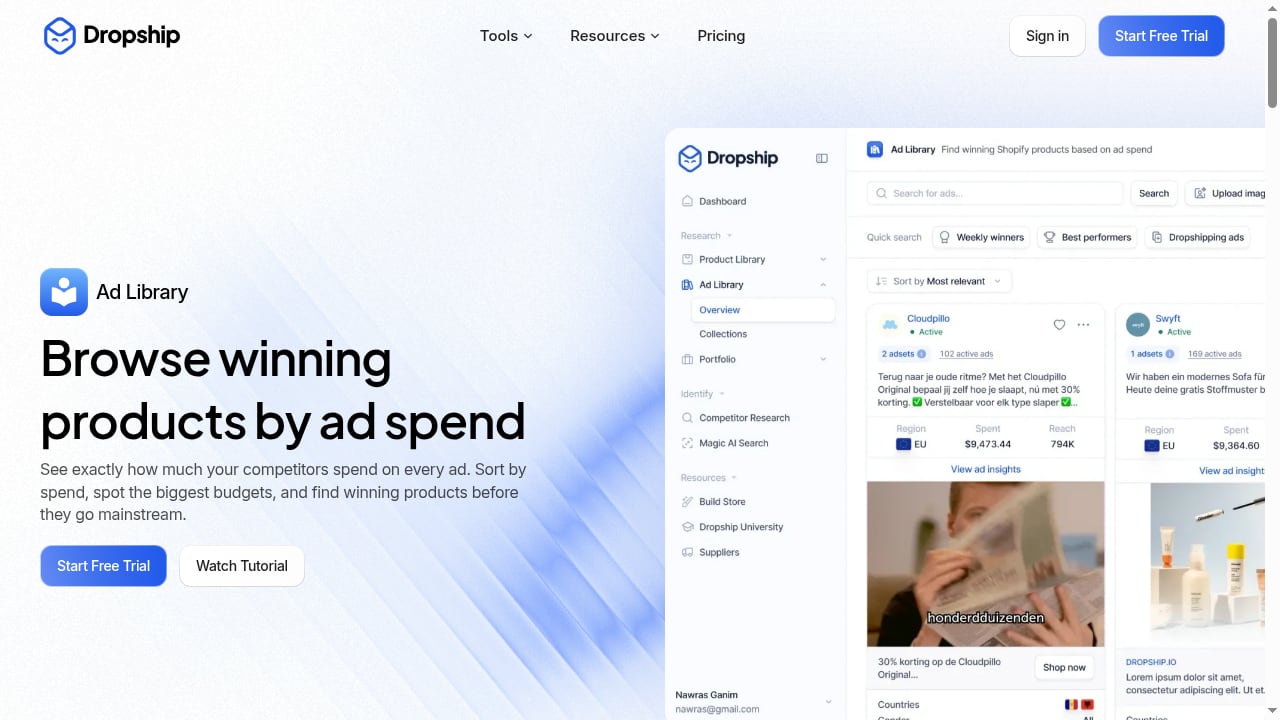
First viewport screenshot of Ad Library - Winning Shopify ads by ad spend | Dropship.
Most dropshippers start with a single source of truth. Some scroll the Meta Ad Library looking for ads that have been running for weeks. Others browse store databases hoping a high-revenue shop will reveal a product they can copy.
Both approaches leave gaps:
- Ad-only research tells you a creative is running, but not whether the store behind it is actually selling at volume or just testing.
- Store-only research shows revenue estimates and product catalogs, but not which creatives are driving those sales or which angles are fatiguing.
PrimeSpy and Dropship fill each other's blind spots. PrimeSpy gives you creative and spend signals across Meta, Instagram, and TikTok, plus a searchable database of over 120 million ads. Dropship gives you the store-level context: who is selling, what they sell, and how their numbers move over time.
What PrimeSpy brings to product research
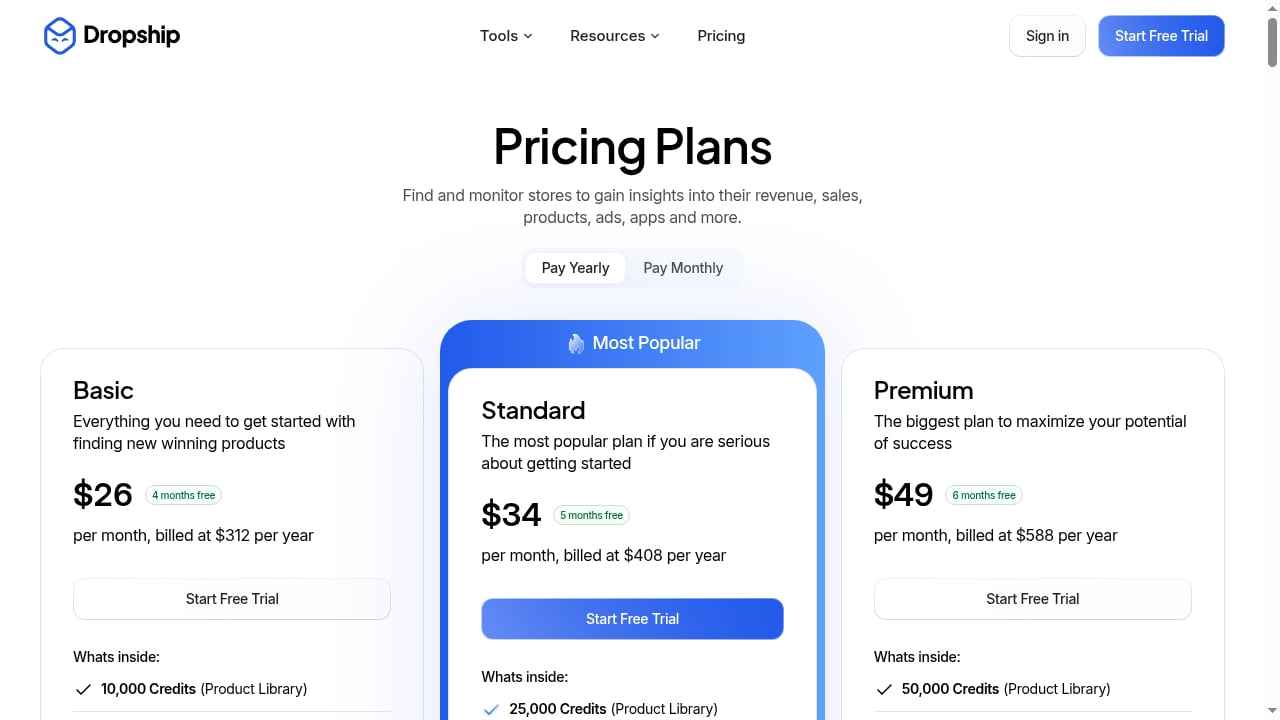
First viewport screenshot of Pricing - Plans for every stage of dropshipping | Dropship.
PrimeSpy is an ad intelligence and competitor ad tracking platform built for performance marketers, ecommerce brands, dropshipping sellers, and agencies. Its core value for product research is signal density.
Key capabilities you will use in a dropshipping workflow:
- Smart search by keyword, URL, or advertiser across Meta and TikTok ad libraries.
- Advanced filters including ad format, CTA type, landing page, reach, spend, duplicates, and EU-specific options.
- Creative signals such as running time, duplicate counts, and reach patterns that hint at scale.
- Ad trackers that monitor competitors 24/7 and email you when new creatives, landing pages, or product updates appear.
- Ecommerce platform filters covering Shopify, WooCommerce, Shoplazza, Shopline, Magento, and Cafe24.
- Daily top products and trend signals that surface rising categories before they saturate.
If you want a deeper comparison of how PrimeSpy stacks up against other ad spy tools, see our breakdown of PrimeSpy vs Dropispy vs AdSpy for dropshippers.
What Dropship brings to product research
Dropship - Discover Winning Products To Sell product interface.
Dropship - Discover Winning Products To Sell is a dropshipping product research platform focused on store discovery and monitoring. Instead of starting from an ad, you start from a store.
Its practical uses in this workflow:
- Find stores in your niche or adjacent niches.
- Monitor stores to track revenue, sales, products, ads, and installed apps over time.
- Inspect product catalogs to see what a store is pushing and when new items appear.
- Compare stores to separate one-hit wonders from operators with consistent sales.
Dropship is strongest when you need to answer: "Is this store actually moving product, or is it just running ads?" That question is hard to answer from ad libraries alone.
The combined workflow: six steps from signal to launch
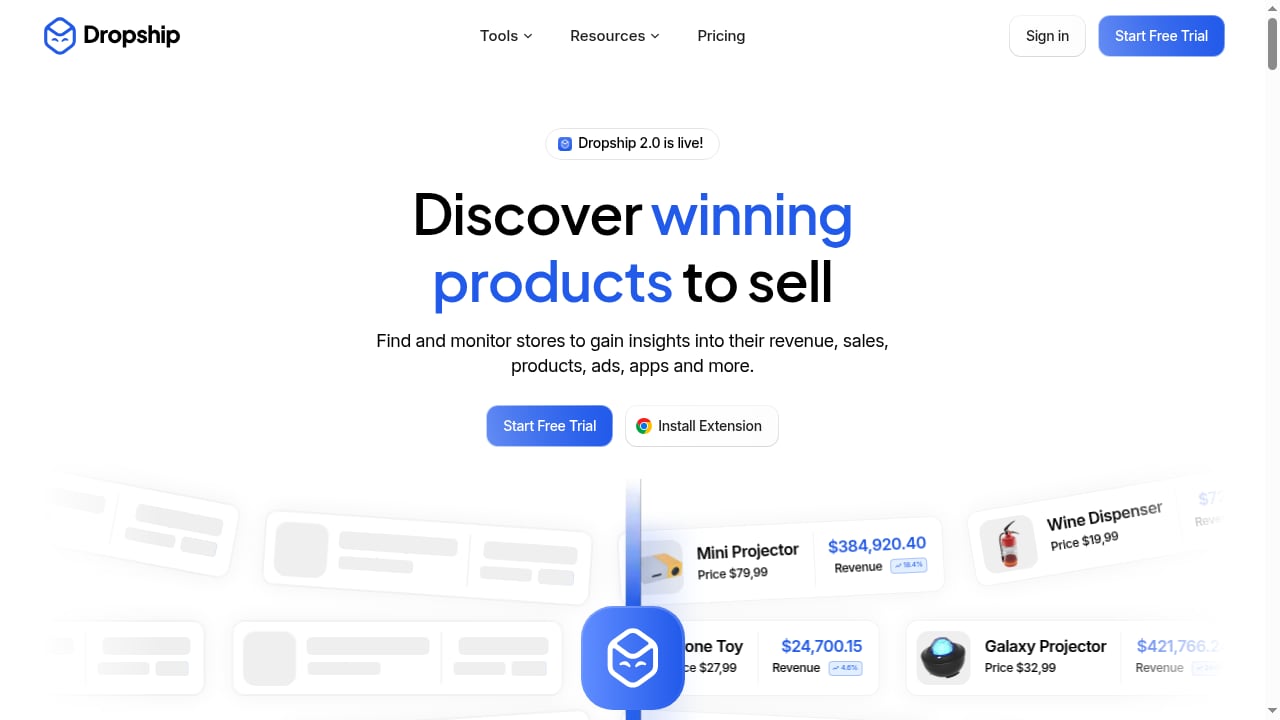
First viewport screenshot of Dropship - Discover Winning Products To Sell.
Here is a practical sequence you can repeat weekly.
Step 1: Start with a broad signal in PrimeSpy
Open PrimeSpy and search a niche keyword, a product category, or a competitor URL. Apply filters that match your business model:
- Set the ecommerce platform filter to Shopify if you sell on Shopify.
- Filter by ad format (video, image, carousel) depending on what you can produce.
- Sort by running time to find creatives that have survived past the typical test window.
- Use duplicate counts to spot advertisers scaling the same creative across multiple ad sets.
Save the search. You will return to it as the niche evolves.
Step 2: Shortlist advertisers, not just ads
A single ad running for 30 days is interesting. An advertiser running 15 variations of the same product angle for 60 days is a stronger signal. In PrimeSpy, open the advertiser view and look at:
- How many active creatives they run.
- How often they refresh creative.
- Which landing pages they send traffic to.
- Whether they run on Meta, TikTok, or both.
Add the most consistent advertisers to an ad tracker so PrimeSpy notifies you when they launch something new.
Step 3: Cross-check the store in Dropship
Take the advertiser's domain and look it up in Dropship. You want to see:
- Estimated revenue and sales trends over the last 30 to 90 days.
- Whether sales are growing, flat, or declining.
- Which products appear in their catalog and which ones look recently added.
- What apps they use, which can hint at their funnel strategy (upsells, subscriptions, reviews).
If the store shows rising sales while PrimeSpy shows fresh creatives, you have a live signal. If the store shows declining sales but heavy ad activity, you may be looking at a last push before a product dies.
Step 4: Validate the product, not just the ad
Before you commit, check three things:
- Creative longevity. Has the core angle been running for weeks without a full refresh? Long-running creatives usually mean positive ROAS.
- Store momentum. Does Dropship show consistent sales, or a single spike that has already faded?
- Market saturation. Search the product in PrimeSpy and count how many distinct advertisers run similar creatives. A handful is healthy competition. Dozens of near-identical ads usually means the window is closing.
Step 5: Build your angle from evidence
Do not clone the ad. Extract the structure:
- What problem does the hook name in the first three seconds?
- What proof does the creative use (UGC, before-and-after, demo, testimonial)?
- What offer appears on the landing page?
- Which CTA type dominates across the advertiser's creatives?
PrimeSpy's creative downloads and saved lists make this step faster because you can collect reference material in one place. For a deeper method, see AdSpy deep ad analysis, which covers search techniques and metric interpretation that apply to any ad intelligence tool.
Step 6: Track after launch
Once your ads are live, keep both tools running:
- In PrimeSpy, track the competitors you studied. When they refresh creative, you will know within hours.
- In Dropship, monitor their store to see if their sales respond to the new creative push.
- Use your own ad account data to confirm whether the angle you borrowed actually converts for your audience.
A worked example
Suppose you are researching pet wellness products.
- In PrimeSpy, you search "orthopedic dog bed" and filter to Shopify stores running video ads. You find an advertiser with 12 active creatives, most running 45+ days.
- You add the advertiser to a tracker and note their landing page structure.
- In Dropship, you look up the store. Revenue is trending upward over 60 days, and a second product (a calming chew) was added three weeks ago.
- Back in PrimeSpy, you search the calming chew category. Only a few advertisers run it with strong creative longevity, so saturation is low.
- You build a creative around the same problem the top advertiser solves, but with your own hook and UGC.
- After launch, you keep both trackers active. When the competitor refreshes their creative, you test a new angle within the same week.
This loop is what makes the combination useful: PrimeSpy tells you what is being advertised, Dropship tells you whether it is working.
Common mistakes to avoid
- Copying ads without checking store health. A running ad is not proof of profit. Dropship's revenue and sales view helps you separate real winners from expensive tests.
- Ignoring creative fatigue. If a competitor has refreshed the same product five times in a month, the original angle is probably burning out.
- Chasing saturated products. Use PrimeSpy's advertiser count and duplicate signals to gauge how crowded a product already is.
- Skipping the landing page. PrimeSpy surfaces landing page changes, which often reveal offer shifts before the ad creative changes.
- Treating one spike as a trend. Dropship monitoring over time is what turns a single sales bump into a usable signal.
When to use each tool on its own
| Situation | Best starting point |
|---|---|
| You have a niche but no product | PrimeSpy keyword and category search |
| You found a store and want to know if it is real | Dropship store lookup |
| You want to know which creative angle is scaling | PrimeSpy advertiser view and trackers |
| You want to see if a store's sales match its ad spend | Dropship monitoring plus PrimeSpy trackers |
| You need to compare ad intelligence platforms first | PrimeSpy vs SocialPeta vs GetHookd |
Related reading
- PrimeSpy vs AdLibrary: Which Ad Intelligence Tool Wins? - Compare PrimeSpy and AdLibrary on ad coverage, tracking, pricing, and API access. Find out which ad intelligence platform fits your workflow in 2026.
- BigSpy Review: Is the #1 Free AdSpy Tool Worth It? - An evidence-based BigSpy review covering its 1B+ ad creatives, 11 channels, pricing, pros, cons, and who should use it for ad research.
Sources and further reading
- Ad Spy Tool for Facebook Ads, TikTok Ads & Meta Ad Library - PrimeSpy is an ad spy and ad intelligence tool for Facebook ads, TikTok ads, and Meta Ad Library research. Find winning ads, spy on competitors, analyze creatives, and find dropshipping and ecommerce product ideas faster.
- 5 Best Dropshipping Niches for 2026: High-Margin Categories - PrimeSpy - Explore the best dropshipping niches for 2026, including biohacking, pet wellness, gut health, eco-tech, and dopamine decor, plus product validation tips.
- PrimeSpy - Find Winning Ads. Win More Campaigns. - PrimeSpy is an AI-powered ad intelligence platform that helps marketers discover winning ads, track competitors, and analyze creative trends across Facebook, TikTok, and Instagram. It offers advanced filters, deep competitor insights, and trend signal tracking to optimize ad campaigns.
FAQ
Do I need both PrimeSpy and Dropship to find winning products?
No, but the combination is stronger than either alone. PrimeSpy shows ad activity and creative signals; Dropship shows store-level revenue and sales. Together they reduce the risk of copying an ad that is not actually profitable.
Can I use PrimeSpy without a Dropship subscription?
Yes. PrimeSpy works as a standalone ad intelligence tool. You can search over 120 million ads, filter by ecommerce platform, track competitors, and download creatives without any other tool. Dropship adds store monitoring on top.
How often should I run this workflow?
Weekly is a practical rhythm for most dropshippers. Daily checks make sense if you are actively scaling and need to react to competitor creative refreshes quickly.
What does PrimeSpy cost?
PrimeSpy offers a free trial with 500 credits and 2 ad trackers, no credit card required. The Pro plan is $9.99/month and includes 20,000 credits, 20 ad trackers, full Meta and TikTok analytics, unlimited creative downloads, saved list export, and priority support.
Is Dropship useful for TikTok Shop research?
Dropship is built around store discovery and monitoring, so it works best when you have a store domain to inspect. For TikTok-native product discovery, PrimeSpy's TikTok ad search and daily top products are usually the faster starting point.
Conclusion
PrimeSpy and Dropship solve different halves of the same problem. PrimeSpy tells you what advertisers are running, how long creatives survive, and where spend is flowing. Dropship tells you whether the stores behind those ads are actually generating revenue and sales. Run them together in a weekly loop: discover in PrimeSpy, verify in Dropship, extract the angle, launch, then keep tracking both. That loop will not guarantee a winner every time, but it will stop you from scaling a product that was already fading before you found it.
If you are still choosing your ad intelligence stack, our comparison of the top social media ad intelligence platforms covers coverage, search depth, tracking, and pricing across the leading options.