
Dropship Explained: How Drop Shipping Actually Works in 2026
A dropship store sells products it never touches. When a customer buys, the order and shipping details go to a supplier, wholesaler, or fulfillment house, and that party ships the item directly to the buyer. You handle marketing, pricing, and customer service; someone else handles the box.
That sounds simple, and structurally it is. The difficulty is not the model, it is the decisions inside it: which product, which supplier, which price, which ad. This guide walks through how drop shipping works, what it really costs, and how to validate a product before you spend money promoting it.
What "Dropship" Means in Plain Terms
Dropship Explained: How Drop Shipping Works in 2026 - What "Dropship" Means in Plain Terms.
Drop shipping is a distribution method, not a product category. The seller accepts the order without holding stock, then transfers fulfillment to a third party. According to Wikipedia's overview of drop shipping, the seller is responsible for marketing and selling, but has limited control over product quality, storage, inventory management, and shipping.
That trade-off defines the model:
- Low startup cost. No warehouse, no bulk inventory purchase, no storefront.
- Location independence. The operation runs from a laptop and an internet connection.
- Thin control. You inherit your supplier's packing quality, dispatch speed, and stock reliability.
- Thin margins. Your profit is the gap between retail price and wholesale cost, minus fees, ads, and refunds.
If you want the shortest honest summary: drop shipping removes inventory risk and replaces it with supplier risk and marketing risk.
How a Dropship Order Actually Flows
Dropship Explained: How Drop Shipping Works in 2026 - How a Dropship Order Actually Flows.
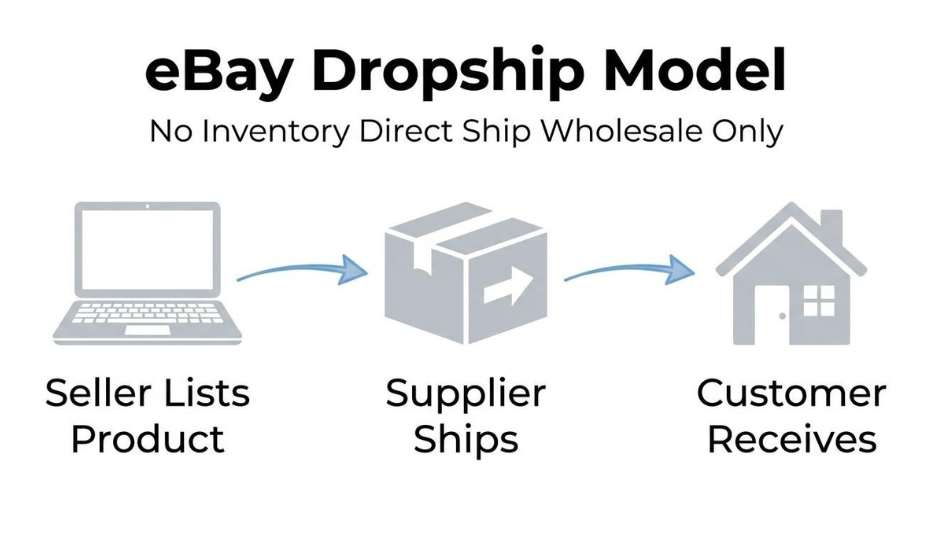
A typical order moves through six steps:
- Customer orders from your store at your retail price.
- You forward the order to your supplier with the customer's shipping details.
- The supplier picks and packs the item, often using blind shipping or private label shipping so your branding appears instead of theirs.
- The supplier ships directly to the customer.
- You send tracking to the customer and handle questions, delays, and returns.
- You keep the difference between what the customer paid and what the supplier charged, minus payment processing, ad spend, and any refunds.
Step 3 is where most beginner stores quietly lose trust. If your supplier ships in their own packaging with their own invoice, customers notice. Ask about blind shipping before you list anything.
The Real Economics of a Dropship Store
Dropship Explained: How Drop Shipping Works in 2026 - The Real Economics of a Dropship Store.
New sellers usually calculate profit as retail price minus supplier cost. That number is almost always too optimistic. A more honest formula:
Profit = Retail price − supplier cost − shipping − payment fees − ad cost − refunds and chargebacks
Two lines do most of the damage:
- Ad cost per purchase. On paid social, this is usually the largest single expense. A product with a $12 margin can be profitable at a $6 cost per purchase and unprofitable at $14.
- Refunds and disputes. Slow delivery, damaged goods, or a product that looks different from the ad all convert into refunds. Each one erases more than one sale's margin.
This is why product selection matters more than store design. A beautiful store selling a $9-margin product with slow shipping will lose to a plain store selling a $30-margin product that ships in five days.
Supplier Options: Which Route Fits Your Stage
Dropship Explained: How Drop Shipping Works in 2026 - Supplier Options: Which Route Fits Your Stage.
| Supplier route | Best for | Main trade-off |
|---|---|---|
| Marketplaces like AliExpress or Alibaba | First tests, low volume | Long delivery windows, inconsistent quality |
| Domestic wholesalers | Faster shipping, higher trust | Higher unit cost, minimum order expectations |
| Fulfillment houses | Scaling once a product proves out | Setup complexity, storage fees |
| Print-on-demand or made-to-order | Custom and niche products | Limited product range, higher unit cost |
A practical approach is to run your first tests through a marketplace supplier, then move any proven product to a faster domestic or fulfillment partner. Keeping a backup supplier for every live product is not optional once you are spending real money on ads.
Product Research Is the Actual Skill
The core question in drop shipping is not "how do I build a store" but "what should I sell, and is anyone already selling it successfully?"
Three signals separate a real opportunity from a guess:
- Demand evidence. Products with visible, sustained sales across multiple stores, not one viral spike.
- Ad evidence. Advertisers spending consistently on similar creatives, which suggests the unit economics work.
- Competition level. Enough competitors to prove the market exists, not so many that you cannot differentiate on offer, bundle, or creative angle.
This is where ad intelligence tools enter the workflow. Instead of guessing which creatives are working, you can search live ad libraries by keyword, advertiser, or product URL and study what competitors are actually running. PrimeSpy is built for this stage: it searches ads across Facebook, TikTok, and the Meta Ad Library, surfaces metrics like reach, spend, and duplicate counts, and shows daily top products, so product discovery is based on observed ad activity rather than intuition. For a broader look at how these tools differ, see this comparison of PrimeSpy, AdSpy, and Swipekit.
If you are also running paid traffic, tracking is the other half of the equation. Ad spy tools tell you what competitors run; a tracker tells you what your own spend is producing. RedTrack is one option media buyers use for cookieless attribution, and it pairs naturally with creative research.
A Simple Validation Sequence
- Find candidates. Scan ad libraries and top-product feeds for products with repeated advertiser activity.
- Check longevity. A creative running for weeks usually means it is profitable, not just new.
- Verify supply. Confirm your supplier can ship within a window you are willing to promise.
- Model the margin. Include ads, fees, and a refund allowance before you commit.
- Test small. One product, one angle, a controlled budget, and a clear kill criterion.
TikTok Shop Changed the Dropship Playbook
TikTok Shop compressed the distance between a product being discovered and being bought. Creators can drive sales directly, and shop-level sales data is now visible in a way it never was on a classic Shopify store.
That shifts research priorities:
- Creator performance matters. A product with strong creator videos converts differently than one with only paid ads.
- Shop-level tracking matters. Watching a shop's revenue trend tells you whether a niche is heating up or cooling down.
- Creative volume matters. Winning products usually have many creative variations, not one perfect ad.
Tools that index TikTok shops, products, and creators alongside Facebook ad data give a fuller picture than ad libraries alone. If you are comparing platforms in this space, this PrimeSpy vs SocialPeta vs Niche Scraper breakdown covers how product discovery and ad coverage differ between them.
Common Dropship Mistakes That Cost Real Money
- Selling a product you have never ordered. Order a sample. Check packaging, instructions, and delivery time yourself.
- Promising delivery you cannot control. Set expectations from the supplier's realistic window, not the best case.
- Ignoring the refund rate. A 10% refund rate on a $40 product removes $4 from every sale before ad spend.
- Copying a competitor's ad word for word. Their creative works for their audience, offer, and price. Study the structure, not the script.
- Scaling before the unit economics work. More spend on a losing product multiplies the loss.
- No backup supplier. One stockout or shipping halt can end a product that was working.
Who Should and Should Not Dropship
Drop shipping suits people who can learn paid traffic, tolerate uncertainty, and treat it as a retail business rather than a shortcut. It does not suit anyone expecting passive income, guaranteed margins, or a product they can fully control without supplier relationships.
The honest framing: drop shipping lowers the barrier to entry, which means the competition is on marketing and product selection, not capital. That is why research tools, tracking, and disciplined testing matter more here than in almost any other ecommerce model.
Related reading
- PrimeSpy vs AdsLibrary vs SocialPeta: 2026 Ad Spy Comparison - Compare PrimeSpy, AdsLibrary, and SocialPeta on ad coverage, search, creative workflow, and pricing to choose the right ad spy tool for 2026.
- Foreplay Login: How to Access Your Account Safely - Learn how to log in to Foreplay, troubleshoot common access issues, and compare ad spy tools like PrimeSpy for creative research.
Sources and further reading
- Dropship - Discover Winning Products To Sell - Find and monitor stores to gain insights into their revenue, sales, products, ads, apps, and more.
- Can someone explain dropshipping in somewhat simple terms? - Jan 28, 2023 ... Drop-shipping is just a distribution method. It allows a product to be sold without having the product in stock. A seller sells a product and a ...
FAQ
Is drop shipping legal?
Yes. Drop shipping is a standard retail distribution method. What is not legal is misrepresenting products, failing to deliver paid orders, or violating a marketplace's terms of service.
How much money do I need to start a dropship store?
You can launch a basic store for the cost of a domain, a storefront subscription, and a small ad test budget. The meaningful number is not startup cost but test budget: you need enough to run several product tests and read the results.
Do I need to hold inventory?
No. That is the defining feature of the model. You may still want a sample on hand to photograph, verify quality, and answer customer questions accurately.
How do dropshippers find winning products?
Most combine supplier marketplaces, social platform trends, and ad intelligence tools that reveal which products advertisers are actively spending on. Longevity of an ad is usually a stronger signal than a single viral post.
What profit margin should I target?
A common working target is a retail price at least three times your landed cost, which leaves room for ad spend, fees, and refunds. Products with thin margins rarely survive paid acquisition.
Is drop shipping still worth it in 2026?
It is more competitive and more data-driven than it was a few years ago. Sellers who research demand, validate supply, and track their own numbers still build profitable stores. Sellers who copy trends without checking margins usually do not.
Conclusion
Drop shipping is a distribution method with a low entry cost and a high execution bar. The mechanics are simple: sell, forward the order, let the supplier ship, keep the spread. The hard part is choosing a product with real demand, a supplier who ships reliably, and a margin that survives ad spend.
Treat research as the job. Watch what advertisers are actually running, verify supply before you promise delivery, model your costs honestly, and test in small controlled steps. The sellers who last are not the ones who found a secret product. They are the ones who built a repeatable process for finding and validating the next one.