
Adspo Review 2026: Ad Creative Intelligence Tested
Adspo is an ad inspiration and competitive intelligence platform built for performance marketers, ecommerce brands, and digital agencies that want to find winning ad creatives faster. Instead of scrolling through Meta's Ad Library and seeing the same ad repeated dozens of times, Adspo tracks ads at the creative level—showing each unique creative once with its full lifespan, runtime, and performance context.
This review is based on the platform's documented capabilities, pricing signals, and how it compares with tools like Foreplay, MagicBrief, Atria, and Denote. It covers who Adspo is actually for, where it shines, where it falls short, and how to decide if it fits your workflow.
What Is Adspo?
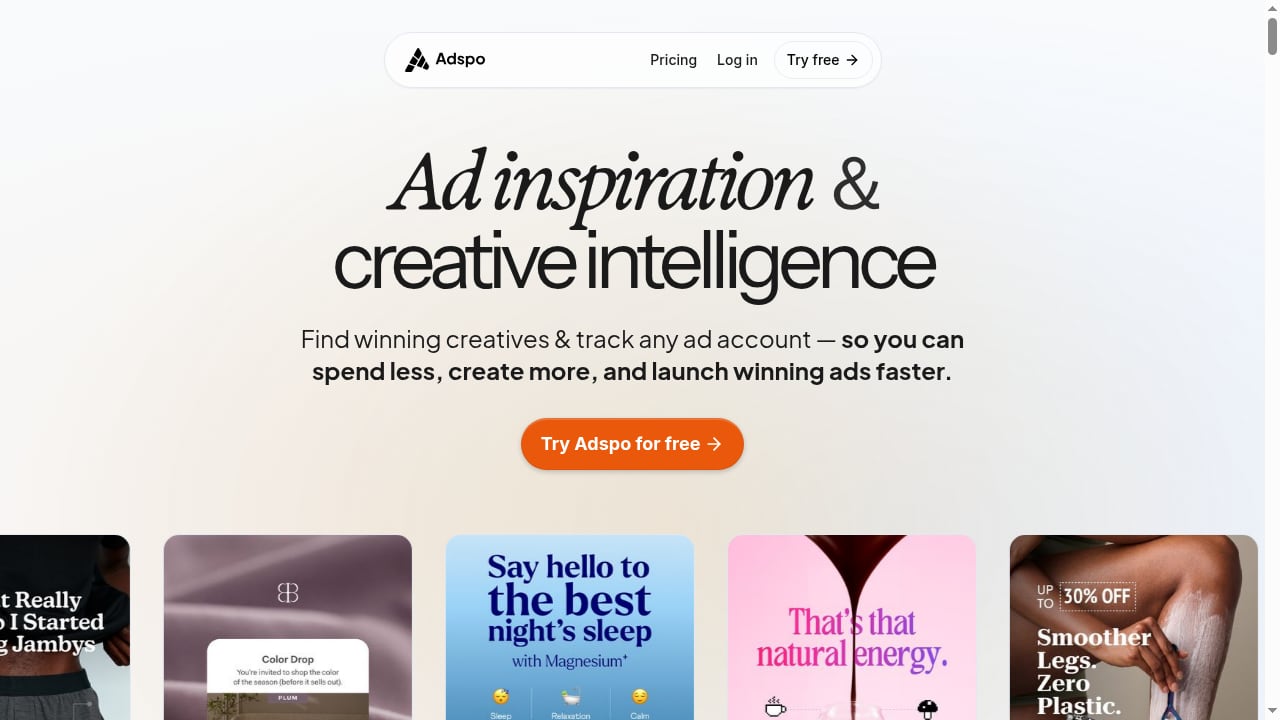
First viewport screenshot of Adspo | Ad inspiration & creative intelligence.
Adspo is a curated ad intelligence library covering over 10,000 verified brands. The core promise is simple: stop wasting ad spend on untested angles and model what is already working in your niche.
The platform tracks ads at the creative level rather than the account level. That means when a brand runs the same creative across multiple placements, countries, or time periods, you see it once—with its complete lifespan and performance indicators attached. This removes the duplication problem that makes Meta's Ad Library frustrating for serious research.
Key data points Adspo surfaces for each creative include:
- Ad runtime and frequency
- Hooks and transcripts
- Target languages and countries
- Creative format and media type
- Brand and niche classification
Users can unlock any competitor's ad account, monitor their strategy over time, and organize multiple competitors into a single feed. Collaboration features let teams save ads to custom boards, share inspiration in dedicated workspaces, and coordinate creative research with clients.
Who Should Use Adspo?
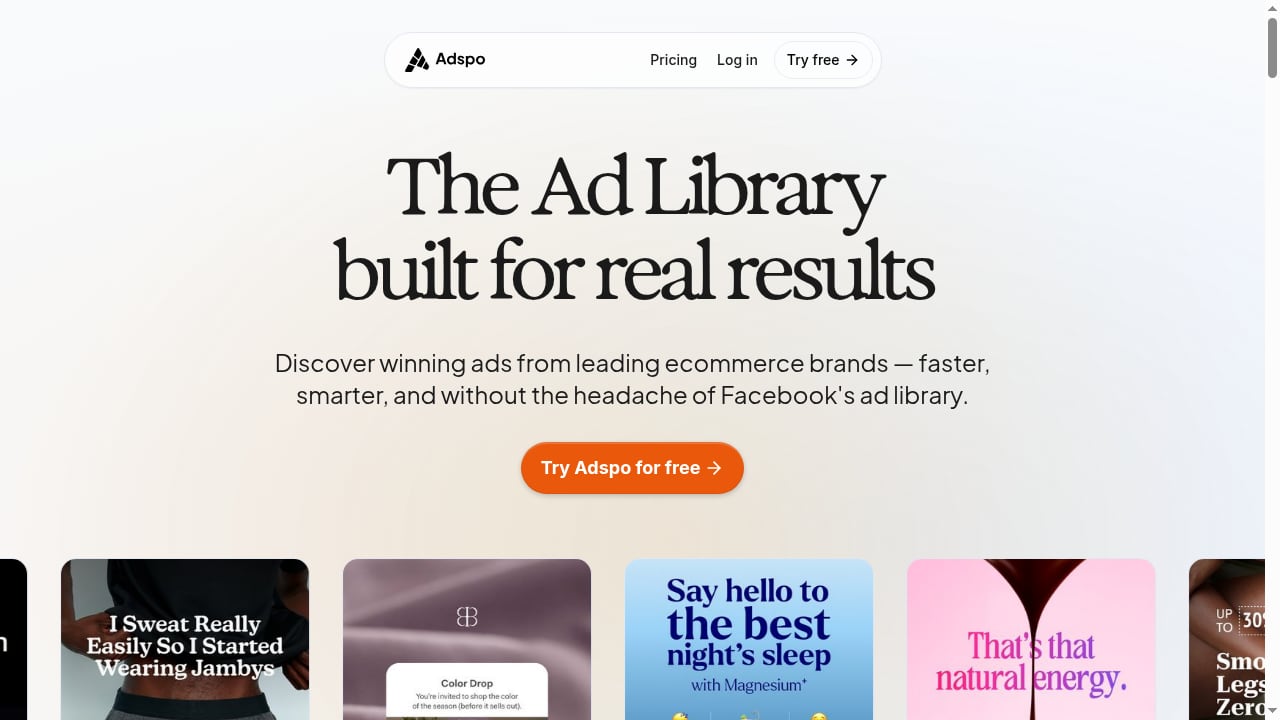
First viewport screenshot of Facebook Ad Library Alternative.
Adspo is not a general-purpose social media tool. It is built for people whose job depends on producing and testing ad creatives at scale.
Performance Marketers
If you manage paid social budgets across Meta, TikTok, or other platforms, Adspo gives you a faster way to validate creative angles before you spend. Instead of guessing which hook will resonate, you can filter by niche, runtime, and media type to see what has already survived in the market.
Ecommerce Brands
DTC brands can monitor direct competitors and adjacent categories. Seeing which creatives a competitor has kept running for 60 or 90 days is a strong signal that the ad is profitable. Adspo surfaces that longevity data directly, which is more actionable than a static snapshot.
Digital Agencies
Agencies managing multiple client accounts can use Adspo's workspaces to keep research organized per client. The Team add-on allows seat-based access, so strategists, media buyers, and creative teams can share boards without exporting screenshots or links.
Who Should Skip Adspo
If you only need occasional ad inspiration and are comfortable with Meta's free Ad Library, Adspo may be overkill. Similarly, if your focus is exclusively on TikTok ads, you should verify current platform coverage before subscribing, since the library's strength is in its verified brand breadth rather than any single channel.
Core Strengths
Creative-Level Tracking
The most significant differentiator is how Adspo handles duplicates. Meta's Ad Library shows every active placement, which means one successful ad can appear dozens of times. Adspo collapses those into a single creative record with its full history. This makes trend analysis and competitor monitoring dramatically faster.
Competitor Account Unlocks
You can unlock any competitor's ad account to see their full creative strategy. This includes runtime data, frequency, hooks, transcripts, and targeting languages. For brands that want to reverse-engineer a competitor's funnel, this is the core workflow.
Filtering and Sorting
Adspo's filtering goes beyond basic keyword search. Users can filter by status, niche, brand, media type, target language, and country. Sorting by date and duration helps identify emerging trends before they saturate.
Collaboration Workspaces
Saving ads to custom boards and sharing them in dedicated workspaces is built in, not bolted on. This matters for teams that need a shared source of truth for creative research rather than a single-user tool.
Cleaner Interface
Compared with tools like Foreplay or Denote, Adspo positions itself as faster and less cluttered. The focus is on getting from search to insight in fewer clicks, which matters when you are reviewing hundreds of creatives per week.
Limitations and Considerations
Young Product
Adspo launched in 2024 and is still maturing. Early adopters should expect feature updates, occasional gaps in coverage, and a support team that is responsive but small. The company lists 1–10 employees and email-based support, which is typical for a product at this stage.
No Free Version
Adspo does not offer a free tier. There is a 7-day free trial, but after that you are on a paid plan. This is reasonable for a data product, but it means you need to commit to testing during the trial window.
Platform Coverage Verification
While Adspo tracks ads across multiple platforms, the exact coverage depth varies. If your primary channel is TikTok, Pinterest, or LinkedIn, verify that the library has enough volume in your niche before subscribing. The strongest coverage is in Meta and Instagram ecosystems, where the Ad Library data is most accessible.
Pricing Transparency
Adspo's pricing is subscription-based with a Pro plan in the $19–$29/month range and a Team add-on at $10–$15 per seat per month. However, pricing can change, and the vendor should be contacted for current rates. The SoftwareWorld profile lists "Per User" pricing with a 7-day trial and no free version, which aligns with the subscription model.
Pricing Signals
Adspo uses a tiered subscription model:
| Plan | Approximate Price | Best For |
|---|---|---|
| Pro | $19–$29/month | Solo marketers and small brands |
| Team add-on | $10–$15/seat/month | Agencies and collaborative teams |
There is no free version, but the 7-day trial gives you enough time to test the library depth and filtering workflow. Payments are processed through Stripe, and data storage runs on Supabase, which are both established infrastructure choices.
Compared with alternatives, Adspo's Pro pricing is competitive. Foreplay and MagicBrief operate in a similar range, while enterprise-grade tools can cost significantly more. The value question is whether creative-level tracking and competitor unlocks save you enough time and ad spend to justify the subscription.
Setup and Onboarding
Getting started with Adspo is straightforward:
- Start the 7-day trial through the official site.
- Define your competitor list—identify 5–10 brands in your niche whose ads you want to monitor.
- Unlock competitor accounts to populate your feed with their creative history.
- Create boards for different angles, products, or clients.
- Set up a weekly review routine—filter by recent activity and runtime to spot new winners.
The onboarding is web-based and cloud-hosted, so there is no software to install. Documentation is primarily video-based, which suits visual learners but may feel light if you prefer written guides.
How Adspo Compares to Alternatives
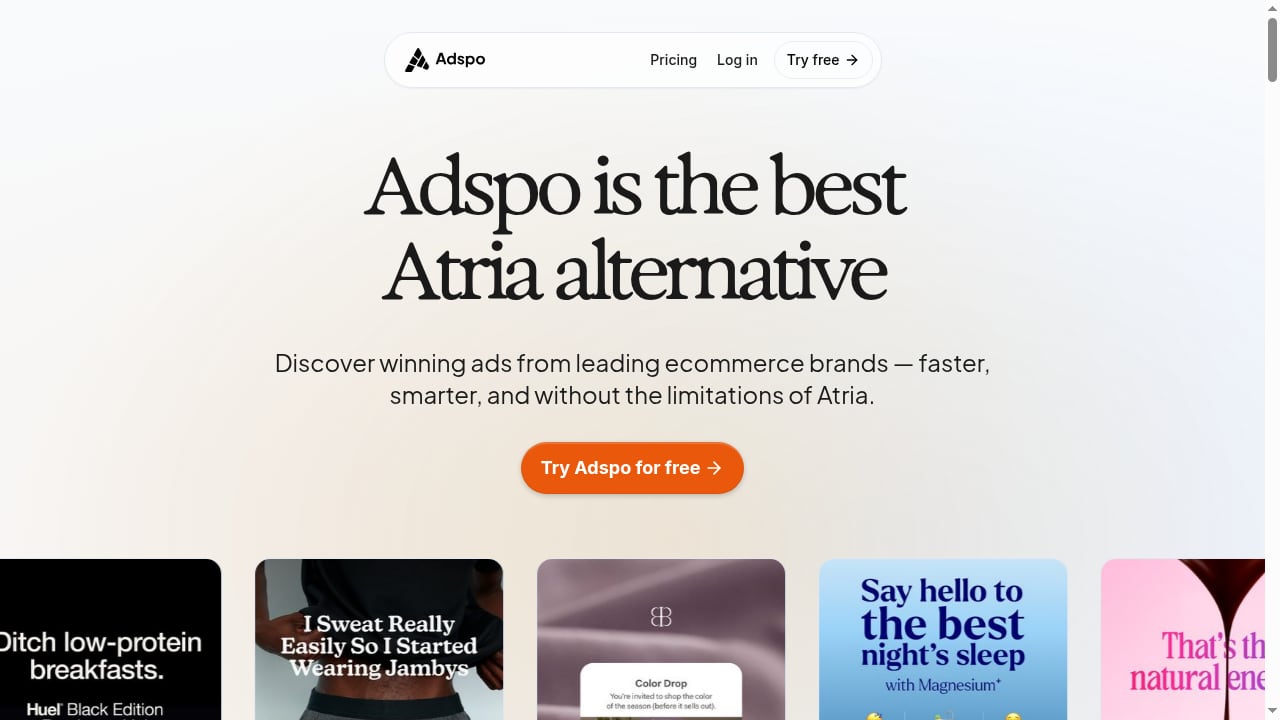
First viewport screenshot of Atria Alternative.
Adspo vs Foreplay
Foreplay is a well-known ad inspiration tool with a strong community and template library. Adspo differentiates on creative-level tracking and competitor account unlocks. If you want to save and organize ads you find, both work. If you want to systematically monitor a competitor's full creative history, Adspo's approach is more direct. For a deeper look at Foreplay's workflow, see this guide to using Foreplay effectively.
Adspo vs MagicBrief
MagicBrief focuses on creative workflow and briefing, with strong collaboration features. Adspo is more research-first, prioritizing discovery and competitor intelligence over production workflow. Teams that need both may use them together.
Adspo vs PrimeSpy
PrimeSpy is another ad intelligence tool with a different coverage emphasis. If you are evaluating multiple options, this PrimeSpy vs Winning Hunter comparison breaks down pricing, platform coverage, and workflow fit. And for a broader view, see PrimeSpy vs AdsLibrary vs Foreplay.
Adspo vs Atria and Denote
Atria and Denote are newer entrants with overlapping feature sets. Adspo's advantage is its verified brand library and focus on reducing duplicate noise. The trade-off is that newer tools may offer more aggressive pricing or niche features.
Practical Workflow Example
Here is how a performance marketer might use Adspo in a typical week:
Monday: Open the competitor feed and filter for ads that started in the last 14 days. Sort by runtime to see which new creatives are already gaining traction.
Tuesday: Review hooks and transcripts from the top 10 new ads. Save the three most promising angles to a board called "Q3 Test Queue."
Wednesday: Share the board with the creative team in a workspace. Add notes on which hooks to adapt for your brand voice.
Thursday: Check on competitors that have been quiet. If a previously active brand stopped launching new creatives, that may signal a strategy shift or budget cut.
Friday: Export the week's findings and brief the media buying team on which angles to test next.
This routine turns ad research from a reactive scroll into a structured process—which is the core value Adspo promises.
Decision Criteria: Is Adspo Right for You?
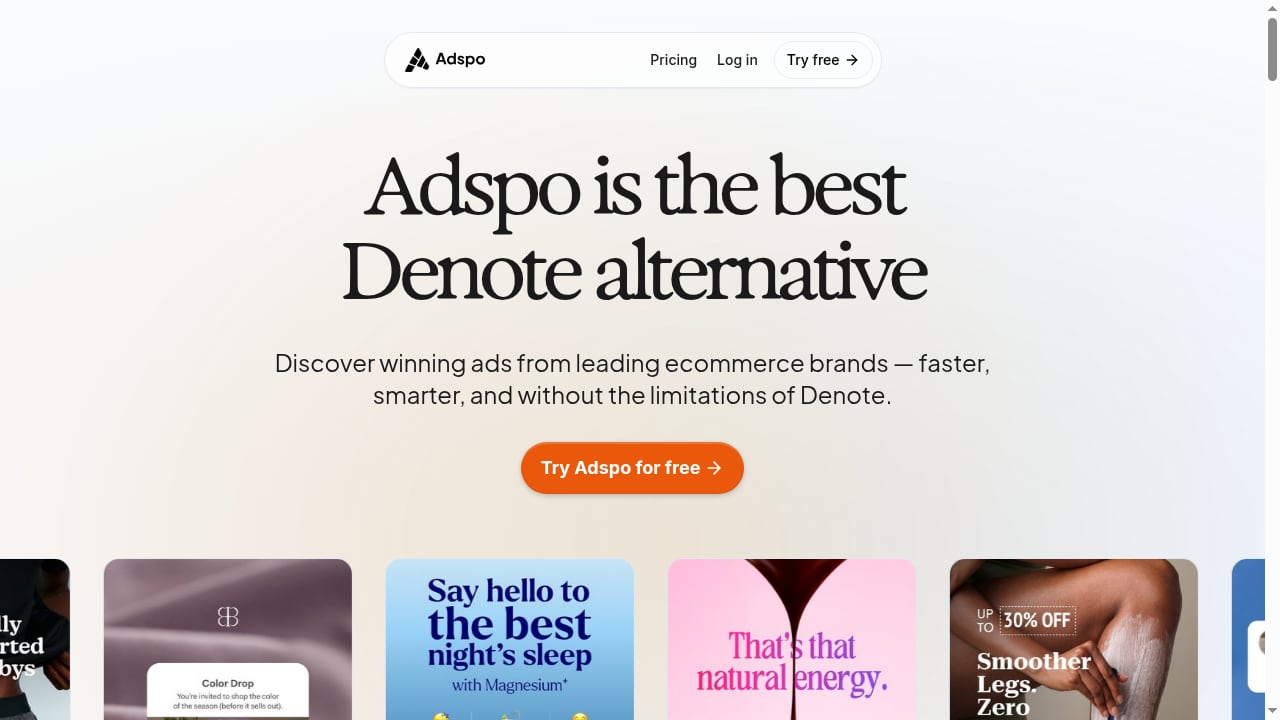
First viewport screenshot of Denote Alternative.
Choose Adspo if:
- You spend at least 5–10 hours per week on ad research and competitor analysis
- You are frustrated by duplicate ads in Meta's Ad Library
- You need to monitor specific competitors over time, not just browse occasionally
- You work on a team that needs shared boards and workspaces
- You want creative-level lifespan data to validate angles before testing
Look elsewhere if:
- You only need occasional inspiration and free tools suffice
- Your primary channel is not well covered by Adspo's library
- You need enterprise features like API access or SSO (not currently specified)
- You prefer a tool with a larger user community and more third-party tutorials
Related reading
- Redtrack Townsville: The Famous Red Track Explained - What is Redtrack in Townsville? Learn about the famous red athletics track at Townsville Sports Precinct, its facilities, events, and how to visit.
- Copyfy Review 2026: AI Shopify Store Builder Tested - Evidence-based Copyfy review: winning product research, AI store generation, pricing signals, setup, limitations, and who should use it in 2026.
Sources and further reading
- Adspo Review-Does this AD INSPIRATION Platform truly meet all the value criteria?See?(Do not Use Yet - You can get started with "Adspo" Now at a price you won't find elsewhere, Click On this link now to get started==https://bit.ly/4nQFYGOIn this Adspo review, ...
- Anyone found a good alternative to manually browsing Facebook Ad ... - Mar 7, 2026 ... Everyone saves during the week, then you do a 20 minute review where you pick 3 ads to model and 2 patterns to avoid. That turns scrolling into ...
- Adspo Reviews Aug 2026: Pricing & Features | SoftwareWorld - Adspo Reviews 2026: Understand its offerings, pricing, & features. Compare and select with confidence.
Frequently Asked Questions
Is Adspo a scam?
No. Adspo is a legitimate software product with a verified profile on SoftwareWorld, a 7-day free trial, and transparent subscription pricing. It launched in 2024 and is operated by a small team based in Australia. As with any subscription tool, test the trial before committing.
Does Adspo offer a free version?
No. Adspo does not have a free tier. It offers a 7-day free trial, after which you must choose a paid plan to continue access.
How much does Adspo cost?
Adspo's Pro plan is approximately $19–$29 per month, with a Team add-on at $10–$15 per seat per month. Pricing is per user and billed monthly. Contact the vendor for current rates, as pricing can change.
What platforms does Adspo track?
Adspo tracks ads across major social platforms, with the strongest coverage in Meta and Instagram ecosystems. The library includes over 10,000 verified brands. Verify coverage for your specific niche and platform during the trial.
How is Adspo different from Meta's Ad Library?
Meta's Ad Library shows every active placement, which creates heavy duplication. Adspo tracks ads at the creative level, showing each unique creative once with its full lifespan, runtime, and performance context. It also adds filtering, competitor unlocks, and collaboration features that the free Ad Library lacks.
Can I use Adspo for TikTok ad research?
Adspo's library includes ads from multiple platforms, but coverage depth varies. If TikTok is your primary channel, test the library during the trial to confirm there is enough volume in your niche before subscribing.
Conclusion
Adspo solves a real problem: ad research is noisy, repetitive, and time-consuming when done through free tools. By tracking creatives at the individual level and surfacing lifespan data, Adspo helps marketers identify proven angles faster and organize that research for teams.
The trade-offs are typical for a young product—no free tier, evolving coverage, and a small support team. But for performance marketers, ecommerce brands, and agencies that live in the ad research trenches, the time saved on duplicate filtering and competitor monitoring can justify the subscription within the first month.
If you are still comparing options, this CrispyAds review covers another ad inspiration platform with AI creative analysis, and this PrimeSpy + Nextify workflow guide shows how to connect research with AI creative generation. The right tool is the one that fits your research volume, platform mix, and team workflow—so use the trial period to test Adspo against your actual weekly process, not just the feature list.