
How to Use PrimeSpy with Nextify for Winning Ads
PrimeSpy tells you what is already working. Nextify turns that insight into fresh, ready-to-test creatives. Used together, they close the gap between competitor research and creative production, so you spend less time guessing and more time scaling.
This guide walks through a repeatable workflow: find proven ad concepts in PrimeSpy, extract the winning elements, generate new variations in Nextify, and launch a structured test. You will also see practical examples, common mistakes, and answers to frequent questions.
Why Pair an Ad Spy Tool with an AI Creative Generator
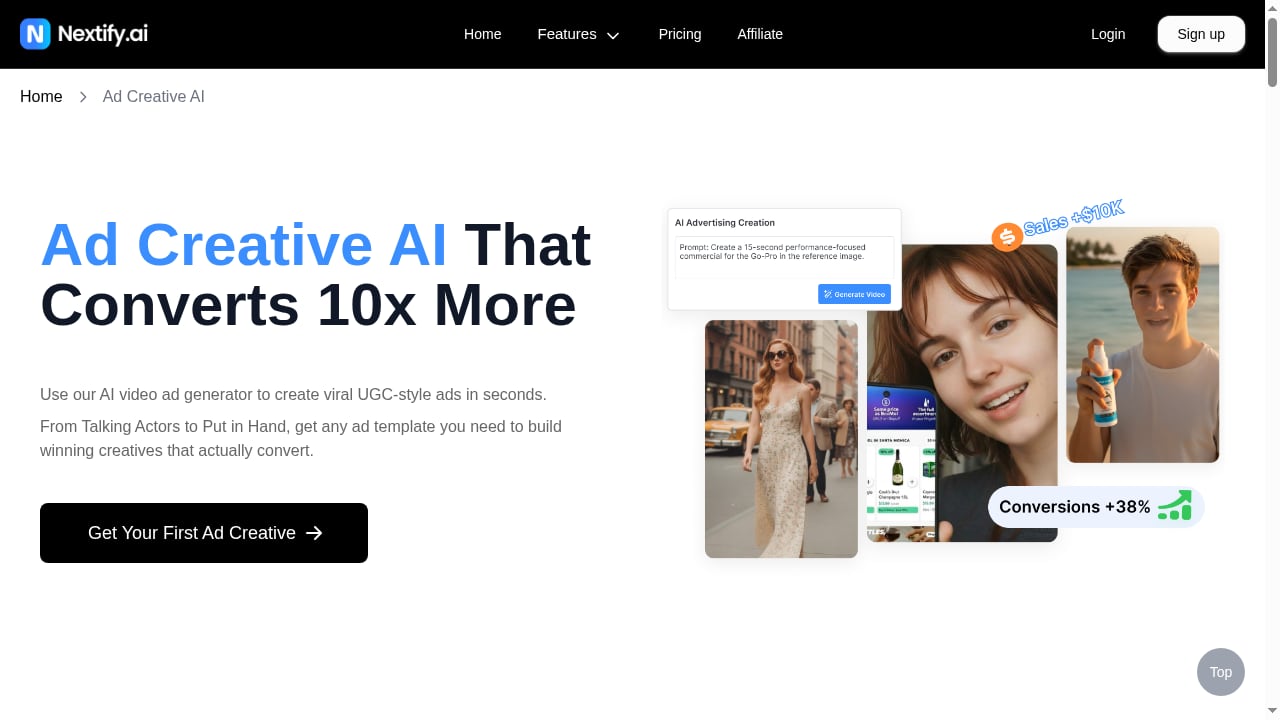
First viewport screenshot of Ad Creative AI | AI Ad Generator for Winning Ad Videos.
Ad spy tools and AI creative generators solve different halves of the same problem.
PrimeSpy helps you answer research questions:
- Which ads are running longest and therefore likely profitable?
- What hooks, formats, and angles are competitors using?
- Which products are trending on TikTok Shop, Facebook, or Meta Ad Library?
- What reach, spend, and duplication signals suggest an ad is scaling?
Nextify helps you answer production questions:
- How do you turn a proven angle into a new creative without filming?
- How do you produce UGC-style videos, talking head ads, and product demos quickly?
- How do you create enough variations to A/B test hooks and scripts?
- How do you fight creative fatigue without a full production team?
Individually, each tool is useful. Together, they create a loop: research informs creation, and creation feeds the next round of testing and research.
The PrimeSpy to Nextify Workflow at a Glance
First viewport screenshot of Nextify AI.
The core workflow has five stages:
- Research winning ads and trends in PrimeSpy.
- Extract the hooks, angles, formats, and scripts that appear repeatedly.
- Generate new ad variations in Nextify based on those findings.
- Test the new creatives against each other on Facebook, TikTok, or Instagram.
- Repeat using performance data to guide the next PrimeSpy search.
This is not a one-time process. The most effective users treat it as a weekly or bi-weekly routine.
Step 1: Find Winning Ads in PrimeSpy
Start with a clear research question. Are you looking for a product to promote, a new angle for an existing product, or a creative format that is currently outperforming?
Smart Search by Keyword, URL, or Advertiser
PrimeSpy lets you search by keyword, advertiser, or URL. For example:
- Search a product keyword like "posture corrector" to see active ads in that niche.
- Search a competitor's store URL to see every ad they are running.
- Search a known brand name to study their current creative strategy.
Use the ad filters to narrow results by platform, ad type, date range, and engagement signals. Focus on ads that have been running for weeks or months, since longevity is a strong signal of profitability.
Read the Metrics Before You Copy Anything
PrimeSpy shows reach, spend, and duplicate counts. These matter more than a single viral metric:
- High spend over time suggests the advertiser is scaling the ad profitably.
- Many duplicates means other advertisers are copying the concept, which is a demand signal.
- Long run time indicates the creative has not fatigued yet.
Do not copy an ad verbatim. Instead, identify the underlying pattern: the hook, the problem framing, the format, and the offer structure.
Step 2: Extract the Winning Elements
Before opening Nextify, document what makes the winning ads work. Create a simple research note for each promising ad:
- Hook: What is said or shown in the first 2 seconds?
- Angle: What problem or desire does the ad address?
- Format: UGC-style, talking head, product demo, unboxing, static image, or carousel?
- Script structure: How does the ad move from hook to problem to solution to call to action?
- Visual elements: Product-in-hand shots, text overlays, avatar style, background, or pacing.
This note becomes your creative brief for Nextify.
Example Research Note
Imagine you find a TikTok ad for a portable blender that has been running for six weeks with high spend and 30+ duplicates. Your note might look like this:
- Hook: "I was skeptical about this $29 blender until I tried it."
- Angle: Skeptic-turned-believer, convenience for busy mornings.
- Format: UGC-style talking head with product demo.
- Structure: Hook, doubt, demonstration, result, offer.
- Visuals: Kitchen counter, product-in-hand, text overlay with price.
You now have a validated creative direction without copying the original ad.
Step 3: Generate New Creatives in Nextify
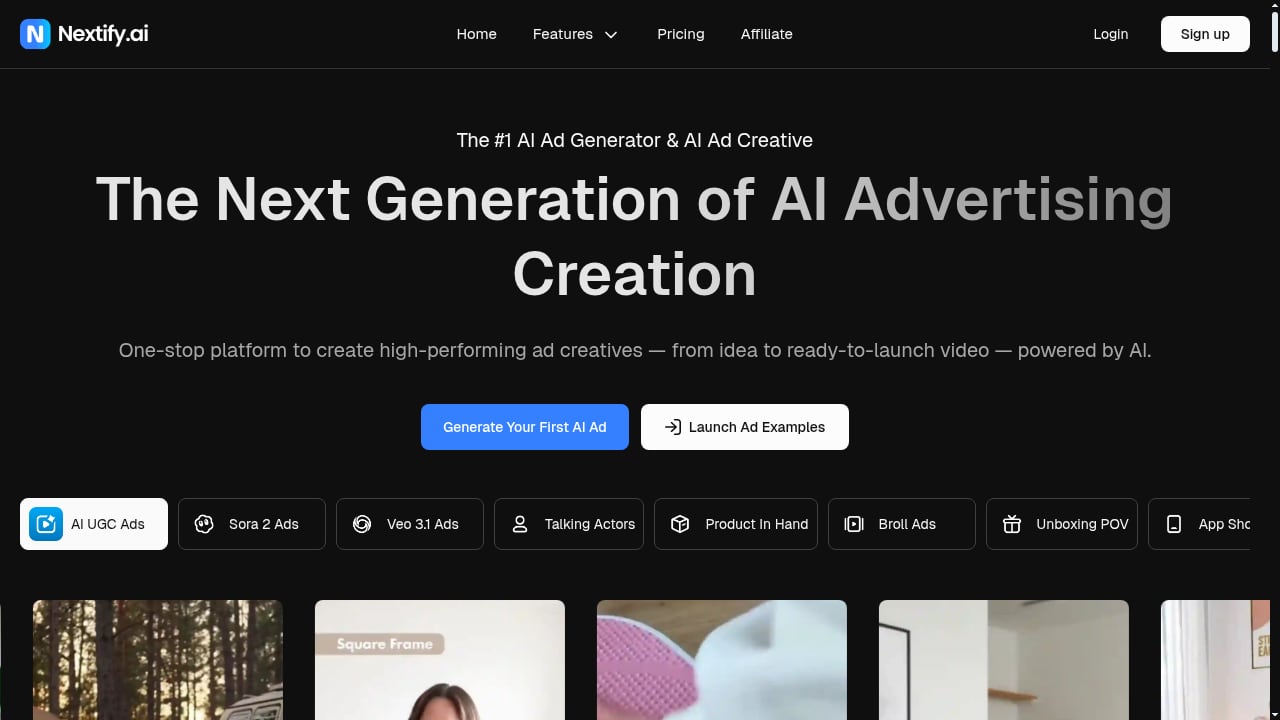
First viewport screenshot of AI Ad Video Generator - Create Ad Creative & UGC Ads by AI.
Nextify turns your research note into multiple ad variations. The goal is not one perfect ad, but several distinct versions you can test against each other.
Choose the Right Format
Match the format to what you found in PrimeSpy:
- If the winning ads are UGC-style, use Nextify's AI avatar library with over 1,000 realistic presenters.
- If they are product demos, generate a product-in-hand or unboxing video.
- If they are talking head ads, select an avatar that matches the style of your target audience.
- If they are static or carousel ads, generate image variations for different placements.
Write Scripts Based on Proven Hooks
Nextify can generate scripts automatically, but the best results come when you guide it with your research. Input the hook and angle from your PrimeSpy note, then let Nextify expand it into a full script.
For the portable blender example, you might prompt Nextify with:
- Hook: "I was skeptical about this $29 blender until I tried it."
- Angle: Busy mornings, convenience, no more bulky blenders.
- Call to action: "Check the link to see today's price."
Nextify then produces a complete script with the structure you identified: hook, doubt, demonstration, result, and offer.
Use AI Voiceovers and Lip-Sync
Nextify supports AI voiceovers in 40+ languages with lip-sync. If your PrimeSpy research shows strong performance in a specific market, generate the voiceover in that language. This lets you localize a proven concept without recording new audio.
Generate Multiple Variations
Create at least three to five variations per winning concept. Change one element at a time so you can identify what drives performance:
- Variation A: Original hook, avatar A, product-in-hand format.
- Variation B: Same hook, avatar B, unboxing format.
- Variation C: New hook based on a different angle, avatar A, product demo.
- Variation D: Original hook, static image with text overlay.
- Variation E: Original hook, shorter 15-second version.
This structured variation approach is what makes the PrimeSpy + Nextify combination powerful. You are not guessing which creative will work; you are systematically testing elements that already showed promise in the market.
Step 4: Launch and Test
Export your Nextify creatives and upload them to Facebook Ads Manager, TikTok Ads Manager, or Instagram. Structure your test so results are readable.
Testing Best Practices
- Use the same audience, budget, and placement for all variations in a test.
- Run a broad audience or your proven audience, not a new untested one.
- Give each variation enough budget to reach statistical significance.
- Track click-through rate, cost per click, and conversion rate, not just impressions.
If you are new to paid ads, start with a small daily budget and one platform. TikTok and Facebook often reward different creative styles, so test separately before scaling.
What to Do with Results
After the test period, identify the winning variation. Then return to PrimeSpy to see if similar concepts are still scaling. This closes the loop: performance data tells you what to research next, and research tells you what to create next.
Step 5: Repeat to Beat Creative Fatigue
Creative fatigue is the biggest hidden cost in paid advertising. An ad that performs well today will decay as audiences see it repeatedly. The solution is a steady pipeline of fresh variations.
A sustainable weekly routine looks like this:
- Monday: Spend 30 minutes in PrimeSpy reviewing new ads and trends in your niche.
- Tuesday: Update your research notes and identify two or three new angles.
- Wednesday: Generate 5 to 10 new creatives in Nextify.
- Thursday: Launch new variations and pause underperforming ones.
- Friday: Review performance and note which hooks and formats are winning.
This routine keeps your creative pipeline full without requiring a production team. Nextify's positioning as a way to reduce production costs by up to 90% matters most when you are producing at this volume.
Practical Example: Dropshipping a Trending Product
Let's walk through a complete example for a dropshipper.
Research Phase
You open PrimeSpy and check the daily top products list. You notice a posture corrector appearing repeatedly with high spend and many duplicates. You search the keyword "posture corrector" and filter for TikTok ads from the last 30 days.
You find three ads that have been running for over a month. All three use the same angle: "desk workers who sit all day." The hooks vary, but the structure is consistent: problem, demonstration, result, offer.
Creative Phase
You write a research note capturing the angle and structure. Then you open Nextify and:
- Select a UGC-style avatar that matches the demographic of desk workers.
- Input a hook based on the winning pattern: "If you sit at a desk all day, your posture is getting worse."
- Generate a script with the problem-demonstration-result-offer structure.
- Create three variations with different hooks and avatars.
- Generate one static image version for Facebook feed placement.
Testing Phase
You launch all four variations on TikTok with a $20 daily budget and a broad audience. After five days, Variation B has the lowest cost per click and the highest conversion rate. You scale that variation and pause the others.
Iteration Phase
You return to PrimeSpy to see if new posture corrector ads have appeared. You notice a new angle emerging: "gift for remote workers." You generate two new Nextify variations using that angle and add them to your test.
This loop continues as long as the product remains profitable.
Common Mistakes to Avoid
Copying Ads Instead of Extracting Patterns
PrimeSpy shows you what works, but copying an ad exactly is both unethical and ineffective. Platforms penalize duplicate creatives, and audiences recognize copied ads. Extract the hook, angle, and structure, then create something original in Nextify.
Generating Too Few Variations
One new creative is not a test. Generate at least three to five variations per concept. The cost of additional Nextify generations is far lower than the cost of a failed campaign.
Ignoring Platform Differences
A TikTok ad that works may not work on Facebook. Use PrimeSpy filters to research each platform separately, and generate platform-specific formats in Nextify.
Skipping the Research Phase
Nextify can generate ads without PrimeSpy, but you lose the data-driven foundation. Without research, you are guessing which angles to test. With research, you are testing angles that already have market validation.
PrimeSpy and Nextify: Complementary, Not Competing
First viewport screenshot of Pricing - Nextify.AI.
Some platforms try to combine research and generation in one tool. The advantage of using PrimeSpy and Nextify separately is specialization.
PrimeSpy focuses on ad intelligence: search, filters, metrics, and competitor tracking. Its credit-based pricing starts with a free trial of 500 credits and a Pro plan at $9.99 per month with 20,000 credits.
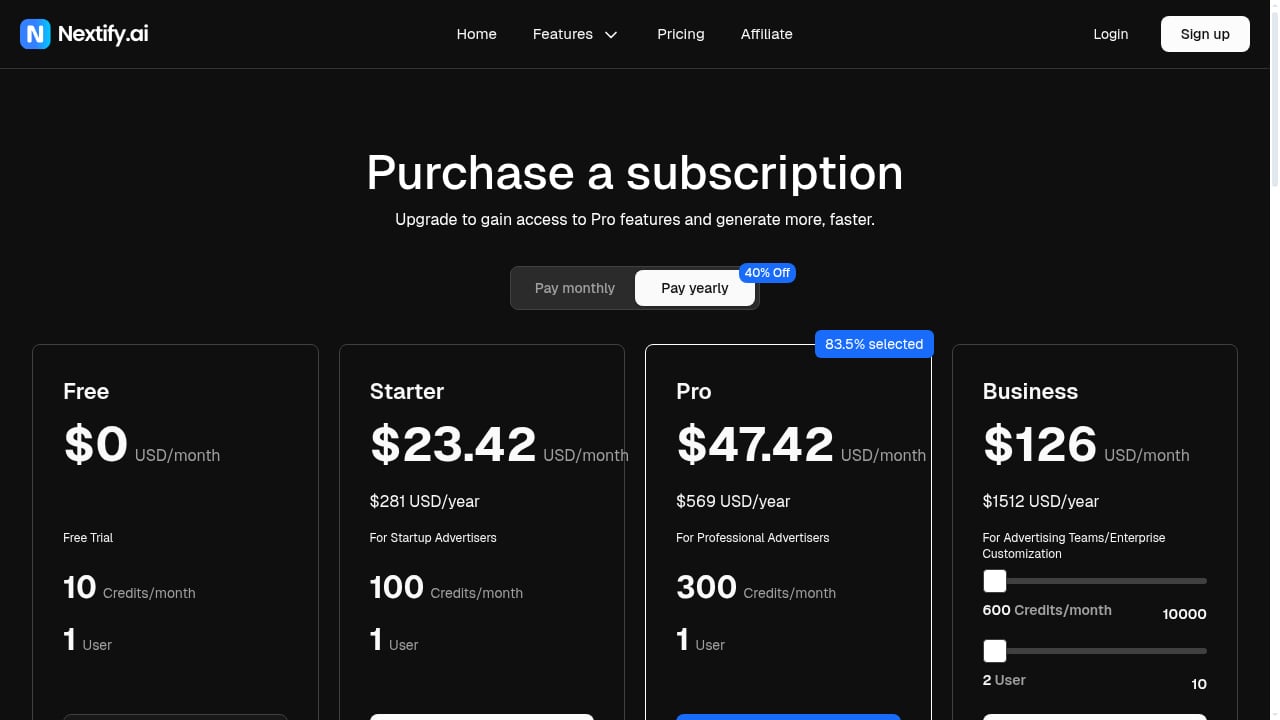
Nextify focuses on creative production: avatars, voiceovers, scripts, and format variety. It offers a free trial with paid plans starting at $23.42 per month.
Together, the monthly cost is modest compared to hiring a media buyer and a video production team. The workflow also scales: as you test more, you learn more, and both tools become more valuable.
For a deeper comparison of ad intelligence tools, see PrimeSpy vs Adspo: Which Ad Spy Tool Wins in 2026? and PrimeSpy vs AdsLibrary vs Foreplay: Which Ad Tool Wins?.
Related reading
- CrispyAds Review 2026: Ad Inspiration & AI Creative Analysis - Evidence-based CrispyAds review: ad library coverage, AI creative analysis, pricing signals, setup, limitations, and who should use it in 2026.
- Pipiads Login: Step-by-Step Access, Fixes & Alternatives - Learn how to log in to Pipiads, fix common access issues, reset your password, and compare Pipiads with PrimeSpy for TikTok and Facebook ad research.
Sources and further reading
- AdKit: AI-powered advertising research, creation, launching, and optimization platform - AdKit: AdKit is an advertising management toolbox for marketers and AI agents. It combines competitor ad research, a multi-platform ad library, AI ad generation and cloning, campaign drafting, campaign management, and performance analysis in one platform. Users can work through the AdKit dashboard or connect an AI agent through MCP or CLI integrations to research competitors, create ad variations, launch campaigns, and identify which ads to kill, scale, or test next. Campaign changes are created as drafts and require user approval before going live.
- The best undress AI websites & AI tools - Toolify - Create editable AI flyers and posters for your small business without starting from a blank canvas. PrimeSpy ... 9 Powerful Use Cases for AWS Speech to Text ...
- Top Advertising AI tools in 2026 - Discover the best AI tools for Advertising, and compare them for use cases, features and pricing. Find the best Advertising tool for your task.
Frequently Asked Questions
Do I need both PrimeSpy and Nextify, or can I start with one?
Start with PrimeSpy if your main gap is knowing what to test. Start with Nextify if you already have validated angles but struggle to produce enough creatives. The full workflow works best when you have both, but either tool provides value on its own.
How many PrimeSpy credits does a typical research session use?
A focused session searching one niche and reviewing 10 to 20 ads can use a few hundred credits. The free trial with 500 credits is enough to test the workflow. The Pro plan with 20,000 credits supports regular weekly research.
Can Nextify generate ads in languages other than English?
Yes. Nextify supports AI voiceovers in 40+ languages with lip-sync. Use PrimeSpy to identify which markets are scaling, then generate localized creatives in Nextify.
How long does it take to go from research to launched ads?
A focused session can take under two hours: 30 to 45 minutes for PrimeSpy research, 30 to 45 minutes for Nextify generation, and 30 minutes for campaign setup. With practice, the routine gets faster.
Is this workflow only for dropshipping?
No. The same loop works for ecommerce brands, TikTok Shop sellers, apps, games, and agencies. Any advertiser who benefits from competitor research and rapid creative production can use it.
What if my Nextify ads do not perform as well as the originals?
Check whether you changed too many elements at once. Test one variable at a time, and make sure your audience and budget match the original ad's conditions. Also verify that your hook and script structure match the pattern you identified in PrimeSpy.
Conclusion
PrimeSpy and Nextify solve complementary problems. PrimeSpy shows you what is already working in the market; Nextify turns that evidence into original, testable creatives at scale. The workflow is simple: research, extract, generate, test, and repeat.
The advertisers who win are not the ones with the biggest budgets. They are the ones who shorten the cycle between insight and creative. PrimeSpy shortens the insight side; Nextify shortens the creative side. Together, they create a feedback loop that compounds over time.
Start with a single niche, run the five-step workflow once, and measure the difference in your testing speed and creative output. For more context on how AI and short-form video are reshaping ad strategy, see Global Ad Trends 2026: AI, Social Video & Commerce.