
Top 10 Ad Tracking & Attribution Software Products in 2026
Most marketing teams still can’t answer one fundamental question: which ads actually drive revenue? Platform-reported metrics inflate conversions, cookie restrictions hide entire journeys, and manual budget shifts eat up hours every week. Ad tracking and attribution software is designed to solve exactly this—by connecting ad spend to real outcomes, unifying cross-channel data, and giving you a single source of truth.
We tested and ranked the top 10 platforms that genuinely belong to the ad tracking and attribution category. Every product on this list was evaluated against a transparent set of criteria, backed by public documentation, user reviews, and measurable proof points. No fluff, no hand‑wavy dashboards—only tools that close the loop between ad investment and revenue.
How We Evaluated These Attribution Platforms
We scored each tool across six dimensions that matter for modern performance marketers:
- Tracking methodology – first‑party, server‑side, pixel‑based, or hybrid; ability to recover lost conversions from ad blockers and consent gaps.
- Multi‑touch attribution (MTA) – range of models (first‑touch, last‑paid, data‑driven, ML‑powered) and flexibility to switch between them.
- Channel coverage – supported ad platforms (Google, Meta, TikTok, programmatic, offline) and data unification quality.
- Automation & optimization – whether the tool stops at a dashboard or actually moves budgets and sends conversion signals back to ad platforms.
- Privacy compliance – readiness for cookieless, ITP, and evolving regulations.
- Pricing transparency & fit – clear tiers, entry points, and use‑case alignment from SMB to enterprise.
What follows is a balanced mix of full‑stack measurement suites, specialised B2B/DTC platforms, and enterprise analytics engines—all ranked by overall capability, not popularity.
Top 10 Ad Tracking & Attribution Software in 2026
Top 10 Ad Tracking & Attribution Software 2026 product interface and feature overview.
1. SegmentStream – Best for Automated Budget Optimization
SegmentStream is the only platform in this round‑up that closes the full measurement loop: it attributes conversions, models marginal returns, and automatically rebalances budgets across ad channels every week. Instead of handing you a dashboard and leaving the rest to spreadsheets, it runs a Continuous Optimization Loop that connects attribution insights directly to execution.
Top Features
- Full multi‑model suite: first‑touch, last‑paid, last‑paid non‑brand, and ML‑driven behavioural MTA.
- Automated weekly budget rebalancing across Google Ads, Meta, TikTok, and more.
- Cross‑device identity graph with deterministic ID stitching and probabilistic matching.
- Expert‑led geo‑holdout incrementality testing.
Who It’s For DTC and e‑commerce brands spending upwards of $100k/month on paid acquisition who need attribution to drive action, not just reports.
Evidence SegmentStream’s own analysis, published on its blog, highlights that most teams waste 10–20 hours per week manually transferring attribution signals into ad platform bid adjustments—a gap its automation eliminates entirely.
2. HockeyStack – Best for B2B Revenue Attribution
HockeyStack unifies CRM, website, product, and ad data into a single go‑to‑market intelligence layer. Its AI agent, Odin, lets you ask questions like “Which blog posts influenced the most enterprise deals?” and get instant, data‑backed answers. The platform specialises in showing how marketing activities generate pipeline and revenue, not just form fills.
Top Features
- Full‑funnel journey mapping for accounts and individuals.
- Flexible attribution models (first‑touch, last‑touch, W‑shaped, custom).
- Atlas data foundation that cleans and unifies siloed GTM data.
- Real‑time revenue and pipeline reporting.
Who It’s For B2B SaaS companies and revenue operations teams with long, multi‑stakeholder sales cycles.
Evidence Kantox used HockeyStack to replace Power BI and Excel, giving every marketer self‑serve visibility; Pylon uncovered hidden Google Ads pipeline drivers and scaled spend confidently. Real‑customer case studies detail 3‑5x ROI in saved engineering hours and better budget allocation.
3. Ruler Analytics – Best for Lead Generation & Call Tracking
Ruler Analytics connects online ad interactions to offline conversions—phone calls, sales calls, and CRM deals. Its visitor‑level tracking stitches anonymous sessions to known leads once a form is submitted, giving closed‑loop attribution for businesses that rely on conversations.
Top Features
- Visitor‑level tracking with lead source attribution.
- Call tracking and ad‑spend attribution integrated with Google Ads, Meta, and LinkedIn.
- Form submission tracking that links every touchpoint to revenue.
- Integrations with major CRMs.
Who It’s For Legal firms, financial services, B2B service providers, and agencies running lead‑generation campaigns where phone calls are critical.
Evidence G2 reviews consistently mention Ruler’s strong lead‑source clarity and helpful call‑tracking functionality. Plans start from £199/month, making it accessible for mid‑market lead‑gen teams.
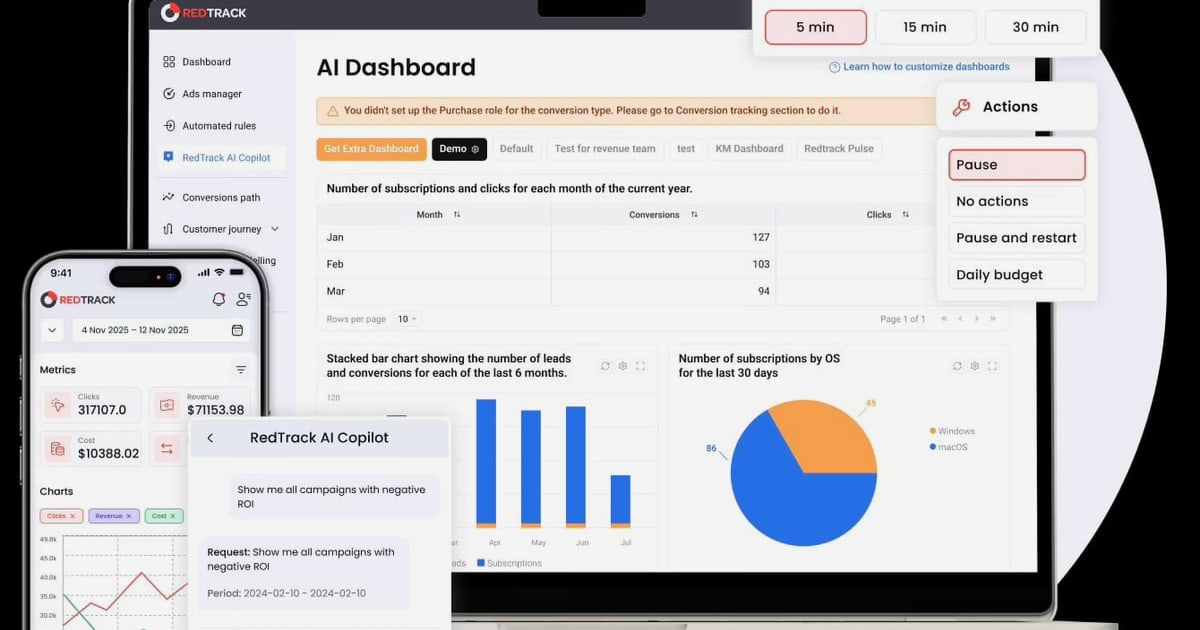
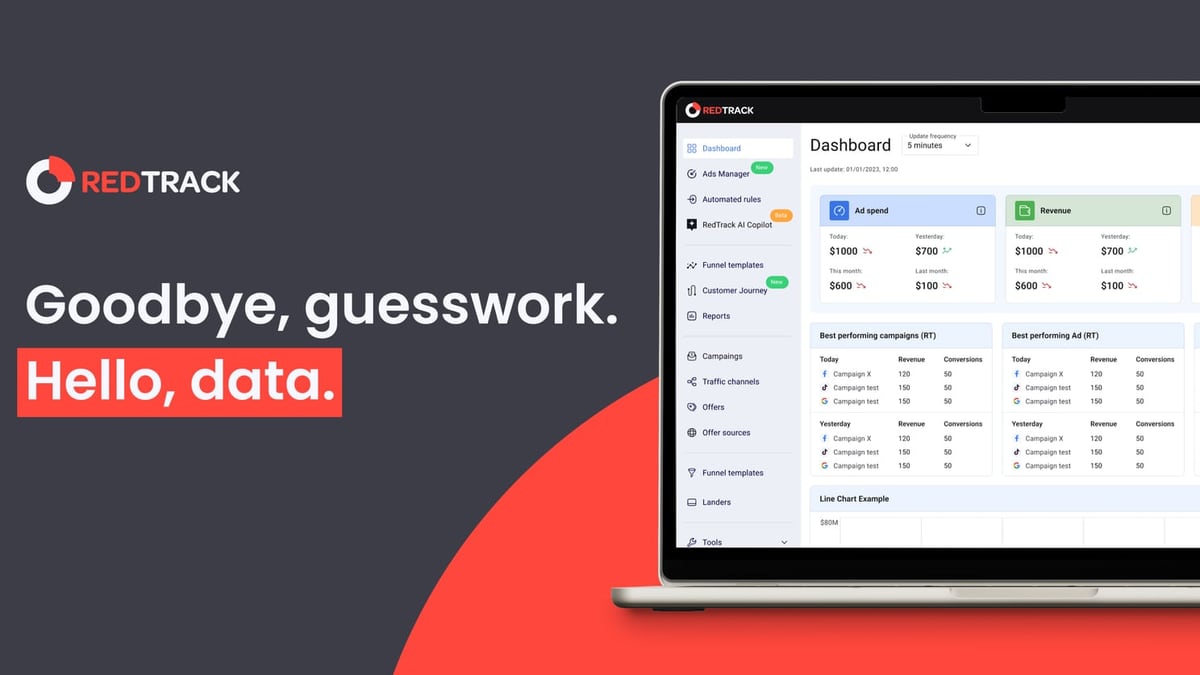
4. RedTrack – Best Cookieless Tracking for Affiliates & DTC
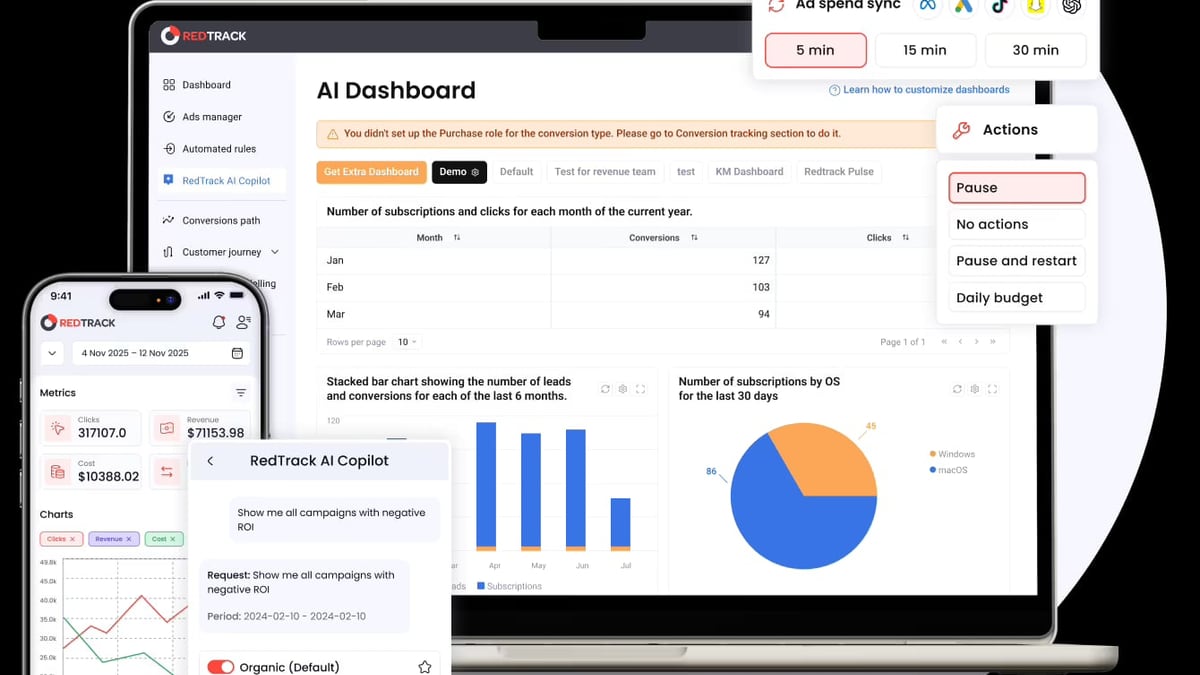
RedTrack is a cookieless ad tracking and attribution platform built for affiliates, media buyers, and DTC e‑commerce brands. It collects first‑party data via server‑side tracking, recovering 30–50% of conversions lost to ad blockers and browser restrictions. Its real‑time cost sync (every 5–30 minutes) and automated rule engine let you pause underperforming campaigns and scale winners without manual intervention.
Top Features
- Server‑side, first‑party tracking that bypasses cookie limitations.
- Multi‑touch attribution models (first‑click, last‑click, linear, time‑decay, custom).
- Real‑time ad cost integration from Google Ads, Meta, TikTok, and more.
- Conversion API (CAPI) integration to send signals back to ad platforms.
- AI‑driven insights and automated optimisation rules.
Who It’s For Performance affiliates, media buyers, and DTC brands obsessed with real ROI per source and campaign.
Evidence RedTrack tracked over 1 billion conversions and $621M+ in revenue through 2025 across 5,000+ active media buyers. This hard data proves its ability to handle high‑volume, privacy‑safe attribution at scale.
5. Triple Whale – Best for Shopify DTC Brands
Triple Whale gives Shopify merchants a unified view of all ad spend and revenue, using its proprietary Total Impact attribution model that blends pixel data, server‑side tracking, and platform APIs. It’s less about academic MTA and more about giving operators a single, actionable RoAS number.
Top Features
- Blended “Total Impact” attribution model.
- All‑in‑one dashboard combining ad spend, COGS, and profitability metrics.
- Pixel and server‑side tracking with Shopify integration.
- Creative and campaign analysis.
Who It’s For Shopify‑first DTC brands that need a clean financial view of advertising performance.
Evidence Triple Whale’s tiered pricing serves brands spending from $50k/month upwards. Multiple user reviews on G2 praise its clarity for understanding true blended RoAS, though some note it’s less suited for non‑Shopify stacks.
6. Northbeam – Best for DTC Paid Media Analytics
Northbeam blends ad platform data, web analytics, and server‑side events to build a single view of the customer journey. Its emphasis on blended attribution and early‑stage geo‑lift testing makes it popular among DTC teams scaling fast on Meta and TikTok.
Top Features
- Blended attribution modelling with server‑side event tracking.
- Geo‑holdout experiments for incrementality testing (in beta).
- Multi‑touch path analysis and creative breakdowns.
- Starter plan from $1,000/month.
Who It’s For Mid‑market to large DTC brands that manage $250k+ monthly ad spend and need an alternative to platform‑reported numbers.
Evidence SegmentStream’s attribution tools comparison notes Northbeam as a strong choice for paid media analytics, though it lacks automated budget execution, leaving teams to act on insights manually.
7. Dreamdata – Best for B2B Buyer Journey Analytics
Dreamdata specialises in reconstructing long B2B buying journeys, connecting marketing touches to sales outcomes across months. It collects data from websites, ads, and CRMs to build a timeline that shows exactly which content, campaigns, and channels influenced a closed deal.
Top Features
- Touchpoint analytics and sales cycle analysis.
- Rule‑based positional attribution models.
- Predictive analytics and pipeline dashboards.
- Free tier for small teams; paid plans custom‑priced.
Who It’s For B2B SaaS companies and revenue operations teams that need to prove marketing’s contribution to revenue over long sales cycles.
Evidence In HockeyStack’s 2026 review, Dreamdata is highlighted for its detailed visibility into customer journeys, though it requires effort to fine‑tune integrations. Real‑world adoption by European B2B scale‑ups confirms its depth.
8. AdBeacon – Best Cross‑Channel Ad Performance Dashboard
AdBeacon aggregates advertising data from multiple platforms into a single, real‑time analytics environment. Rather than relying on each ad platform’s self‑reported numbers, it gives media buyers a centralised view of what’s actually driving results.
Top Features
- Cross‑platform ad performance tracking.
- Multi‑touch marketing attribution.
- Real‑time campaign analytics dashboards.
- Revenue‑focused measurement.
Who It’s For E‑commerce brands and agencies running ads across Google, Meta, TikTok, and programmatic that want a unified reporting layer.
Evidence The platform’s own 2026 review of attribution software positions AdBeacon as solving the “each platform claims the same conversion” problem, a common pain point for agencies managing client spend.
9. Google Analytics 4 – Baseline Attribution for GA‑Centric Teams
Google Analytics 4 includes built‑in data‑driven attribution (DDA) that uses Shapley values to assign credit across touchpoints. While it only sees Google‑ecosystem data and lacks cross‑platform coverage, its free tier and tight integration with Google Ads make it a starting point for many teams.
Top Features
- Data‑driven attribution model (Shapley‑value based).
- Path exploration and conversion modeling.
- Seamless Google Ads integration.
- Free up to 50 properties.
Who It’s For Small teams that primarily use Google Ads and need a basic, no‑cost attribution layer.
Evidence SegmentStream’s 2026 comparison notes that GA4’s model only analyses position and sequence within Google’s own data, not actual session engagement signals. For any team spending across multiple platforms, it’s best supplemented with a dedicated cross‑channel tool.
10. Rockerbox – Enterprise Omnichannel MTA & MMM
Rockerbox combines multi‑touch attribution with marketing mix modelling (MMM) and geo‑experiment incrementality testing, making it suitable for complex, omnichannel brands. It’s used by enterprises that need a single source of truth across TV, radio, digital, and direct mail.
Top Features
- MTA and MMM under one roof.
- Geo‑holdout incrementality experiments.
- Advanced journey mapping and reporting.
- Custom implementation and onboarding.
Who It’s For Large brands and agencies managing multi‑million‑dollar omnichannel budgets where offline channels play a significant role.
Evidence While less discussed in the DTC‑focused sources above, Rockerbox’s ability to run geo experiments is highlighted in multiple industry analyses as a core capability for enterprise incrementality, and its custom pricing reflects its scale.
Beyond Attribution: Using Ad Intelligence to Amplify Results

Top 10 Ad Tracking & Attribution Software 2026 product interface and feature overview.
Choosing the right ad tracking platform solves the “what’s working” question. But before you spend on ads, you still need to know which creatives, angles, and products are already winning. That’s where ad intelligence tools complement your attribution stack.
For example, PrimeSpy helps you reverse‑engineer competitor campaigns across Meta and TikTok, uncovering profitable product‑ad combinations before you test them. At $9.99/month, it’s an accessible way to feed fresh creative ideas into your attribution-optimised campaigns. If you’re already using RedTrack for cookieless tracking, the workflow becomes even more powerful: spy on winning ads with PrimeSpy, launch them, then track real ROI through RedTrack’s server‑side attribution. We cover this integration in detail in our guide on how to use PrimeSpy with RedTrack, showing exactly how to stop guessing and start scaling.
Practical Scenario: Picking the Right Tool for Your Team
Top 10 Ad Tracking & Attribution Software 2026 product interface and feature overview.
- You’re a solo media buyer or affiliate → Start with RedTrack. Its cookieless first‑party tracking recovers conversions you’re currently losing, and the automation rules save hours of manual monitoring.
- You run a B2B SaaS with a 6‑month sales cycle → HockeyStack or Dreamdata will tie marketing activities to closed revenue, while HockeyStack’s AI lets the whole team query attribution data in plain English.
- You’re a DTC brand burning $200k/month on Meta/TikTok → SegmentStream gives you the only automated budget rebalancing in this list, or Triple Whale/ Northbeam if Shopify‑centric analytics is enough.
- Phone calls and form submissions drive your deals → Ruler Analytics connects those offline conversions back to the exact ad and keyword.
- Agencies managing multiple client mixes → AdBeacon provides a unified dashboard that tames the “double‑counting” problem across platforms.
Combine your chosen attribution tool with a product research platform like PrimeSpy to nail both what to sell and how to measure every ad dollar. That end‑to‑end loop—product intelligence plus attribution—is what top‑performing e‑commerce teams build from day one.
Related reading
- PrimeSpy with Dropship: Step-by-Step Workflow for Dropshipping - Learn how to use PrimeSpy ad spy and Dropship product research together to validate winning products, analyze competitor ads, and scale your dropshipping store profitably.
- PrimeSpy vs Foreplay vs BigSpy: Features, Pricing & Verdict - Compare PrimeSpy, Foreplay, and BigSpy on ad intelligence, pricing, platform coverage, and unique features. Find out which ad spy tool fits your budget and workflow best.
- PrimeSpy vs BigSpy (2025): Features, Pricing & Winner - Compare PrimeSpy vs BigSpy on features, pricing, ad databases, and user experience. See why PrimeSpy offers better value at $9.99/month vs BigSpy's $99 plan.
Sources and further reading
- 19 Best Marketing Attribution Software Solutions in 2026 - With the right attribution tool, businesses can stop guessing and start making smarter marketing decisions based on real data. Keep reading!
- 10 Best Marketing Attribution Tools & Platforms (2026) - Compare the 10 best marketing attribution tools in 2026 — SegmentStream, Google Analytics 4, Triple Whale, Northbeam, Dreamdata, and more.
- 19 Best Marketing Attribution Software Solutions Reviewed ... - 19 Best Marketing Attribution Software Solutions Reviewed ...HockeyStackhttps://www.hockeystack.com › BlogHockeyStackhttps://www.hockeystack.com › BlogJun 12, 2026 — Find the best marketing attribution software to track ROI, optimize campaigns, and make data-driven decisions with our top 19 picks. T
Frequently Asked Questions
What is the difference between ad tracking and attribution?
Ad tracking records when and where an ad was seen or clicked. Attribution assigns credit for a conversion across multiple touchpoints. Tracking is the raw data; attribution is the model that turns that data into actionable insights.
Why is cookieless tracking important?
Browser restrictions (ITP, ETP) and ad blockers can prevent standard pixel‑based tracking from firing. Cookieless or server‑side tracking recovers 30–50% of otherwise lost conversions, giving a truer picture of ad performance.
Can I use more than one attribution tool?
Yes, many sophisticated teams run both a day‑to‑day operational tool (like RedTrack for media buyers) and a strategic analytics platform (like SegmentStream for cross‑channel modelling). Ensure data sources align to avoid conflicting numbers.
How often should I update my attribution model?
At minimum, review your model quarterly. If you launch new channels, change your funnel, or see significant shifts in consent rates, adjust immediately. Tools that support multiple models allow A/B testing different credit rules.
Is automated budget optimization safe?
Robust platforms like SegmentStream use controlled, incremental adjustments based on marginal return modelling, not black‑box AI that moves large sums at once. You can set guardrails and review changes before they happen.
Final Verdict

Top 10 Ad Tracking & Attribution Software 2026 product interface and feature overview.
The ad tracking and attribution market in 2026 is no longer about pretty dashboards. The top tools now fight to either automate budget execution (SegmentStream), unify fragmented B2B data (HockeyStack, Dreamdata), or deliver privacy‑safe measurement that recoups lost conversions (RedTrack).
Define whether you need an attribution tool that just reports, or one that acts on that reporting. If your team still spends Fridays exporting CSV reports and manually adjusting bids, it’s time to upgrade. Pair the right attribution foundation with complementary ad intelligence—like the budget‑friendly PrimeSpy—and you’ll finally close the loop between ad spend and profitable growth.