
Digital Ad Insights: Turn Competitor Data Into Winning Campaigns
Most advertisers do not lose because they lack budget. They lose because they make decisions on guesswork while competitors make decisions on data. Digital ad insights close that gap. They show you which creatives are actually running, how long they have been live, where budget is flowing, and which angles are resonating with real audiences.
This guide breaks down what digital ad insights are, where they come from, how to read them, and how to turn raw signals into campaign decisions that improve performance.
What Are Digital Ad Insights?
Best PiPiAds Alternatives.
Digital ad insights are structured observations about paid advertising activity across platforms. They typically include:
- Active ad creatives — the images, videos, and copy competitors are running right now
- Ad longevity — how long a specific ad has been live, a strong proxy for profitability
- Estimated reach and spend — modeled data that shows how aggressively an advertiser is scaling
- Duplicate creative patterns — the same ad concept appearing across multiple ad sets or accounts
- Landing page and funnel signals — where clicks are sent and how offers are structured
- Platform distribution — whether a brand is active on Facebook, TikTok, YouTube, or elsewhere
These signals come from ad intelligence platforms, native ad libraries, and analytics tools. Nielsen Ad Intel, for example, tracks advertising behavior across millions of brands to help marketers understand budget allocation and competitive positioning. Sensor Tower provides similar visibility into mobile ad creatives, share of voice, and paid campaign iteration across networks like Facebook and TikTok.
The key difference between raw data and insight is interpretation. A list of active ads is data. Knowing that a competitor has kept the same video live for 90 days while rotating three new hooks every week is an insight.
Why Digital Ad Insights Matter More Than Ever
Paid media has become more expensive and more volatile. Platform algorithm changes, rising CPMs, and creative fatigue mean that what worked last quarter may not work next month.
Digital ad insights help in four specific ways:
1. Reduce Testing Costs
Every failed creative test costs money. By studying which hooks, formats, and angles are already working in your niche, you can start your own tests closer to the winning zone. You still need to test, but you test smarter variations instead of blind guesses.
2. Spot Market Trends Early
When multiple unrelated advertisers start running the same creative angle, product category, or offer structure, that is a trend signal. Catching it early gives you a window before saturation drives up costs.
3. Understand Competitor Strategy
Ad insights reveal more than individual ads. They reveal strategic patterns: whether a brand is launching a new product line, testing a new audience, shifting budget between platforms, or scaling a seasonal promotion.
4. Benchmark Your Own Performance
Without external reference points, it is hard to know if your CTR, creative style, or offer is competitive. Seeing what top advertisers in your vertical are doing gives you a realistic baseline.
Where Digital Ad Insights Come From
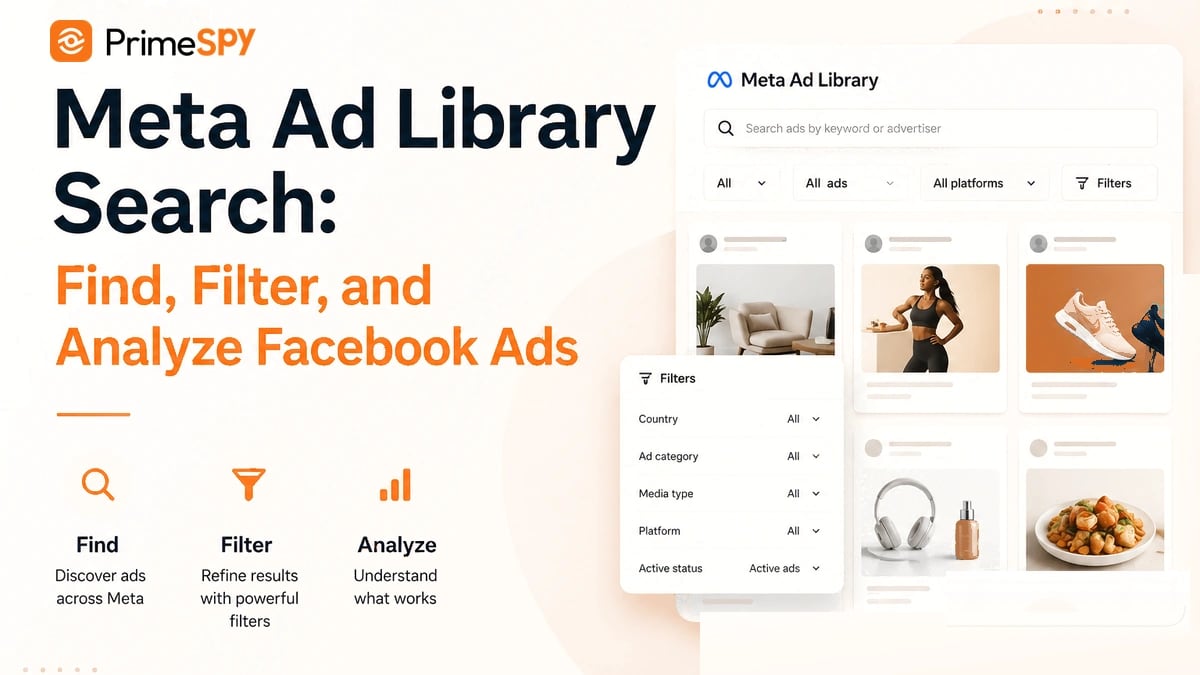
PrimeSpy product interface.
There are three main sources, each with different strengths and limitations.
Native Ad Libraries
Meta Ad Library, TikTok Creative Center, and Google Ads Transparency Center provide official visibility into active ads. They are free and authoritative, but limited. You can see what is running, but not performance metrics, spend estimates, or historical data.
Enterprise Intelligence Platforms
Tools like Nielsen Ad Intel and Sensor Tower serve larger brands and agencies. They provide cross-channel spend data, share of voice, and competitive benchmarking at scale. These platforms are powerful but often expensive and oriented toward enterprise workflows.
Ad Spy and Research Tools
Ad spy tools sit between native libraries and enterprise platforms. They aggregate data from multiple ad networks, add modeled metrics like reach and spend, and provide search and filtering designed for competitive research. PrimeSpy is an example in this category: it lets marketers search by keyword, URL, or advertiser across Facebook, TikTok, and Meta Ad Library, then filter by platform, ad type, and performance signals.
The right source depends on your budget, business model, and research depth. A solo dropshipper needs different insights than a brand manager at a Fortune 500 company.
How to Read Digital Ad Insights Like a Strategist
Collecting data is easy. Interpreting it correctly is the skill. Here are the most important signals and what they actually mean.
Ad Longevity: The Strongest Profit Signal
An ad that has been running for 60, 90, or 180 days is almost certainly profitable. Advertisers do not keep losing ads live for months. When you see longevity, reverse-engineer the creative: the hook, the visual style, the offer, the landing page experience.
Short-lived ads are not necessarily failures. They may be tests, seasonal pushes, or retargeting creatives. But longevity is the clearest public signal of sustained performance.
Duplicate Creatives: Scaling Evidence
When the same ad concept appears in multiple variations or across multiple ad accounts, the advertiser is scaling what works. Duplicates often mean the creative has passed the testing phase and is being pushed to broader audiences.
Spend and Reach Trends: Momentum Indicators
Estimated spend and reach show you whether an advertiser is ramping up or pulling back. A sudden increase in spend on a specific creative suggests strong performance. A gradual decline may indicate fatigue or budget reallocation.
Creative Format Mix: Platform Strategy
Are competitors using user-generated content, polished video, static images, or carousel ads? The format mix tells you what is working on each platform. TikTok rewards native-feeling UGC. Facebook often favors direct-response video with clear hooks. Matching format to platform is a fundamental insight.
Offer and Angle Patterns: Positioning Intelligence
Beyond the creative itself, look at the offer structure. Are competitors using discounts, bundles, free trials, or urgency mechanics? What pain points are they addressing? What objections are they preempting? These patterns reveal the market's current buying psychology.
A Practical Framework for Using Digital Ad Insights
Here is a repeatable workflow that turns research into action.
Step 1: Define Your Research Scope
Start with a clear question. Are you researching a specific competitor, a product category, or a creative format? Your scope determines which tools and filters you need.
Step 2: Collect and Organize
Gather active ads from your target competitors or keywords. Save the strongest examples with notes on hook, format, offer, and longevity. A swipe file is useful here. If you need a structured system, swipe file software can help you capture and organize winning examples for later reference.
Step 3: Identify Patterns
Look across your saved ads for recurring themes. What hooks appear most often? Which formats dominate? What offers are most common? Patterns are more valuable than individual ads because they represent what the market has validated at scale.
Step 4: Generate Hypotheses
Turn patterns into testable hypotheses. For example: "A 15-second UGC video with a problem-first hook and a 20% discount outperforms static product images in this niche." Your hypothesis should be specific enough to test.
Step 5: Test and Validate
Run your own variations based on your hypotheses. Track performance against your baseline. The goal is not to copy competitors but to use their validated patterns as a starting point for your own creative development.
Step 6: Monitor and Iterate
Digital ad insights are not a one-time research project. Set up ongoing tracking for your key competitors and categories. When their strategy shifts, you will see it early.
Digital Ad Insights for Different Business Models
The same data serves different purposes depending on what you sell.
Ecommerce and Dropshipping
For product sellers, ad insights are product research. When you see a product advertised consistently across multiple stores, that is demand evidence. Track the creative angles, the price points, and the landing pages. Then decide whether to enter the market or find an adjacent angle.
TikTok Shop Sellers
TikTok Shop moves fast. Winning products can saturate in weeks. Ad insights help you spot products early, understand which creator styles drive sales, and identify when a trend is peaking so you can exit before margins collapse.
Apps and Games
Mobile app and game marketers use ad insights to track competitor user acquisition strategies. Which ad networks are competitors using? What creative formats are driving installs? How are they positioning their app in a crowded store? Sensor Tower's approach shows how share of voice and creative iteration data support these decisions.
Agencies and Freelancers
For agencies, digital ad insights are a client acquisition and retention tool. Showing a prospect exactly what their competitors are running builds immediate credibility. Ongoing competitive monitoring demonstrates value beyond monthly reports.
Common Mistakes When Using Digital Ad Insights
Copying Instead of Learning
The goal is not to replicate a competitor's ad pixel for pixel. That creates legal risk, accelerates creative fatigue, and teaches you nothing. Extract the underlying principle — the hook structure, the offer logic, the format choice — then apply it with your own creative execution.
Ignoring Context
An ad that works for a brand with a large email list and retargeting budget may not work for a cold-traffic campaign. Longevity and spend data are signals, not guarantees. Always consider the advertiser's full funnel context.
Overvaluing Short-Term Trends
A creative that spikes for three days may be a fluke or a test. Focus on sustained patterns: ads running for weeks or months, concepts repeated across accounts, and formats that appear consistently across competitors.
Neglecting Your Own Data
Competitor insights are a starting point, not a replacement for your own performance data. Your audience, offer, and brand context will always differ. Use external insights to generate hypotheses, then let your own results make the final call.
Choosing the Right Digital Ad Insights Tool
primespy-1024proxy.
Your tool choice should match your research intensity and budget.
Free native libraries work for occasional checks and basic competitor visibility. They are limited but useful for quick validation.
Mid-range ad spy tools like PrimeSpy offer a balance of depth and affordability. With smart search by keyword, URL, or advertiser, advanced filters, and modeled metrics like reach and spend, they serve marketers who need regular competitive research without enterprise pricing. The credit-based model also makes it accessible for testing before committing.
Enterprise platforms like Nielsen Ad Intel and Sensor Tower provide the deepest cross-channel data but require significant investment. They make sense for brands and agencies managing large media budgets where granular competitive intelligence justifies the cost.
For most direct-response marketers, a focused ad spy tool plus regular use of native libraries covers the majority of research needs.
Combining Ad Insights with Creative Generation
PrimeSpy product interface.
Research tells you what to create. AI creative tools help you create it faster. The most effective workflow connects both.
Start with ad insights to identify winning hooks, formats, and angles. Then use AI ad creative generation platforms to produce variations based on those validated patterns. This combination reduces both research time and creative production time.
For a detailed walkthrough of this workflow, see how to use PrimeSpy with AdCreative.ai to research winning ads and generate data-backed creatives in a single process.
Related reading
- Top 10 AI Ad Creative Generation Platforms 2026 - Compare the 10 best AI ad creative generation platforms for 2026. Evidence-based rankings, pricing, features, and best-fit use cases for marketers and agencies.
- How to Use PrimeSpy with AdCreative.ai - Learn a step-by-step workflow for combining PrimeSpy ad intelligence with AdCreative.ai to research winning ads and generate data-backed creatives faster.
- AdFox Review: Ad Intelligence for Smarter Creative Decisions - An evidence-based AdFox review covering ideal users, key features, limitations, pricing signals, setup, and how it compares to other ad spy tools.
Sources and further reading
- Competitive Advertising Intelligence | Nielsen - Set your brand apart from the competition with a detailed track of ad spend in markets and media outlets including TV, print, digital, out-of-home and cinema.
- Digital Advertising - Reports, Statistics & Marketing Trends - Latest Digital Advertising data and analysis from EMARKETER including reports, charts, and articles.
- Digital Ad Intelligence | Paid Media Insights - Get accurate signals to optimize mobile marketing programs, insights on competitor strategies, market trends, everything for in-depth ASO and Apple Search Ads
Frequently Asked Questions
What is the difference between ad insights and ad analytics?
Ad analytics measure your own campaign performance: impressions, clicks, conversions, and ROAS. Ad insights describe the broader competitive landscape: what other advertisers are running, how long their ads have been live, and where they are spending. Both are valuable, but they answer different questions.
Are digital ad insights legal and ethical?
Yes, when sourced from public ad libraries and legitimate intelligence platforms. These tools surface information that advertisers have already made publicly visible. The ethical line is copying creative assets directly. Use insights to inform your strategy, not to steal someone else's work.
How often should I check competitor ads?
For fast-moving niches like dropshipping or TikTok Shop, weekly checks are reasonable. For more stable B2B or brand categories, monthly monitoring may be sufficient. Set up alerts or trackers if your tool supports them so you catch major changes without constant manual checking.
Can small businesses benefit from digital ad insights?
Absolutely. Small advertisers often benefit most because they have less budget to waste on failed tests. A focused ad spy tool with a low-cost entry point can pay for itself by preventing a single bad campaign decision.
What metrics matter most in ad intelligence?
Ad longevity is the strongest public signal of profitability. Estimated spend and reach show scaling momentum. Duplicate creative patterns indicate validated concepts. Format and angle patterns reveal what resonates with the target audience. No single metric tells the whole story; look at them together.
How do I know if an ad is actually working?
You cannot see exact conversion data for competitor ads. But longevity is a reliable proxy. Advertisers do not keep unprofitable ads running for months. When you see the same creative live for 60+ days with consistent spend, it is almost certainly generating acceptable returns.
Conclusion
Digital ad insights transform paid media from a guessing game into a structured research process. By studying what competitors are running, how long their ads survive, and which patterns repeat across the market, you can make faster, more confident decisions with less wasted budget.
The most successful advertisers are not necessarily the most creative. They are the most observant. They watch the market, extract validated patterns, and apply those patterns with their own unique execution. Start with clear research questions, use the right tools for your budget, and build a repeatable workflow that turns competitor data into your next winning campaign.