

Attribution Software: How to Pick the Right Tool in 2026
Every ad platform claims credit for the same sale. Google says it drove 500 conversions, Meta says 450, TikTok says 200 — and your bank account shows 600 orders. That gap is why attribution software exists: to reconcile platform-reported numbers against real revenue and tell you which channels actually earned the credit.
This guide explains what attribution software does, how the main methodologies differ, what separates a good tool from a dashboard you'll stop opening, and how to choose one for your spend level and business model.
What Attribution Software Actually Does

Attribution Software: How to Pick the Right Tool in 2026 - What Attribution Software Actually Does.
Attribution software identifies which channels, campaigns, and touchpoints contribute to a conversion, then distributes credit across them. The output is a defensible answer to two questions:
- Which campaigns should get more budget?
- Which ones are only appearing to work because they touched a user who was already going to buy?
A modern customer journey typically involves 5–15 touchpoints across paid search, social, email, organic content, and direct visits. Single-touch models like last non-direct click credit only the final interaction and ignore everything upstream. Multi-touch attribution (MTA) spreads credit across the journey, but the quality of that spread depends entirely on the methodology and the data underneath it.
That last point matters more than most buyers realize. A recommendation is only as good as the data it's built on. If the tool ingests campaign-level conversion counts from ad platform APIs, it inherits the double-counting problem. If it binds real ad spend to individual user journeys and compares that against actual revenue events, the numbers reconcile with your bank account.
The Three Attribution Methodologies (and What Each Answers)
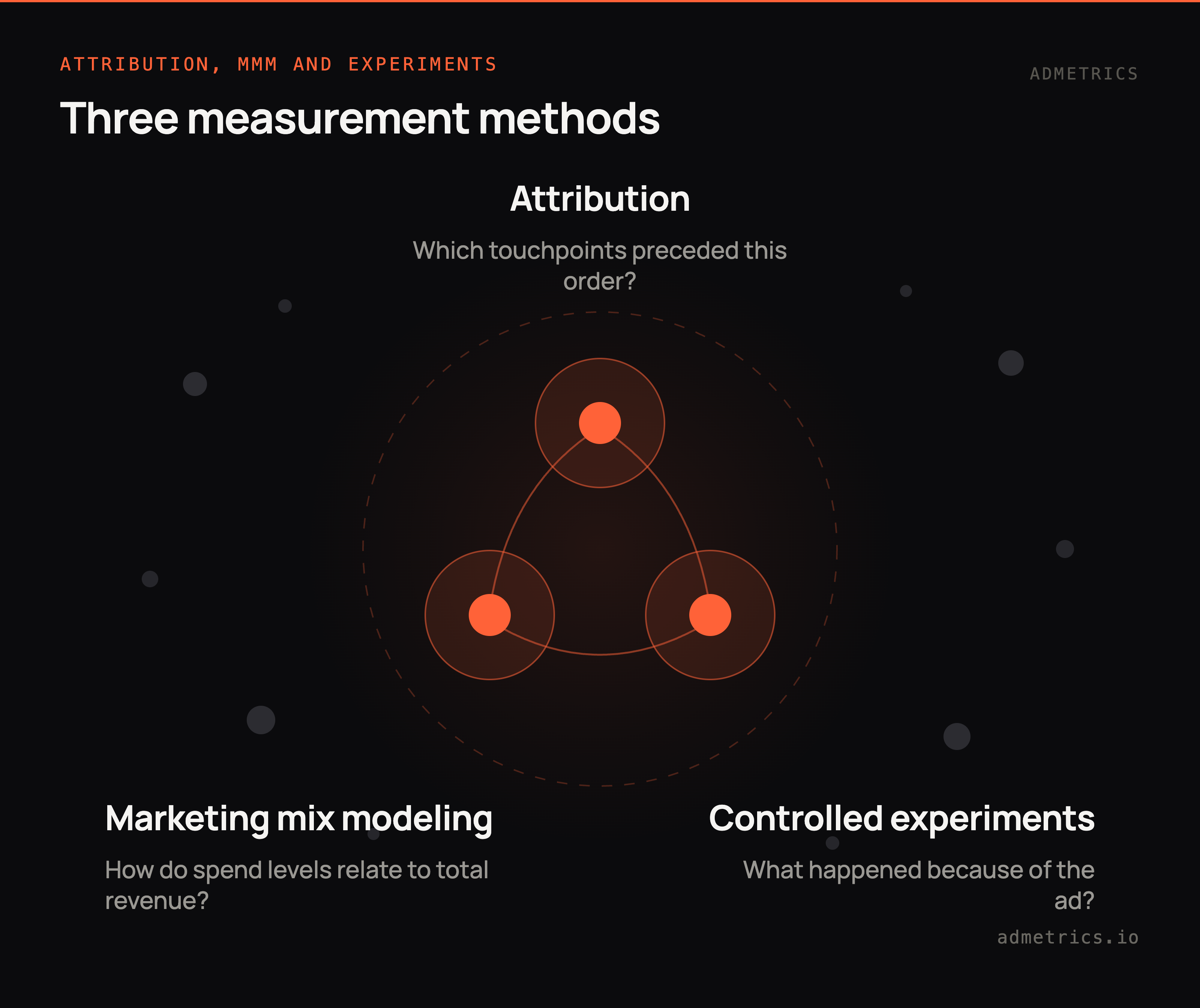
Attribution Software: How to Pick the Right Tool in 2026 - The Three Attribution Methodologies (and What Each Answers).
Attribution tools in 2026 generally fall into three buckets. Most serious platforms combine at least two.
1. Rule-Based Multi-Touch Attribution
Linear, time-decay, U-shaped, first-touch, last-touch. Credit is assigned by position in the journey using fixed formulas. These models are fast, easy to explain to stakeholders, and still useful as a sanity check — but they were standard practice a decade ago and have largely been superseded for budget decisions.
2. Data-Driven and Behavioral MTA
Google's Data-Driven Attribution uses a Shapley-value approach that evaluates the position and sequence of touchpoints — but it only sees Google's own data. ML-powered behavioral models go further by evaluating engagement signals within each session (navigation depth, key events, time on site, micro-conversions) and assigning credit based on measured incremental lift in conversion probability.
The practical difference: rule-based models tell you where a touchpoint sat; behavioral models estimate how much it moved the needle.
3. Incrementality Testing
Rather than modeling credit distribution, incrementality uses controlled experiments — typically geo holdouts — to measure whether ads caused conversions that wouldn't have happened otherwise. Attribution and incrementality answer different questions:
| Method | Question it answers | Best for |
|---|---|---|
| Attribution | How should I split budget across channels today? | Daily and weekly optimization |
| Incrementality | Is this channel worth funding at all? | Quarterly strategy and channel-level go/no-go |
If you're choosing a tool, look for one that supports both. Attribution without incrementality can optimize you into a local maximum; incrementality without attribution leaves you unable to act weekly.
Why Platform-Reported Numbers Don't Add Up
Attribution Software: How to Pick the Right Tool in 2026 - Why Platform-Reported Numbers Don't Add Up.
This is the core problem attribution software solves, and it's worth understanding before you evaluate vendors.
Conversion APIs report at the campaign level, not the user level. When Meta's API says a campaign generated $8 in revenue, it claims credit for every conversion that touched that campaign — even if Google touched the same user first. Add up Google, Meta, and TikTok's reported conversions and you routinely get 1,150 attributed conversions against 600 actual sales.
Three forces make this worse every year:
- Platform inflation. Each platform counts credit for the same conversions independently.
- Consent gaps. More users decline tracking consent, and iOS ATT restricts cross-app visibility. The share of unattributed conversions grows each quarter, and tools that can't model missing data get progressively less accurate.
- Manual reconciliation cost. Teams spend 10–20 hours a week interpreting reports, building budget spreadsheets, and logging into ad platforms to adjust bids.
The fix is user-level cost data: binding actual ad spend to each user's deterministic journey across channels and sessions, then comparing it to actual revenue. That produces true per-user CAC, ROAS, CAC payback, and LTV:CAC — numbers a CFO can audit.
What Separates Good Attribution Software From a Pretty Dashboard

Attribution Software: How to Pick the Right Tool in 2026 - What Separates Good Attribution Software From a Pretty Dashboard.
Most tools measure and report. Fewer help you act. When you're evaluating options, score them against these five dimensions:
Data foundation
- Does it pull spend directly from ad platform APIs, or estimate from UTMs?
- Does it track at the user and account level, or only campaign level?
- Can you drill from any metric down to the underlying visits, clicks, and revenue events?
Model flexibility
- How many models are available, and can you compare them side by side?
- Can you tune lookback windows, direct-traffic handling, and cutoff events?
- For product-led or trial-based businesses, can you exclude post-signup visits from receiving credit?
Incrementality capability
- Does it support geo holdouts or other controlled experiments?
- Is incrementality a core feature or a bolt-on?
Actionability
- Does it recommend specific budget shifts, or just show charts?
- Can you verify the recommendation before acting on it?
- Does it integrate with your CRM, CDP, warehouse, and ad platforms?
Data export and ownership
- Can you export raw visit-level and user-level data to Snowflake, BigQuery, or Redshift?
- Is the export full-fidelity, or aggregated summaries only?
That last dimension is underrated. Raw export means your data team can build custom models in SQL and feed events into AI pipelines — which is how attribution stops being a vendor lock-in and becomes infrastructure.
Matching the Tool to Your Business Model
The right attribution software depends heavily on what you sell and how you sell it.
Ecommerce and DTC
You need blended ROAS, first-time purchaser cost separated from returning-customer revenue, and Shopify-level integration. Tools like Triple Whale and Northbeam are built for this segment. Look for platforms that reconcile platform-reported revenue against actual payment processor data.
B2B and SaaS
Your journey spans long sales cycles, offline touchpoints, and CRM pipeline stages. You need closed-loop reporting that connects marketing touches to deals and revenue, not just form fills. HockeyStack, Ruler Analytics, and Dreamdata compete here. Prioritize CRM integration depth and account-based attribution.
Mobile apps and games
Mobile measurement partners (AppsFlyer, Branch, Adjust) handle install attribution, but they don't cover web-to-app journeys or cross-channel spend reconciliation. If you run paid social to app installs, you'll likely need both an MMP and a cross-channel attribution layer.
Media buying and arbitrage
If your business is buying traffic and monetizing it, attribution is your P&L. You need user-level cost data, fast lookback windows, and the ability to see which creative and placement combinations produce profitable users — not just cheap clicks. This is also where ad intelligence and attribution intersect: knowing which creatives competitors are scaling tells you where to test, while attribution tells you whether the test paid off. Tools like PrimeSpy cover the research side — smart search across Facebook, TikTok, and the Meta Ad Library, plus ad metrics like reach, spend, and duplicate counts — which pairs naturally with an attribution stack that validates the results.
Pricing: What You'll Actually Pay
Attribution software pricing varies wildly, and the sticker price rarely reflects total cost.
| Tier | Typical range | Examples |
|---|---|---|
| Free / built-in | $0 | Google Analytics 4 |
| SMB ecommerce | $19–$200/mo | Attribution, entry DTC tools |
| Mid-market | $1,000+/mo | Northbeam Starter, Ruler Analytics |
| Enterprise | Custom (often $50K+/yr) | Measured, Adobe Analytics, SegmentStream |
The real cost isn't the subscription. It's the 10–20 hours per week your team spends manually interpreting reports and adjusting bids — unless the tool automates that loop. When you compare vendors, price the labor, not just the license.
For teams that need tracking infrastructure before attribution modeling makes sense, it's worth understanding how a dedicated tracker fits the stack — see our explainer on what RedTrack does for media buyers.
A Practical Evaluation Checklist
Before you book a demo, write down your answers to these:
- What's my monthly paid media spend, and across how many platforms?
- Do I need incrementality testing, or is MTA enough for now?
- What does my CRM or payment processor need to connect to?
- Who on my team will actually act on the reports, and how often?
- Do I need raw data export for a warehouse or BI team?
- What's my tolerance for a black-box model I can't audit?
Bring those answers to demos. Vendors optimize their pitch around whichever dimension you emphasize, so knowing your priorities prevents you from buying features you'll never use.
If you're also evaluating ad research tools to feed your creative pipeline, our comparisons of PrimeSpy vs AdSpy vs Swipekit and PrimeSpy vs Dropispy vs Anstrex cover how the research side of the stack differs from the measurement side.
Related reading
- AdSpy Free Trial: What You Actually Get in 2026 - AdSpy doesn't offer a free trial. Compare real trial options, pricing, and features, and see how PrimeSpy's 500 free credits stack up in 2026.
- PrimeSpy vs SellerCenter vs GetHookd: 2026 Ad Spy Comparison - Compare PrimeSpy, SellerCenter, and GetHookd on ad coverage, product research, creative workflow, and pricing to pick the right ad spy tool in 2026.
- Dropship Explained: How Drop Shipping Works in 2026 - Dropship explained: how drop shipping works, real costs, supplier options, product research, and how to validate winning products before you spend on ads.
Sources and further reading
- 10 Best Marketing Attribution Tools & Platforms (2026) - Compare the 10 best marketing attribution tools in 2026 — SegmentStream, Google Analytics 4, Triple Whale, Northbeam, Dreamdata, and more.
- 19 Best Marketing Attribution Software Solutions Reviewed for 2026 - 1. HockeyStack. HockeyStack is a GTM intelligence platform built to solve the core challenges of B2B marketing attribution. It moves beyond simplistic models by ...
- Attribution: Marketing Attribution Software that Works - Attribution that matches your bank account.
FAQ
What is attribution software in simple terms?
It's a tool that tracks every marketing touchpoint a customer interacts with, then calculates how much credit each one deserves for the conversion. The goal is to stop guessing which channels work and start allocating budget based on evidence.
What's the difference between attribution software and Google Analytics 4?
GA4 is a free web analytics platform with a data-driven attribution model, but it only sees Google's own data and doesn't analyze what happened during each visit. Dedicated attribution software pulls spend from every ad platform, tracks user-level journeys across channels, and reconciles against actual revenue.
Do I need multi-touch attribution if I only run one channel?
Probably not. MTA earns its cost when you're splitting budget across three or more channels and need to know how they interact. With a single channel, incrementality testing will usually tell you more.
How accurate is attribution software?
Accuracy depends on the data foundation. Tools built on user-level cost data and actual revenue events can reconcile with your bank account. Tools that ingest campaign-level conversion counts from platform APIs inherit the platform's double-counting and will overstate total conversions.
What's the difference between MTA and marketing mix modeling?
MTA tracks individual user journeys and assigns credit at the touchpoint level. Marketing mix modeling (MMM) uses aggregate data and statistical regression to estimate channel contribution over longer time horizons. Many enterprise teams run both — MTA for weekly optimization, MMM for annual planning.
Can attribution software work without cookies?
Yes, but with caveats. Cookieless approaches rely on deterministic ID stitching, probabilistic matching, server-side tracking, and modeled conversions. The more consent declines you have, the more your tool depends on modeling — which is why auditability matters. If you can't trace a number back to underlying events, you can't trust it.
Conclusion
Attribution software is the difference between optimizing against platform-reported numbers that don't add up and optimizing against revenue that actually landed in your account. The category has matured: rule-based models are table stakes, behavioral MTA and incrementality testing are the new baseline, and auditability is becoming the deciding factor as consent gaps widen.
Start by diagnosing your real problem. If you can't reconcile platform conversions with your bank account, you need user-level cost data. If you can't tell whether a channel is worth funding at all, you need incrementality. If your team spends hours every week translating dashboards into budget changes, you need automation. Match the tool to the problem, price the labor alongside the license, and insist on seeing the raw data behind any recommendation before you act on it.