
Adspo Review: Ad Inspiration & Creative Intelligence for Creative Teams
Most ad spy tools show you a firehose of individual ads. Adspo takes a different angle: it groups ads by the underlying creative, so you see each image or video once with a timeline of every ad that ran it. That single design decision shapes who the tool is for and where it falls short. This review breaks down Adspo's features, pricing signals, ideal users, limitations, and how to decide whether it belongs in your creative research stack.
What Adspo actually does
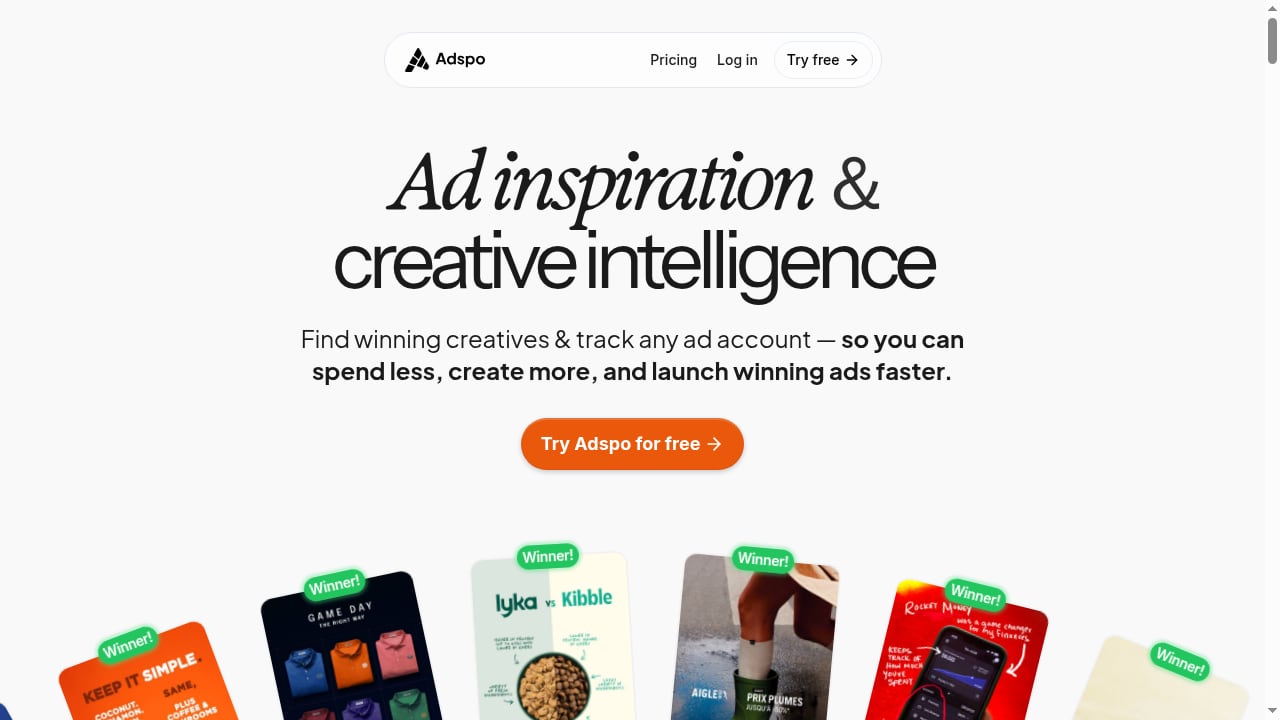
First viewport screenshot of adspo.co.
Adspo is a library of winning ad creatives compiled from brands across the globe, paired with brand-level intelligence and team workflow features. Instead of tracking every ad separately, it groups by the actual creative asset (image or video). For each creative, you get a breakdown of every ad running it, from first launch to when it was turned off.
The platform positions itself as a creative research layer rather than a media-buying automation tool. Its core pillars are:
- Ad library grouped by creative: See each asset once, with all the ads that used it.
- Brand intelligence: View a brand's targeting, formats, hooks, funnels, and the creatives driving spend.
- Workflow: Follow and track unlimited brands, save winning creatives, invite the whole team, collaborate with clients, and share.
- MCP/API access: Pull creative performance data into tools like Claude or build your own tools on top of the API.
Who Adspo is for
First viewport screenshot of adspo.co.
Adspo fits teams whose job is to find new concepts and angles faster, not to manage bids or automate campaign launches.
Ideal users
- Creative strategists and art directors who need a swipe file that shows which creatives are actually scaling, not just running.
- Agencies managing multiple client brands that need shared workspaces, client collaboration, and unlimited brand tracking.
- Performance marketers who want to reverse-engineer hooks, formats, and funnels before briefing new creative.
- Teams with technical workflows that want to pipe ad data into Claude or custom dashboards via MCP/API.
Less ideal users
- Media buyers looking for automated campaign management or bid optimization. Adspo is a research and inspiration tool, not an ad automation platform.
- Solo dropshippers on a tight budget who mainly need product research and revenue estimates rather than creative strategy.
- Teams that need native ad generation. Adspo helps you find and organize inspiration; it does not produce finished ad assets.
Key features and how they work in practice
Creative-grouped ad library
This is Adspo's differentiator. Instead of scrolling through duplicate ads, you see one creative with a full history of every ad that used it. In practice, this helps you answer questions like:
- How long has this creative been running? (Longevity is a rough proxy for performance.)
- Which brands are reusing the same asset across multiple campaigns?
- When did a brand stop running a creative, and what replaced it?
For a strategist building a brief, that timeline is more useful than a raw feed of ads.
Brand intelligence
Adspo claims to show more than a feed: targeting, formats, hooks, funnels, and the creatives driving spend. Treat these as directional signals rather than verified performance data. No third-party tool can see a competitor's exact ROAS, so use brand intelligence to form hypotheses, then validate with your own tests.
Workflow and collaboration
You can follow and track unlimited brands, save and organize creatives, create separate workspaces, and invite clients to collaborate. For agencies, the client-facing workspace is a practical differentiator: it turns research into a shared deliverable rather than a personal bookmark folder.
MCP and API access
Adspo offers an MCP connection for Claude and an API for custom builds. This is a meaningful feature for teams that want to query creative data in natural language or feed it into internal dashboards. If your workflow already lives in Claude or a custom tool, this reduces manual export work.
Pricing signals
First viewport screenshot of adspo.co.
Adspo's published pricing (as shown on its site) includes:
- Pro plan: $29/month billed monthly, or $19/month if paid yearly (a 35% annual saving).
- Included features: Unlimited ad browsing, AI search across ads and brands, unlimited brand tracking, saving and organizing ads, separate workspaces, client collaboration, MCP and API access, and access to 10k+ verified brands.
- Free trial: Adspo advertises trying it for free, with the pitch of full access from about $0.63 per day.
At this price point, Adspo sits at the affordable end of creative research tools. Compare that with broader ad intelligence platforms that often start well above $100 per month. The trade-off is scope: Adspo is focused on creative inspiration and brand intelligence rather than revenue estimates, product research, or campaign automation.
Strengths
- Creative-first organization reduces duplicate noise and makes creative longevity easy to assess.
- Affordable entry price with annual savings and a free trial lowers the risk of testing.
- Unlimited brand tracking suits agencies and multi-brand teams.
- Client collaboration and workspaces turn research into a shareable workflow.
- MCP/API access is uncommon at this price and useful for technical teams.
Limitations
- No native ad generation. You still need a separate tool or process to produce new creative.
- Directional performance signals. Brand intelligence shows what is running, not verified revenue or ROAS.
- Creative research focus. If you need product research, revenue estimates, or automated campaign management, you will need complementary tools.
- Platform coverage is not fully detailed in the source material. Confirm which ad networks are covered before committing, especially if TikTok or Google coverage is essential to your workflow.
- Pricing and feature details can change. Verify current plans on the official site before purchase.
Setup and workflow
A practical setup for a creative team looks like this:
- Define your brand watchlist. Start with 10–20 direct competitors and adjacent brands in your category. Unlimited tracking is useful, but a focused list produces better signal.
- Build a swipe file by angle. Save creatives into categories such as hooks, formats, offers, and proof types rather than one undifferentiated folder.
- Review creative longevity. Prioritize creatives that have run for weeks or months; they are stronger candidates for adaptation.
- Brief from patterns, not copies. Use the library to identify recurring angles, then brief original creative that fits your brand.
- Connect your tools. If you use Claude or a custom dashboard, set up MCP/API access early so research flows into your existing process.
- Share with clients or stakeholders. Use separate workspaces to keep client research organized and reviewable.
For a step-by-step example of turning ad intelligence into new video creative, see how to use PrimeSpy with AI Ad Video Generator. The same research-to-production logic applies to Adspo's library.
Adspo vs alternatives: decision criteria
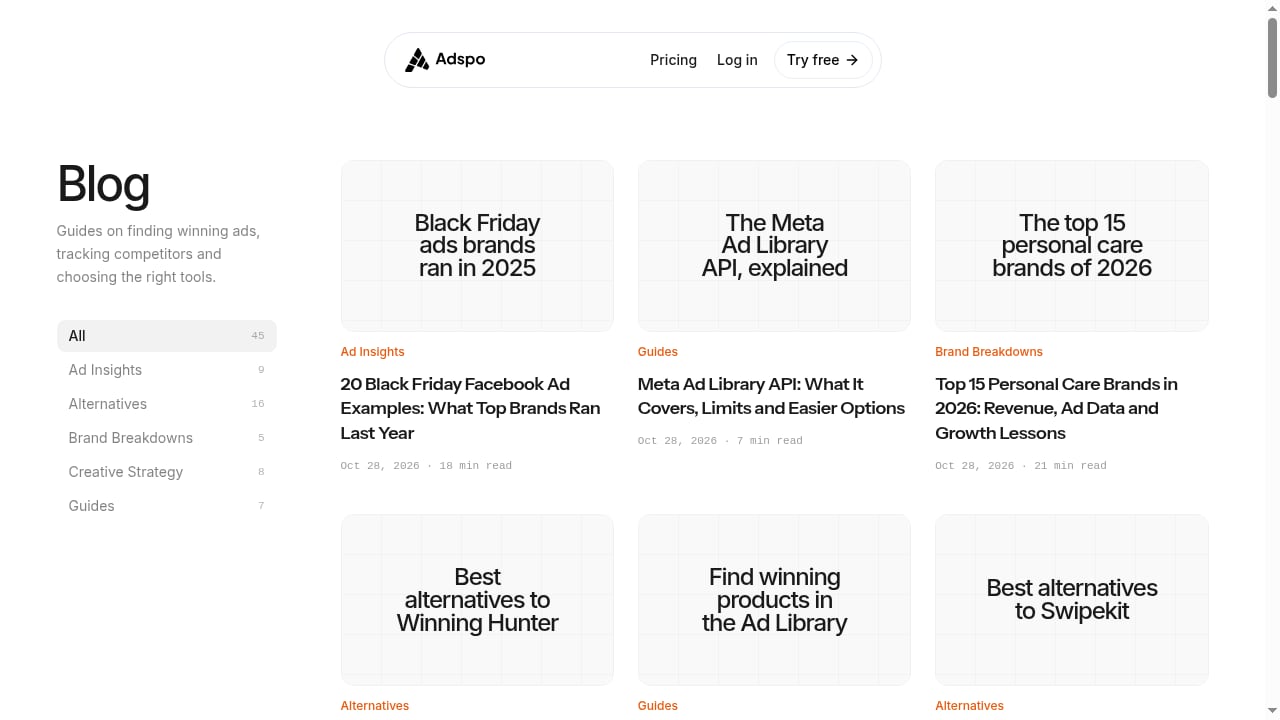
First viewport screenshot of adspo.co.
Adspo is one option among several creative research tools. The right choice depends on your primary job.
| Need | Adspo fit | Alternative direction |
|---|---|---|
| Creative inspiration grouped by asset | Strong | — |
| Brand-level creative strategy signals | Good (directional) | — |
| Client collaboration and workspaces | Strong | — |
| MCP/API access at low cost | Strong | — |
| Revenue estimates and product research | Weak | See Top 10 ecommerce spy & product research software 2026 |
| Broad ad intelligence across Meta and TikTok | Partial | Compare PrimeSpy vs Panoramata for ad library depth and competitor tracking |
| AI-powered analytics and benchmarking | Partial | See Top 10 AI ad analytics & competitive intelligence tools 2026 |
If your priority is creative inspiration and team workflow, Adspo is a credible, affordable option. If your priority is verified performance data, revenue estimates, or automated campaign management, pair it with a dedicated ad intelligence platform or choose a broader tool.
Related reading
- PrimeSpy vs PowerAdSpy: Which Ad Spy Tool Wins in 2026? - Compare PrimeSpy and PowerAdSpy for ad intelligence in 2026. See pricing, Meta and TikTok coverage, search filters, and which tool fits your workflow.
FAQ
Is Adspo free?
Adspo offers a free trial. After that, the Pro plan is $29/month billed monthly or $19/month billed yearly, according to its site.
Does Adspo show competitor revenue or ROAS?
No. Like other third-party ad research tools, Adspo shows what ads are running and creative signals such as longevity and formats. It does not provide verified competitor revenue or ROAS.
What makes Adspo different from a standard ad spy tool?
Adspo groups ads by the underlying creative asset, so you see each image or video once with a full timeline of every ad that used it. This reduces duplicate noise and makes it easier to judge creative longevity.
Does Adspo generate ads?
No. Adspo is a research and inspiration platform. You still need a separate creative production tool or process to make new ads.
Who should skip Adspo?
Solo dropshippers focused on product research, teams needing automated campaign management, and marketers who require verified performance data should look at broader ad intelligence platforms instead.
Conclusion
Adspo is a focused, affordable creative intelligence tool for teams that want to find new concepts and angles faster. Its creative-grouped library, brand intelligence, collaboration features, and MCP/API access make it a strong fit for creative strategists and agencies. Its limitations are equally clear: no ad generation, directional rather than verified performance data, and a narrower scope than full-stack ad intelligence platforms. If your job is creative research and briefing, Adspo is worth testing. If you need revenue estimates, product research, or campaign automation, pair it with a broader platform or choose a different tool. For a wider view of the market, see our comparison of PrimeSpy, AdSpyder, and Anstrex.
Sources: Adspo official site, Ad Creative AI review and alternatives, 7 best AI ad tools for creative analysis